
Second wave of COVID testing Canadians and their lenders

As the second wave of COVID is shutting down large parts of Europe and Canada’s cases hit a fresh record, studies suggest antibodies may be short-lived.

Not surprisingly, a study released today from FP Canada finds that 30% of Canadians surveyed worry they’ll never recover from the pandemic’s economic impact, and 42% say they can’t financially handle the virus resurgence.  More than a third of respondents say they’ve drawn from personal savings or taken on new debt because of the pandemic.

Separately, the latest Bloomberg Nanos Canadian Confidence Index, released on Monday, dropped for the fourth straight week. Just 12.9% of respondents polled, believe the country’s economy will strengthen in the next six months.  See:  Canadians’ Finances can’t handle the second wave of COVID, poll says.

Three-quarters of Canada’s national wealth is held in real estate, including principal residences, and some sixty-eight percent of Canadians are homeowners.  It’s noteworthy that gloom is pervasive today even as single-family home prices have continued to leap.

One can imagine the sentiment impact for present owners, many of whom are highly indebted, if/when prices retreat and mortgage balances do not.  Condo owners in many cities are already there.

Several forecasters, including Moody’s Corp., UBS Group AG and Canada Mortgage and Housing Corporation, are predicting steep declines over the next year while, on average, the six largest Canadian lenders are forecasting more modest drops of up to 6.9% (see left courtesy of Bloomberg).
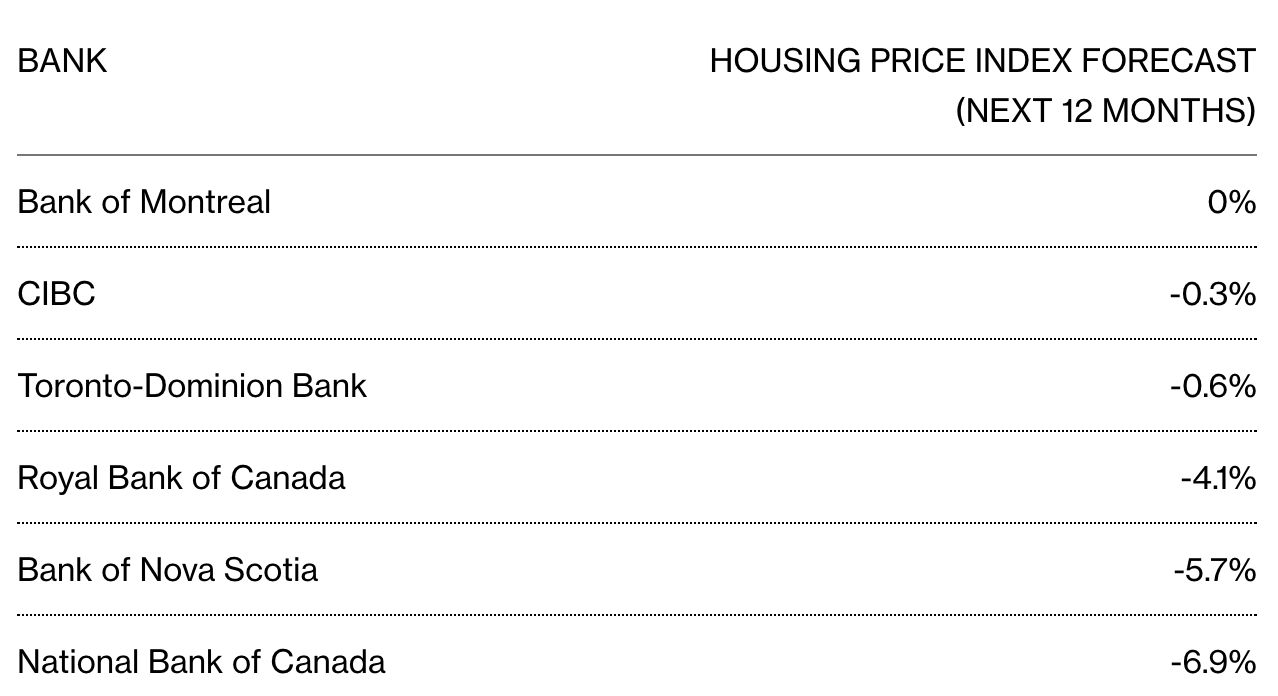
Residential mortgages account for about 40% of the loans at the Big Six, on average–some $1.13 trillion in Canadian residential mortgages on the books at the end of July.  As job losses continue and loan deferrals turn into defaults, asset writedowns are likely to join a flat yield curve and shaky capital markets in reducing bank profits.   See Cracks in the Canadian real estate market fail to rattle big banks:

“Residential mortgages up to this point have been one of the strongest-growing asset classes, and it is the largest component of their books,” said John Aiken, an analyst at Barclays Plc. “So if that all goes to 0% growth, they are going to have a hard time trying to squeeze out growth from other areas.”

So far, the Canadian financial share index (XFN) is -20%, and the Canadian real estate investment trust (XRE) -33% from their February highs; after rebounding briefly from March to April, both have flatlined again since the spring.

A retest of the March lows is likely in the months ahead, as debt and lenders are repriced to the reality of the deepest economic downturn since the 1930s.  There will be higher yields and investment value to be found on the other side.  We’re not there yet.

Posted in Main Page | Comments Off on Second wave of COVID testing Canadians and their lenders

Actively cultivate mindfulness and peace

We are experiencing three pandemics right now, according to wellness expert and best-selling author Deepak Chopra.  The first is the Covid-19 pandemic and loss of life associated with the virus.  The second is the concurrent financial crisis hitting people across the country. The third pandemic is anxiety and stress and fear of death.  Here is a direct video link.

Posted in Main Page | Comments Off on Actively cultivate mindfulness and peace

‘SPAC’ and gambling in today’s greater recession

Never before have so many companies with no revenue pursued a public market listing at such high valuations.  The froth is particularly evident in sectors like online gambling and nascent start-up companies.  See:  EV start-ups are Wall Street’s hot new thing.  No revenue? No problem:

Companies at such a nascent stage are inherently risky and are typically funded by venture-capital investors as they build out assembly lines and sales operations. Instead, these startups are going public at a far earlier stage than is standard by merging with blank-check companies, before they have proven that they can manufacture their product or that they have a viable business model. Blank-check companies are publicly traded shell companies that merge with private companies, enabling the private firms to sidestep an initial public offering.

Even EV companies with world-changing, first-in-class products like Tesla offer gambling-grade investment prospects when priced at crazy multiples of sales and profits.  Earning 50 cents a share over the past four quarters, at $422, Tesla shares are trading more than 840 times trailing earnings.  See:  Tesla stock price still makes no sense.

Tesla shares and other ‘FAANG’-like favourites will be remembered (by those with financial memory, at least) as hallmarks of the 2017-2020 mania that was,  just as many other tech and pharma names were after 2000, and commodity and financial shares after 2008. The companies may well survive and thrive, but their present stockholders are unlikely to do as well.

Today’s speculative mania is evident in the appetite for special purpose acquisition companies (SPAC)–“blank check” shell corporations designed to take companies public without going through the traditional IPO process with investor protections. SPACs lure retail investors to invest in private equity-type transactions, particularly leveraged buyouts, and the financial sector reaps fortunes packaging and selling the products to the gullible and reckless.

Short-seller Jim Chanos, President & Founder of Kynikos Associates, discussed SPAC, Tesla, rampant financial fraud and more with Hedgeye CEO Keith McCullough in a “Hedgeye Investing Summit” interview last week.  Here is a direct video link.

Posted in Main Page | Comments Off on ‘SPAC’ and gambling in today’s greater recession




