
OECD: most economies will remain well below 2019 output levels by end of 2021

According to third-quarter forecasts by the OECD, by the end of 2021, most economies, including Canada, will have a level of output that remains well below that of 2019, and considerably weaker than projected a year ago.

As shown in the graphic below, all projected growth paths undershoot the 2019 forecast (shown in grey), including a best-case scenario where the pandemic ends in 2021 (top pink dashed line), a downside (lower dashed line) where it does not, and the current forecast where it is assumed contained and managed enough to keep the economy out of lockdown and employment recovering.

Bu the end of 2021, America’s economy is forecast to be the same size as it was in 2019, China’s is expected to be 10% larger, while Europe and Japan are forecast to remain below their 2019 pre-pandemic level of output for several years.

The variation is the result of differences between how effective countries are in stopping the spread of COVID-19 but also the extent to which they are dependent on manufacturing versus services which have been the hardest hit from the reduction in discretionary spending. As observed by The Economist in The pandemic has caused the world’s economies to diverge:

Over the past week Paris has closed its bars and Madrid has gone into partial lockdown. In China, meanwhile, you can now down sambuca shots in nightclubs. Another difference is the pre-existing structure of economies. It is far easier to operate factories under social distancing than it is to run service-sector businesses that rely on face-to-face contact. Manufacturing makes up a bigger share of the economy in China than in any other big country.

More good reasons to invest in domestic manufacturing and the production of essential goods in Canada.

Posted in Main Page | Comments Off on OECD: most economies will remain well below 2019 output levels by end of 2021

Electric vehicles are the future, Canada will evolve or die

Canada is a global leader in auto and parts production yet one of the few auto-producing nations with no homegrown auto companies.  Twenty years ago, Canada was assembling about three million internal combustion engine (ICE) vehicles a year for foreign giants (Fiat-Chrysler, Ford, General Motors, Honda and Toyota), today this has dropped to about 2 million and falling as other countries lead on electric vehicle (EV) production.

We are falling behind not for a lack of skilled labour or opportunity but because of a backward-looking focus on sunk costs in fossil fuels and ICE. We can evolve or die.  Initiatives to think and invest forward are imperative and many Canadians get it.  Smart incentives in this direction are critical.  See:  Avenging the Avro Arrow:  Canada’s audacious play to build an all-Canadian electric car:

On Tuesday, the Automotive Parts Manufacturers’ Association, which represents Canadian companies that ordinarily supply parts to international automakers, announced the design for what it has branded Project Arrow – an effort to prove that a zero-emissions vehicle can be completely designed, engineered and built here. It’s now to proceed to the engineering stage, with the rollout of a full concept car targeted for 2022.

Posted in Main Page | Comments Off on Electric vehicles are the future, Canada will evolve or die

Oil demand flatlining as EVs accelerate

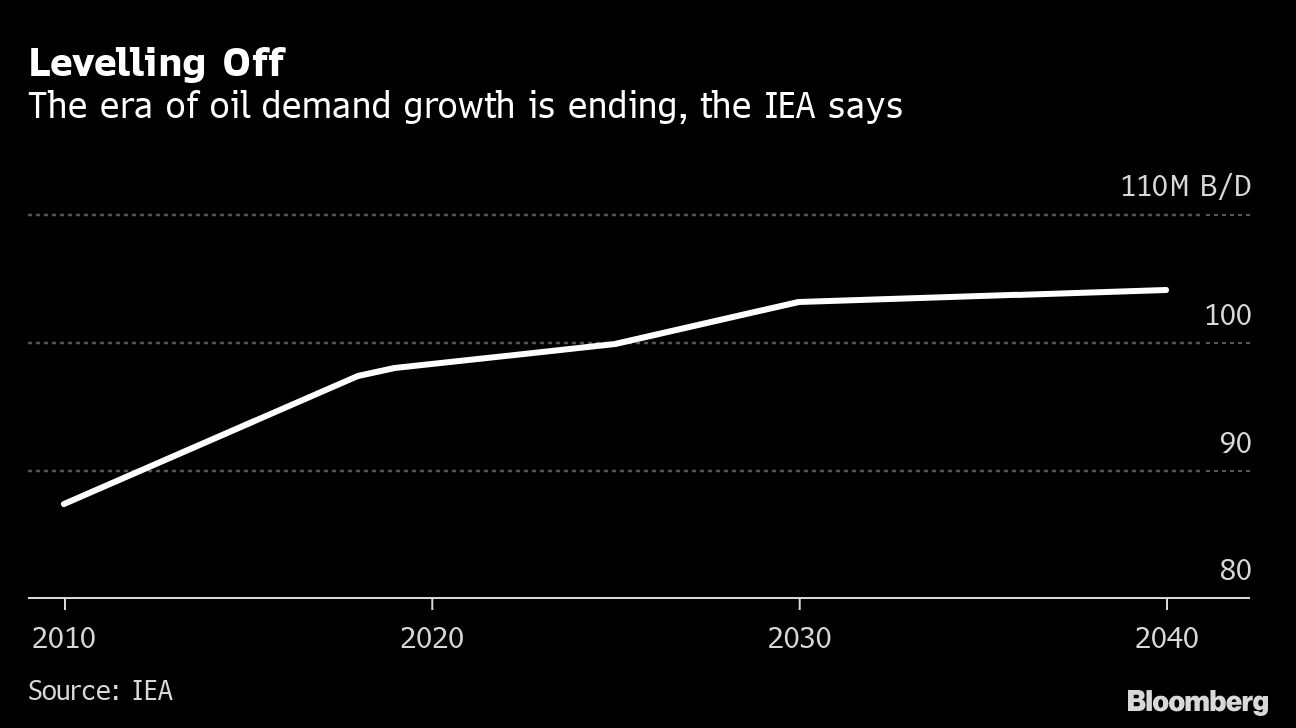
In its latest annual World Energy Outlook report, the International Energy Association (IEA) reiterates its forecast that global oil demand will plateau over the next decade and at lower levels than they forecast last year.  Here is their chart courtesy of Bloomberg.

Each week pensions, banks and other institutions announce that they will no longer make new investments or loans in the oil and gas sector (see last week’s JP Morgan promises to shift portfolio away from fossil fuels) and oil majors like BP and Royal Dutch Shell have acknowledged that drastic changes required to reduce climate crisis will have profound consequences for their assets and business models.   See IEA sees oil demand suffering long-lasting blow:

Long-term growth in oil demand will be tamed by the switch to more efficient or electric vehicles, the IEA forecast. Consumption will increase by about 750,000 barrels a day each year to reach 103.2 million a day in 2030. That’s about 2 million a day less than predicted in last year’s report.

The increase will be entirely concentrated in developing nations — most notably India — and dominated by feedstocks for plastics and other petrochemicals, rather than fuel for road transportation. After 2030, annual growth will dwindle to just 100,000 barrels a day.

This is a raging heads up for oil producers globally (including Canada):

OPEC members also face a difficult period as depleted revenues strain national budgets, and a chunk of growth that had been anticipated from Nigeria, Iraq and Angola is now expected to be lost.

Canada must transition oil investment and employment to the critical components needed for batteries and renewable electricity and infrastructure without further delay. The segment below discusses a new study out of the University of Toronto on the accelerating shift to electric vehicles.  “Once you go electric, you’ll never go back.”  True that.

Alexandre Milovanoff, a University of Toronto researcher says full electrification of vehicles is needed to meet aggressive climate targets set in the Paris agreement. Here is a direct video link.

Posted in Main Page | Comments Off on Oil demand flatlining as EVs accelerate




