Yesterday the US Fed offered its next iteration of low policy rates for longer, and longer, and longer with a promise that it would not hike for (at least) another three years in its effort to manufacture price inflation above 2%.
The truth is, as we’ve already seen in places like Japan and Europe, keeping policy interest rates near zero does not manufacture inflation when, after 40 years of slashing rates and increasing debt, the masses are already cash strapped, debt-choked and aging. Doing more of the same does not boost demand in any meaningful way. On the contrary, once those who can and will borrow are maxed out, minuscule yields and stagnant income mean people are incentivized to spend less, repay debt and increase savings.
While lower costs are helpful to households needing to make ends meet, central banks fear that monetary powers will be revealed as impotent in a deflationary spiral of falling consumption and prices that erode sales, profits, jobs and the ability to service debt in the economy.
The poster-child for monetary inflation theories, Japan’s central bank has been deploying zero rates and asset-buying in pursuit of a 2% annual target for the last 15 years. They achieved it once, briefly in 2008, just before the Great Recession when demand and prices collapsed into deflation once more.
Central banks have always been confidence-men and women, they seek to encourage levered risk-taking and optimism at all points in the cycle. Today, fresh out of more credit uptake prods for the masses, efforts to weaken currency (to increase prices) are all they have left. It’s worked again since March, but this hand too shall lose. The treasury market knows it as government bonds remain bid, calling the Fed’s bluff.
As I pointed out last on September 9th, the US dollar rides a teeter-totter with most other risk assets on the other end. As the dollar index weakened since the end of March, the price of stocks (S&P 500 in red below), commodities (copper in brown), precious metals (gold) rebounded as shown here in my partner Cory Venable’s chart from August 28, 2020. He noted that a hold in the 92 area for the dollar index (in green below) could mark the next trend turning point for global markets and opportunity to re-enter the dollar for further capital gains as other markets enter the next wave of liquidation selling.
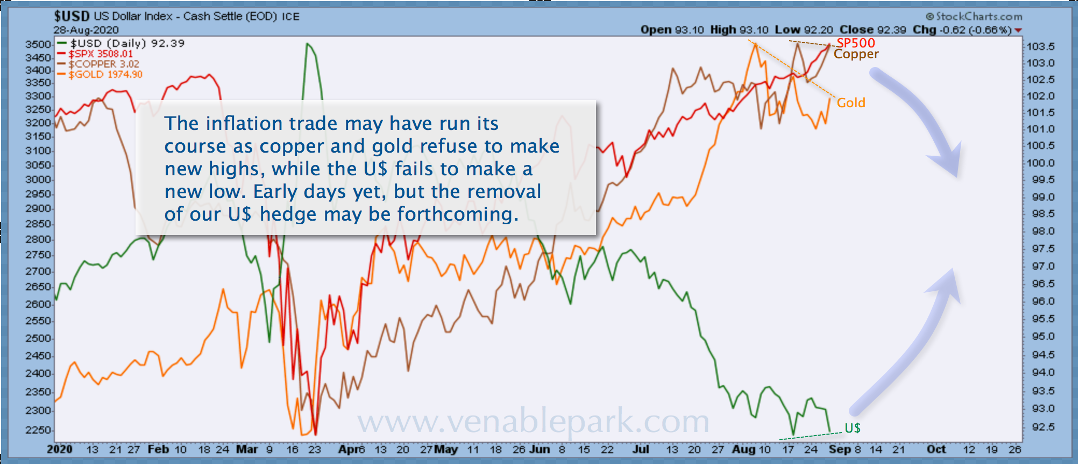
As the Fed talked its inflation-targeting talk yesterday, currency markets didn’t buy the pitch. The U$ continued to strengthen, moving through 93.26 this morning with risk markets predictably falling once more.
Bear markets move in waves. Extreme leverage and speculation are making the swells in this one larger than most, but the tsunami has not yet run its course.