Confidence-crushing capital blows still in motion

On August 9th, I noted here that the US dollar index (DXY) was looking oversold and that a hold in the 92 area could signal the next round of ‘risk-off’ in an ongoing bear cycle for global markets.  From a closing low of 92.14 on August 31, the dollar index has strengthened since and closed September at 93.88.

In Canadian dollar terms, greenback strength is shown below in my partner Cory Venable’s chart (green arrow), along with the accompanying rollover in risk assets priced in U$–gold, copper, oil and the S&P 500.  Macro forces continue to have the upper hand amid the worst global recession since the 1930s.

Caught in this, Canada’s TSX (below in black) is also looking piqued, with all the largest sectors–financials (in blue), energy (in brown), gold miners (gold), materials (orange) and REITS (in green)–seeing outflows and price weakness in September.

Over the last 13 years, the risk tolerance and time horizons of aging asset owners have come in significantly, with volatile ‘buy and hold’ efforts increasingly counter to financial and mental stability.  Companies are cutting and suspending their dividends at a record pace, and even those received are insufficient offset for the capital losses mounting.

The art of this is to stay defensive, calm and prepared to buy income yielding assets when the masses are liquidating in panic.   March offered a patch test but was too fast and shallow for the multi-month, confidence-crushing body blows needed.  In the meantime, treasuries and cash-like deposits will continue to outperform equity allocations.

 

Posted in Main Page | Comments Off on Confidence-crushing capital blows still in motion

Danielle’s biweekly market update

Danielle was a guest with Jim Goddard on Talk Digital Network talking about recent developments in the world economy and markets.  You can listen to an audio clip of the segment here.

Posted in Main Page | Comments Off on Danielle’s biweekly market update

Toronto and Vancouver areas most overvalued homes in North America

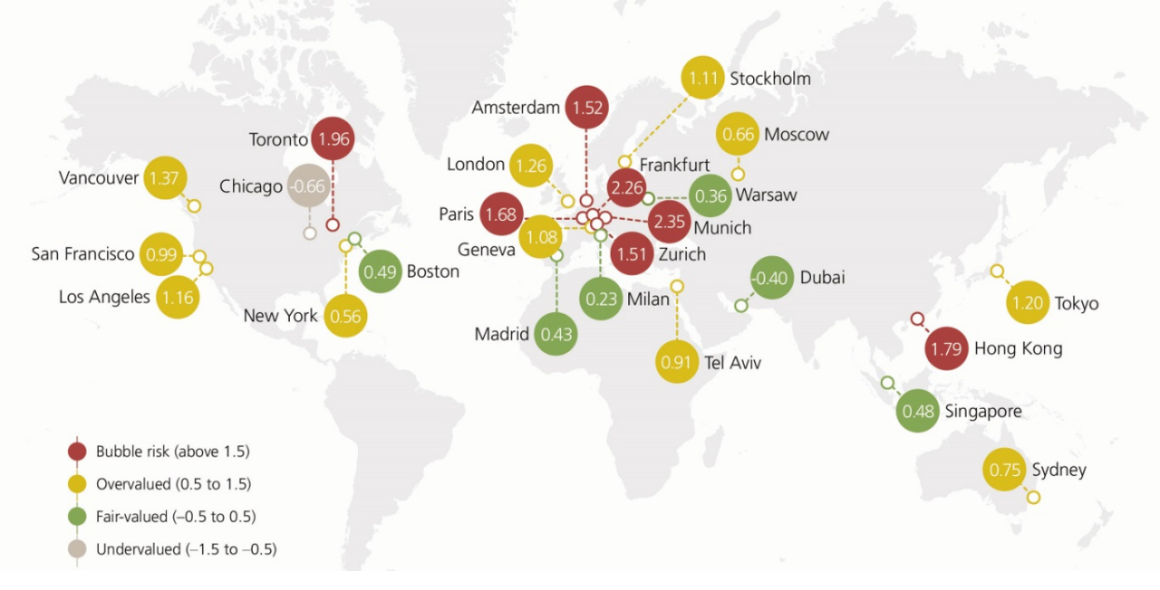
A new report from Swiss real estate investments at UBS Global Wealth Management analyzed residential property prices in 25 major cities and determined that Munich, Frankfurt and Toronto are the top three bubble risk areas in the world, with valuation readings above 1.5 in their composite (relative to rents and income).

Compared with Toronto’s 1.96 (the most extremely priced city in North America), Vancouver scored a more subdued 1.37 but was still the second most overvalued city on the continent.  Here is the summary graphic.

As for why home prices have remained jubilant in the midst of a global pandemic and deepest recession since the 1930s,  the study cites three main factors:

  1. Home prices are a backward-looking economic indicator, only able to reflect an economic downturn with a delay.
  2. The majority of potential home buyers did not suffer direct income losses in the first half of 2020 as credit facilities for companies and short-time work schemes mitigated [deferred] the fallout from the crisis.
  3. Governments supported homeowners in many cities through housing subsidies, reduced taxes, and a suspension of foreclosure procedures.

Time will tell what government support initiatives come next, but the second wave of COVID-19, ongoing job losses and business failures are driving more people out of urban areas and into shared accommodation with family and friends.  Household formation levels are falling sharply.  All of this makes uneconomical home prices even less feasible:

“…it’s clear that the acceleration over the past four quarters is not sustainable in the short run. Rents have been falling already in most cities, indicating that a correction phase will likely emerge when subsidies fade out and pressure on incomes increase.”

Posted in Main Page | Comments Off on Toronto and Vancouver areas most overvalued homes in North America