America’s largest retailer Walmart reported today that it ended its latest quarter July 31st with revenues 5.6% higher than a year earlier as consumers spent government support funds: “Stimulus was definitely impactful to the consumer in the second quarter, and we’re watching what’s going on in Washington, and how we’re going to progress with a new stimulus package,” Walmart CFO Brett Biggs said. The share price turned down as the company noted sales growth slowed later in the quarter as stimulus checks tapered off. Consumers drive just under 70% of America’s GDP growth, and in Canada just over 50%.
On top of government-sanctioned deferral programs for mortgages, other debts and rents, the Canada Emergency Response Benefit (CERB) doled out $2,000 per month to keep Canadians spending since the end of March. After falling 31% between February and April, Canadian retail sales jumped 18% in May, and an estimated 25% more in June (Statistics Canada data) as provinces moved to re-open. But these measures were always meant to be temporary. Already extended by two months, the CERB is to end October 3rd and other payment deferral programs at the end of September.
The Canadian Centre for Policy Alternatives estimates that 2.9 million Canadians will have their income lost or cut in the transition from CERB to Employment Insurance come October. At the beginning of August, 4.7 million Canadians were receiving CERB. Of that number, just 1.4 million are eligible for EI under the current rules, and many would receive less than CERB’s $500 per week.
Canadian consumer solvency trustee Doug Hoyes noted last month, that payment deferral programs have added to high household debt levels, reducing future spending ability while delaying and increasing the coming wave of insolvency filings.
As GMO’s James Montier writes this month, a study from the University of Chicago estimates that up to 40% of COVID-19-related layoffs in the past 6 months could be permanent. Personal finance guru Suze Ormon implored her viewers to think of longer-term implication on July 20 as follows:
“The first thing people must do is to stop spending money. Any money that you are receiving, whether it is a paycheck, stimulus check or unemployment, put it into an emergency fund, after you pay the bills. Take a look at new income opportunities out there for you. Stop thinking that your job is going to come back. It may, but many of them may not.”
The first phase of the pandemic shock was the abrupt shutdown and asset price collapse between February and March. The next was a relative improvement purchased by payment deferrals and government transfers as the economy moved to re-open, and financial markets bounced on central bank injections and idle speculation.
We now approach the next wave of this saga as recession continues, layoffs rise, bad debts mount, and the quest for cash intensifies.
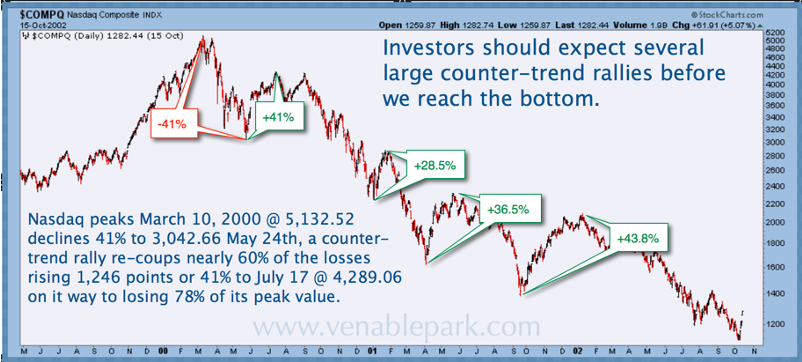
With market sentiment back near historical highs and reliant on the continued exuberance of a few tech leaders, one is reminded of the summer of 2000 when the NASDAQ index bounced sharply into July after losing 41% between March and May 24. Bulls were convinced the worst was over. As shown in Cory Venable’s chart below, the NASDAQ went on to lose 60% over the next seven months (for a total decline of 78%) even as the US experienced just a short, mild recession. It would be 15 years, three months and 23 days before this basket of stocks recovered its March 2000 highs again in June 2015. Food for thought.