This is how talking, breathing, and coughing compares, with and without a mask pic.twitter.com/Lk7PccWdID
— How Things Work (@ThingsWork) April 8, 2020
Follow






_________________________
This is how talking, breathing, and coughing compares, with and without a mask pic.twitter.com/Lk7PccWdID
— How Things Work (@ThingsWork) April 8, 2020
After the 2018 fourth-quarter meltdown, large-cap stocks rebounded on share buybacks to a higher high before hitting the skids this February and taking out the 2018 low. This was a significant breach.
The sequentially lower low circled in my partner Cory Venable’s S&P 500 chart since 2004 below, has now set the neckline for a retest in the 2200 area (red circle) some 27% below current levels.
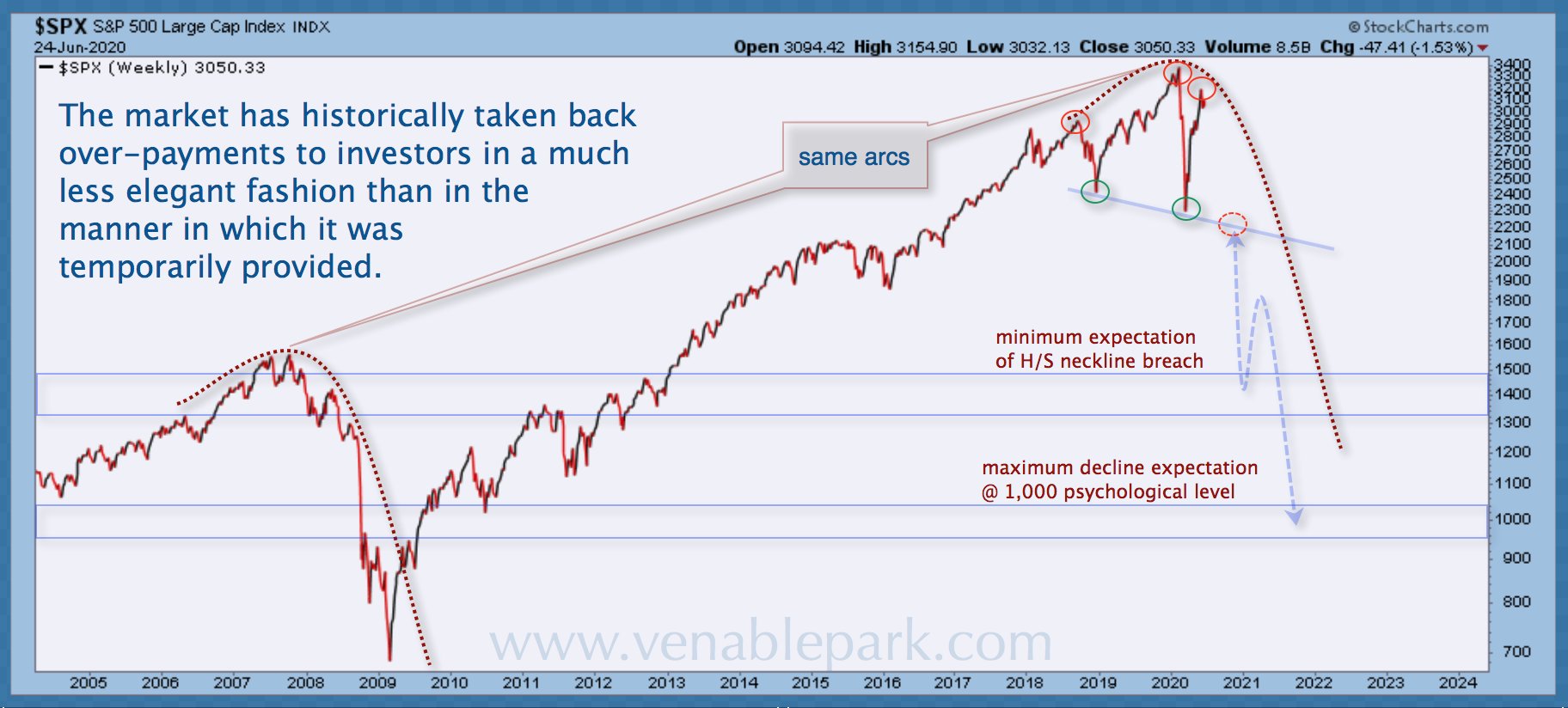
A similar pattern can be seen above in the 2006-08 topping pattern before the retest broke support into a waterfall cascade to the March 2009 cycle low.
A failure at the 2200 level in the weeks ahead would affirm the probability of a downside test in the 1500 area at a minimum (2007 cycle top) and potentially the 1000 area after that.
Further confirming the ongoing cyclical decline, the 2000 smallest-cap companies in the broad Russell 3000 index did not join large-cap leaders into a new high in 2020. Despite following the big bounce since March, the Russell 2000 remains in a bear market today 20% below its August 2018 top.
Big picture views are needed to navigate full market cycles successfully. Those with savings to lose are wise to remember ladders are routinely followed by snakes that wipe out years of perceived progress in a short period of time. This is why avoiding snakes has to be job number one.
As COVID-19 cases surge across 27 US states this week, the IMF revised its 2020 global economic contraction forecast today to -4.9% (from -3% in April) thanks to a larger-than-anticipated supply shock and an ongoing hit to demand from social distancing and other safety measures. Dubbing it a “crisis like no other” the report notes that if safety measures are not followed effectively, longer lockdowns will take an even greater toll on global growth.
While noting that financial markets have improved in the second quarter, they add that the rebound “appears disconnected from shifts in underlying economic prospects” and at risk of reversal.
They further warn that more than 90% of emerging-market and developing economies are forecast to show declines in per capita income this year and this huge hole is unlikely to be filled in the foreseeable future.
Former OECD Chief economist Catherine Mann discussed the IMF report and her own outlook on Bloomberg this morning and warned that 60% of the world will not see a recovery to 2019 GDP levels before 2022, with recovery to 2019 employment levels not apparent in the forecast horizon.
Catherine Mann, global chief economist at Citigroup, discusses what she’s watching in global GDP for the third-quarter and beyond, and the “fear factor” that could hold back consumers. Here is a direct video link.