Capitalizing on financial mistakes

I learned what not to do with money when I was 35–the hard way.  I wrote about this in my book Juggling Dynamite. Graduate degrees in business and finance didn’t teach it to me, loss did.  The experience was gut-wrenching and anxiety-producing and absolutely the best thing that ever happened to me.  In the 20 years since, the lessons learned and principles developed have helped not just our family to financial strength, but also thousands of readers, listeners and clients.

As painful as money lessons tend to be, it is essential that we learn them and stop repeating classic errors.  Windfalls, inheritance and big incomes can give the appearance of financial acumen for a time, but ultimately it is what we choose to do with the money that defines outcomes.  The later in life that we come to wise decisions the more we will have wasted, and the less time and opportunity we will have to make up for that.

Today, there are a great many people in their 50’s and older that are still immersed in debt and wagering what savings they do have on speculative financial products in an effort to win money or appear wealthier than they are.  These actions are self-defeating.

The great news is that we are not helpless.  Sound financial management is just a collection of habits and choices that we can cultivate and propagate by example.  It does require us to admit our mistakes though, and sharing them openly with others is a generous public service.  For a worthwhile read that you can pass along see What the Forced Sale of my BMW can teach you about money:

I fell for the lie of the BMW ad. I thought I needed a luxury car to prove something to people about the success of my business.

The car made me feel good, but it was a lie. I bought the car on finance because I hadn’t earned the money to pay for it, yet. The allure of flashy brands and possessions is that it shows what you have achieved. But the whole world doesn’t need to know what you’ve achieved.

It’s fine to be a millionaire and drive a Toyota Corolla.

Your financial situation is not represented by the flashy stuff you own. In fact, the more flashy stuff a person appears to own, the less financially wealthy they probably are.
Posted in Main Page | Comments Off on Capitalizing on financial mistakes

Real Vision: Monetary Madness is not the Answer

This 17-minute segment offers a worthwhile summary of present policies and impacts on global markets and the economy.

This week Real Vision uses Refinitiv’s best-in-class data to look at the latest conversations about monetary policies that continue to stack the rebound in favor of risk assets and large corporates, at the expense of the real economy. Are these policies continuing to damage the economy despite the recovery in equities? The Chatter looks at the sell-off in the US dollar and puts the bull vs bear debate in historical context. The Whisper looks at the potential rise of both bankruptcies and the zombie company. Here is a direct video link.

Posted in Main Page | Comments Off on Real Vision: Monetary Madness is not the Answer

Déjà vu: Extremely valued tech companies propping up stock markets

In the spring of 2000, as now, there was a widespread belief (we remember well, we were there) that the leading tech companies would be impervious to recessionary strife in their customers, the wider economy and financial markets.  See The NASDAQ’s summer 2000 bounce, might contain a cautionary lesson:

“Along similar lines, the current environment carries the risk that — with COVID-19 likely to continue disrupting consumer and business activities in the coming months — the financial woes of companies in industries such as travel, energy, auto and hospitality are going to weigh on many of the tech companies directly or indirectly relying on them. And there’s also a real risk that consumer spending in fields such as e-commerce and tech/electronics hardware, which is currently benefiting from stimulus payments and much lower discretionary spending on things such as travel and dining/entertainment, softens in the coming months.”

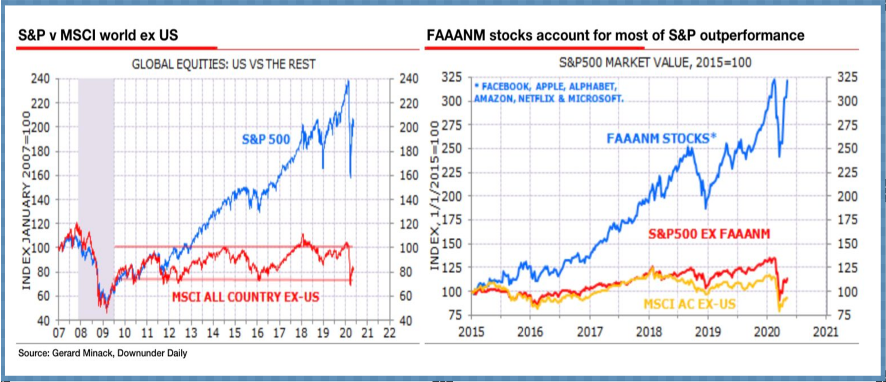
In the recent cycle, we can see (lower left panel in blue) that U.S. stocks traded in lockstep with international markets between 2007 and 2012 before the FAAANM stocks—Facebook, Apple, Alphabet, Amazon, Netflix & Microsoft—exploded away from the rest, taking, not just the NASDAQ, but the S&P 500 index along for a wildly volatile ride since.

In the right panel below, we see the price change (in blue) of these largest six technology companies (FAAANM) from 2015 to now, compared with the flat change in the other 494 companies that make up the index (in red) and negative returns of international markets, excluding the U.S (in yellow).

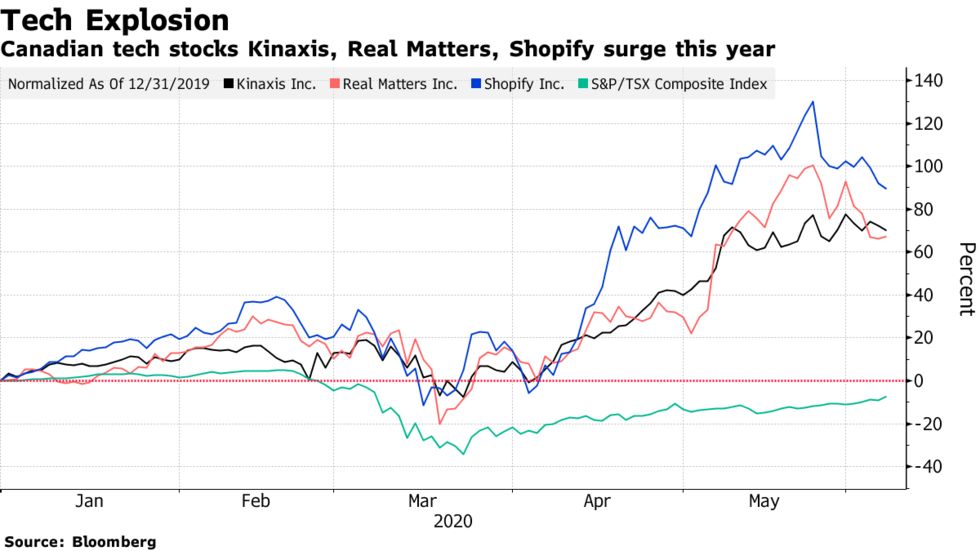
Tech stocks make up just 8.8% of the Canadian stock market today, but similar price action is evident in the chart below of three largest TSX listed tech companies (Kinaxis-in black, Real Matters-in red and Shopify-in blue) which have rocketed higher following the Feb 20 to March 23 market collapse, while the TSX composite (in green) has languished far behind.


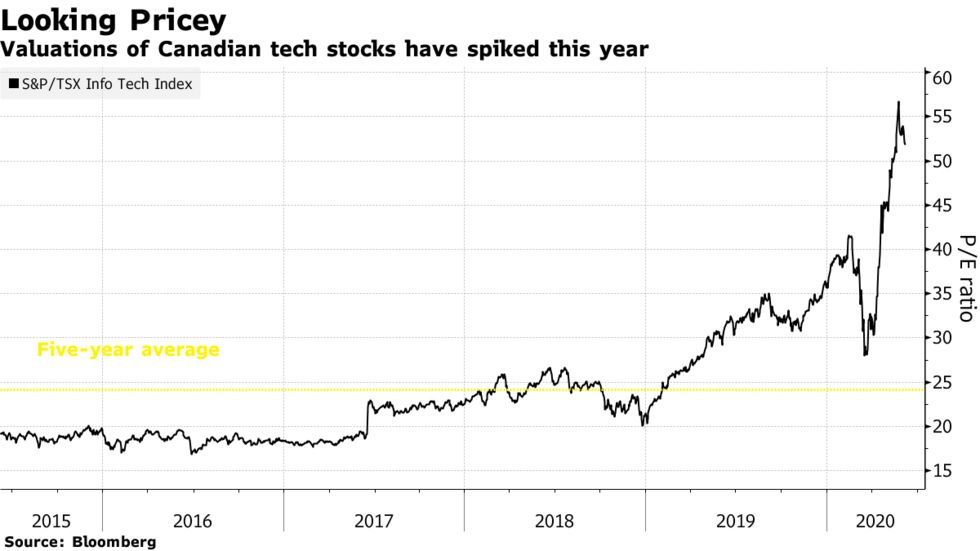
On a valuation basis, as shown below, Canada’s S&P/TSX Info Tech Index is now trading at an average price to earnings multiple of well over 50– about double the five-year average, according to data compiled by Bloomberg.  See:  Meet the tech companies propping up Canada’s stock market.


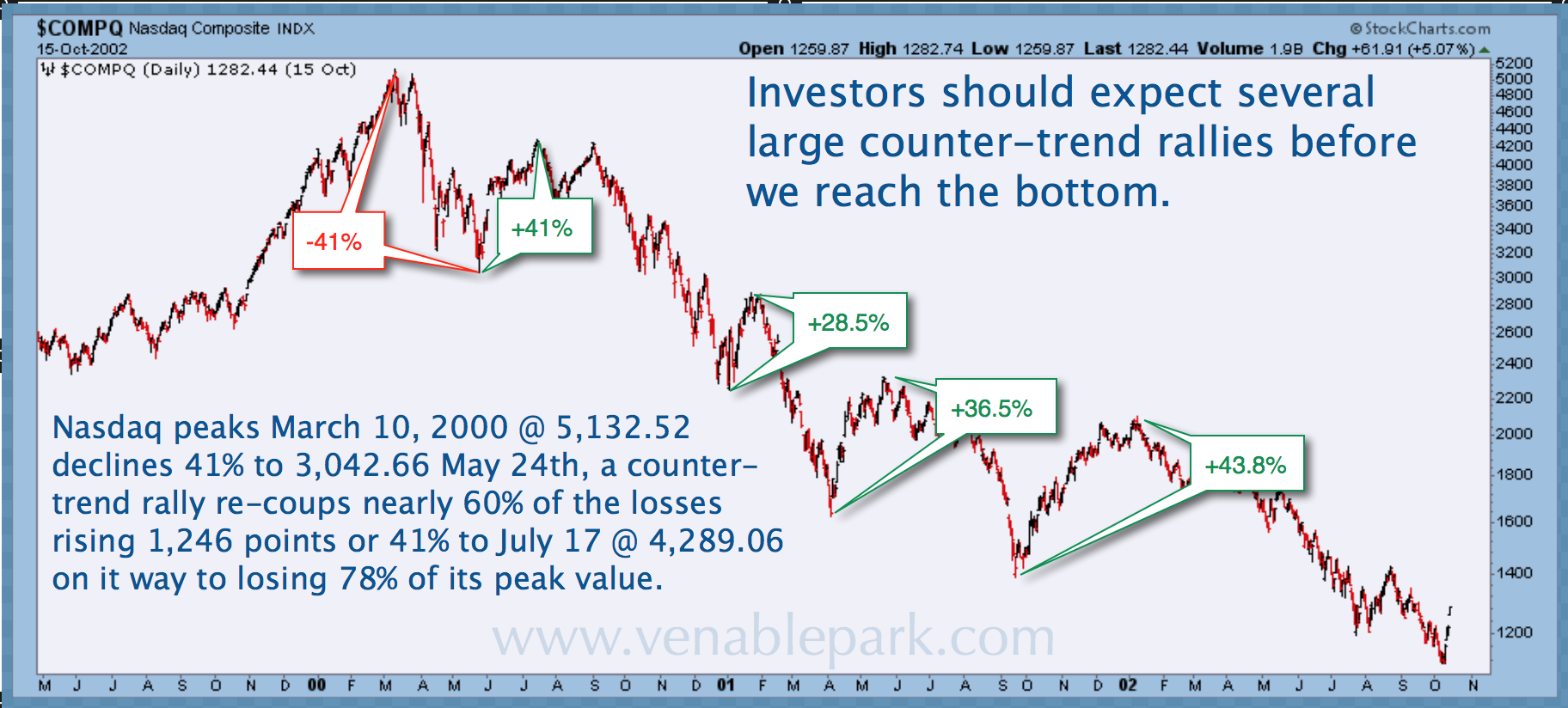
Extreme overconfidence in the tech sector was punished severely in past cycles.  As shown below, in the spring of 2000 the tech-centric NASDAQ index plunged 41% between March 10 and May 24 before bouncing 41% to make back 60% of its losses by July 14 and treading water there through the summer. Bulls were certain the worst had passed; then, over the next 7 months, the NASDAQ lost another 60% (for a total decline of 78%).


Moreover, it took 15 years, 3 months and 12 days to June 22, 2015, before this basket of stocks recovered its March 10, 2000 high of 5,153.  Confirming yet again, that while asset valuations can stay extreme for extended periods of price-indiscriminate speculation and overconfidence, they always exact their capital penalty from holders in the end through sharp drops and years of negative returns thereafter.  The price paid always matters eventually.

Posted in Main Page | Comments Off on Déjà vu: Extremely valued tech companies propping up stock markets