Canadian credit cycle starting to bite

As Canadian banks begin reporting their second-quarter earnings this week (for Feb thru April), Bank of Nova Scotia was first on deck with a 39% drop in profits and a 111% increase in loan loss provisions. Since business lockdowns and layoffs only surged in the latter half of March, half of this quarter was still pre-COVID-19.

It is important to note that the millions in loan payment deferrals presently in place are not yet counted as defaults.  We will have a better sense of how many deferred loans will be defaults and ‘bad debts’ for lenders after the emergency deferral period ends.  Presently, that is to happen in September, but there could be a further extension granted.

The segment below offers a good overview of the issues unfolding for the Canadian banks.

Nigel D’Souza, financial services investment analyst Veritas Investment Research, joins BNN Bloomberg to discuss what the Canadian banks will likely report as the quarter is set to reveal the beginning damage of COVID-19 to the financial sector. Here is a direct video link.

The problem is that many Canadians are missing large chunks of their income even with massive government support, so debt payment deferrals have slowed but not helped the insolvency crisis spreading through many households and businesses today.  Moreover, lost income is not bouncing back soon for many as spending remains subdued and companies look for ways to keep costs down.  Some of the millions of jobs lost will not be coming back at all; others, as in past cycles, will take years to recover.

After falling 40% between February 20 and March 23, Canadian financial sector shares (XFN) are today still 27% below the February peak.  We will have a better sense of where loan losses and financial profits lie as we head into the 4th quarter, as well as how all-important home prices are impacting the balance sheets of households and their lenders.

The push for aging owners to downsize expensive-to-maintain real estate was underway in Canada well before 2020.  Now, losses in investment portfolios and the present recession are likely to motivate more sellers to list.

The latest survey from Point2Homes finds that the percentage of Canadians saying they intend to buy a home in the next six months decreased to 24% in April from 31% in March, and 37% of those looking to buy say they are interested in a less expensive home, compared with 27% at the end of March.

If they wait a while, buyers, who are able, may well find the cheaper offers they seek.
Posted in Main Page | Comments Off on Canadian credit cycle starting to bite

Rosenberg: It will take years to get to normal, assuming a vaccine

“It’s going to take years – maybe three, four, five years to even get back to normal, and that’s assuming we get a vaccine,” Economist David Rosenberg explained in an interview with BNN Bloomberg Monday. Here is a direct video link.

Posted in Main Page | Comments Off on Rosenberg: It will take years to get to normal, assuming a vaccine

Reopening is not business as usual

As many North American businesses move to reopen with social distancing this month, China offers a glimpse of why business-as-usual is unlikely to follow.

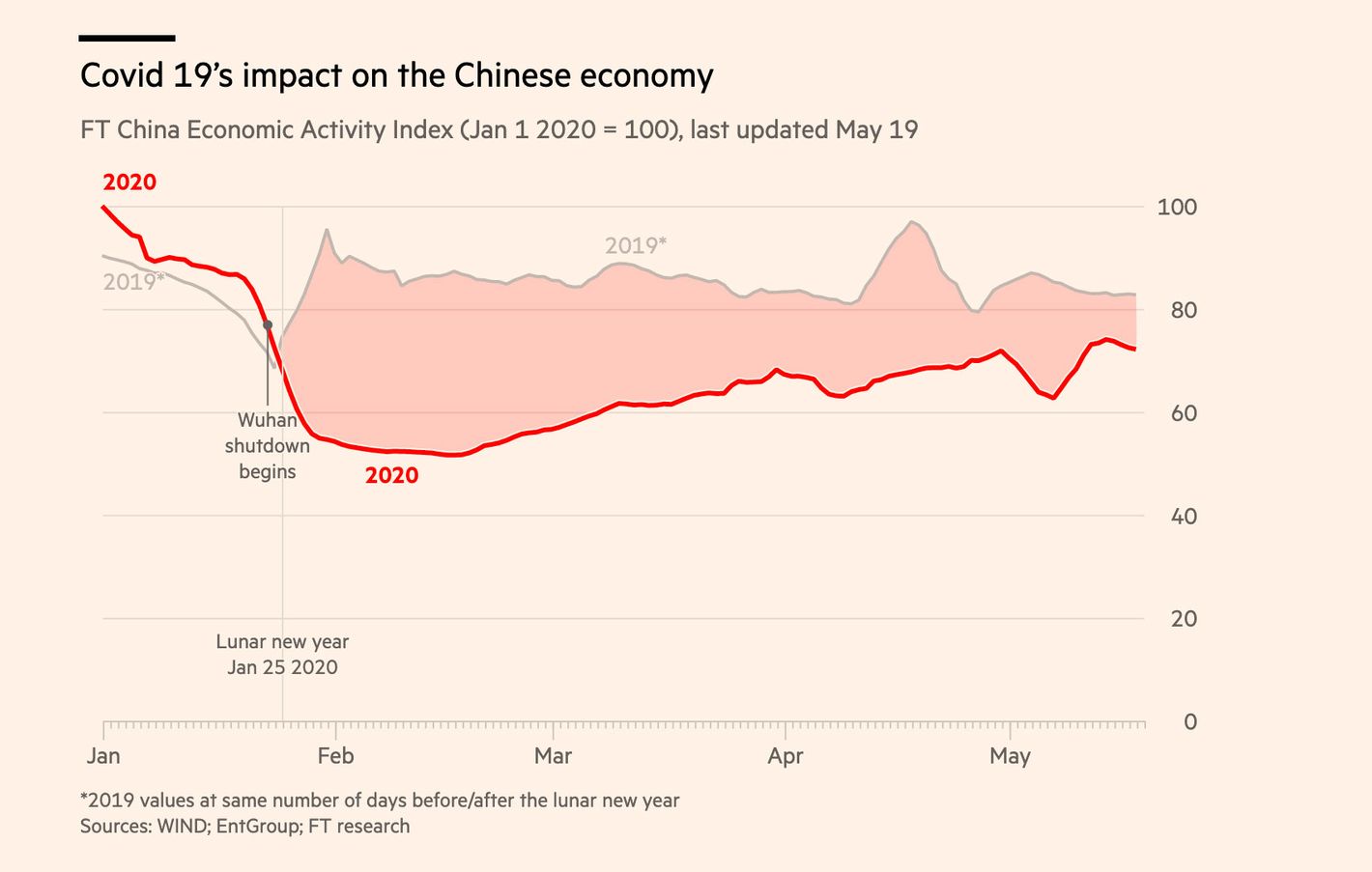
After a strict lockdown bent the spread of COVID-19 in April,  China has reopened schools and businesses and was operating at 87% of typical output on May 12, according to the Trivium National Business Activity Index.  However, as shown below, the nation’s economic activity remains well below January 2020 and year-ago levels.

North America has lost more than 33 million jobs in just the last two months and regrowing employment is likely to take many years.  It took a decade (2009 -2019) to recover the 22 million US jobs lost in the 2007-08 recession, and much of that came from the service sectors which are most impaired in the present downturn.

Economist Nouriel Roubini explains that the west should prepare for a slow, lacklustre “U-shaped” economic rebound in the pandemic’s immediate aftermath, followed by an “L” decade as spending and investment is suppressed by the weight of accumulated debts, an ageing population and a focus on saving.  See Why our economy may be headed for a decade of depression:

“So when unemployment benefits expire, lots of people aren’t going to have any income. Those who do get jobs are going to work under more miserable conditions than before. And people, even middle-income people, given the shock that has just occurred — which could happen again in the summer, could happen again in the winter — you are going to want more precautionary savings. You are going to cut back on discretionary spending. Your credit score is going to be worse. Are you going to go buy a home? Are you gonna buy a car? Are you going to dine out? In Germany and China, they already reopened all the stores a month ago. You look at any survey, the restaurants are totally empty. Almost nobody’s buying anything. Everybody’s worried and cautious. And this is in Germany, where unemployment is up by only one percent. Forty percent of Americans have less than $400 in liquid cash saved for an emergency. You think they are going to spend?

Economist Daniel Lacalle expounds on recovery shapes further in this 6-minute video segment.

Posted in Main Page | Comments Off on Reopening is not business as usual