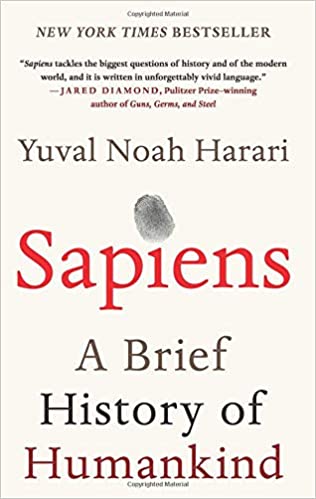
 Thanks to Tim for recommending that I read Sapiens: A Brief History of Humankind (2015) by Yuval Noah Harari. It’s worth the time.
The cover note gives a good taste: “Fire gave us power. Gossip helped us cooperate. Agriculture made us hungry for more. Mythology maintained law and order. Money gave us something we can really trust. Contradictions created culture. Science made us deadly. This is the thrilling account of our extraordinary history–from insignificant apes to rulers of the world.”
The last few chapters review the history of trade, capitalism, corporations, finance and central banks, and remind us of the deafening rhyme of recent events to past episodes. The story of the Mississipi Company chartered, in 1717 in France, to colonize the lower Mississipi Valley in America, is one example. The Mississipi Company founders promised riches and the wealthy piled in followed by the bourgeoisie. The stock was initially priced at 500 livres and by December 1719 was trading at 10,000. Euphoria spread. People took out loans to buy the shares. Then, early speculators decided to take profits and sell. What happened next reminds of recent events. Here’s a segment (page 361):
“When other investors saw the price going down, they also wanted to get out quick. The stock prices plummeted further, setting off an avalanche. In order to stabilise prices, the central bank of France–at the direction of the governor, John Law–bought up Mississippi shares, but it could not do so forever. Eventually, it ran out of money. When this happened, the controller general of finances, the same John Law, authorised the printing of more money in order to buy additional shares. This placed the entire French financial system inside the bubble. And not even this financial wizardry could save the day. The price of Mississippi shares dropped from 10,000 back to 1,000 livres, and then collapsed completely, and the shares lost every sou of their worth. By now, the central bank and the royal treasury owned a huge amount of worthless stock and had no money. The big speculators emerged largely unscathed–they had sold in time. Small investors lost everything, and many committed suicide.”
Sad, but common. We’ve been amply warned of how monetary madness ends…