
Real talk on the Fed’s disastrous financial schemes

As the price of oil now drowns in oversupply, financial bubbles bust retirement plans once more, hundreds of thousands of overvalued ‘investment’ properties sit empty and income-less in cities all over the globe, and inventories of excess consumer goods like autos pile up (see Gm, Ford credit, may lose billions on car-price plunge), unfettered central banks should be top of the reform list. They are the enemy of self-correcting forces, free markets and personal accountability the world over, and we cannot afford this plague to continue.

Below is the segment Danielle mentions from Pimco’s Mark Kiesel. Real talk on behavioural evolution now underway–much needed, even though it means less consumer spending in the economy.

Mark Kiesel, global credit chief investment offices at Pacific Investment Management Co. (Pimco), warns the economic fallout from the coronavirus pandemic might be worse than what investors are expecting. Here is a direct video link.

Posted in Main Page | Comments Off on Real talk on the Fed’s disastrous financial schemes

Koo: balance sheet recessions last longer

Conventional economic theory assumes that households and businesses will always borrow when credit is made available and they have the cash flow to service debt.  As debt levels expand asset prices and economic activity rise along for the ride.  But once an economic shock hits, financial bubbles burst, asset prices plunge and debt levels become a crushing weight.  In this environment, financial vulnerability is writ large and priorities shift to selling assets and reducing expenditures in order to pay down debt and repair balance sheets.

This behaviour shift dominated developed economies after the financial crash of 1929 and in Japan after 1989.  It began happening after the 2008 collapse as well until government bailouts and extraordinary central bank interventions managed to reinflate debt appetite and levered risk-taking in the private sector once more.  This enabled debt and asset valuations to record highs worldwide.

Finally, the 2020 income shock and plunge in asset prices have revealed our epic financial vulnerability once more.  Corporations and households are now motivated to use excess cash to pay down debt and rebuild liquid savings.  This will be constructive on an individual level but detract from corporate earnings and discretionary spending.  Moreover, if history is a guide, this new preoccupation is likely to last for years and have deflationary implications for asset prices and the economy.

Nomura economist Richard Koo coined the phrase ‘balance sheet recession’ for this deleveraging process in his 2003 book Balance Sheet Recession: Japan’s Struggle with Uncharted Economics and its Global Implications and other books and interviews since. He points out that Japan’s experience is a cautionary tale for other countries on why balance sheet recessions are different and longer-lasting than traditional recessions.

Koo explained in this April 2010 interview, here is a direct video link.

Koo discussed the implications in the 2015 interview below. Here is a direct video link

And most recently in this December 11, 2019 discussion at the French Japanese Business Summit. Here is a direct video link.

Posted in Main Page | Comments Off on Koo: balance sheet recessions last longer

Danielle’s bi-weekly market update

Danielle was a guest with Jim Goddard on Talk Digital Network talking about recent developments in the world economy and markets.  You can listen to an audio clip of the segment here.

On the topic of property tax deferrals, I would like to clarify that it is participating provinces who enable the deferral by forwarding the taxes to municipalities and waiting to collect on an eventual property transfer or refinancing.  BC offers the widest deferral program of the provinces, you can compare terms here.  These programs were offered on the erroneous presumption of perpetually rising property prices.  If Canada is entering an overdue period of years where property prices are not rising, tax deferral programs are likely to be up for review.

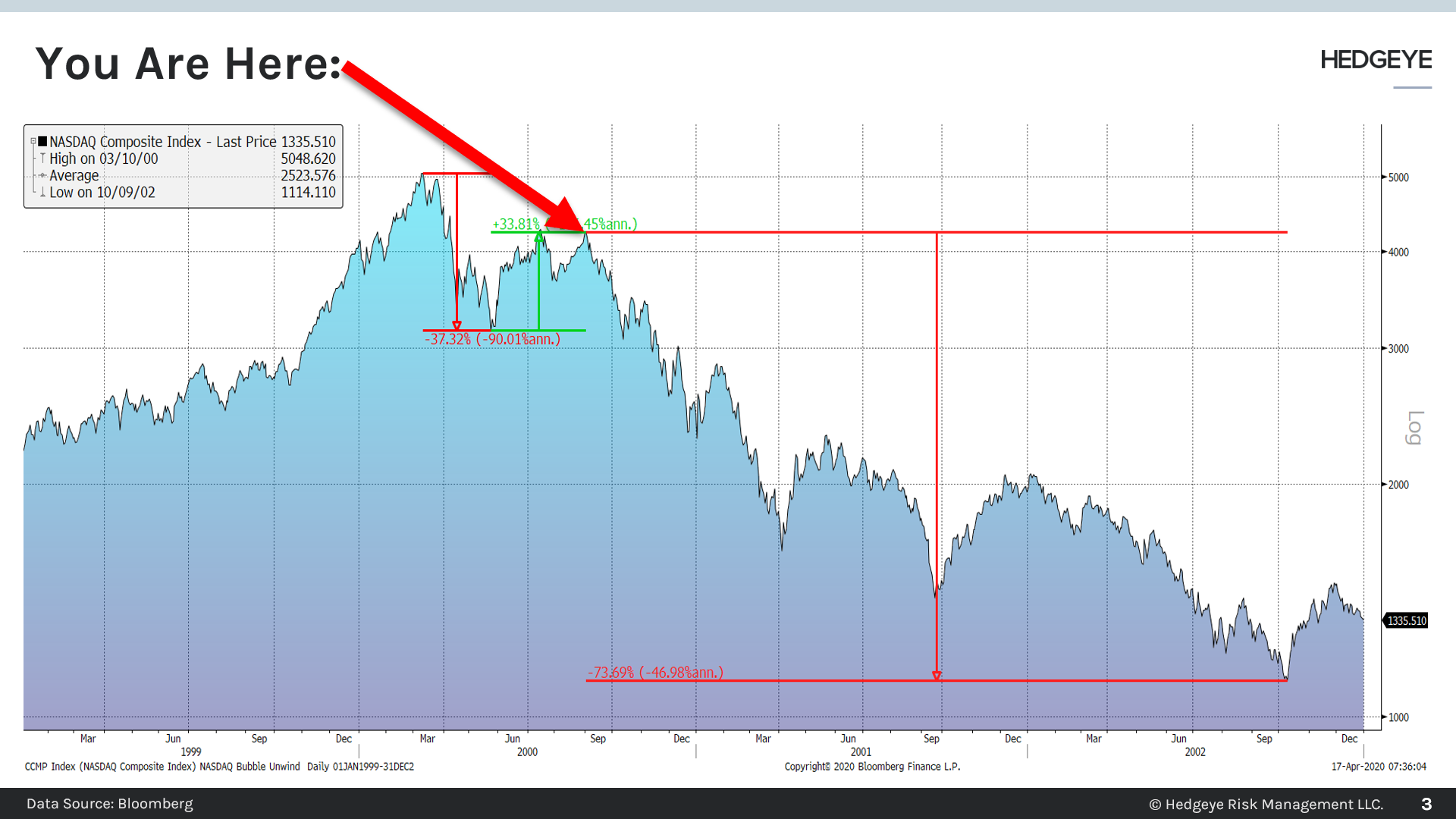
As to the question of whether or not it is too late to lower risk exposure and increase cash for capital protection and future buying opportunities, the Hedgeye chart below of the NASDAQ price behaviour during its March 2000 to December 2002 bear market, offers perspective.  Unless you’re a day trader (and most of them fail), rebounds within bear markets should be used as another opportunity to sell and correct risk allocations that came into the downcycle long and wrong.  It’s not too late to get defensive.

Posted in Main Page | Comments Off on Danielle’s bi-weekly market update




