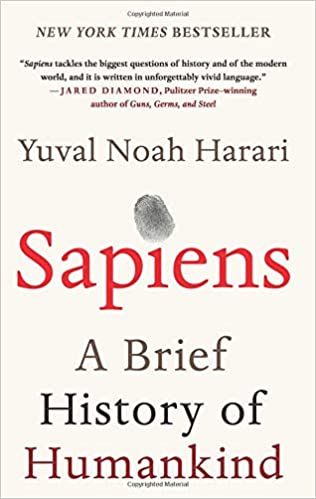
Sapiens: A Brief History of Humankind

Thanks to Tim for recommending that I read Sapiens:  A Brief History of Humankind (2015) by Yuval Noah Harari.  It’s worth the time.

The cover note gives a good taste:  “Fire gave us power.  Gossip helped us cooperate.  Agriculture made us hungry for more.  Mythology maintained law and order.  Money gave us something we can really trust.  Contradictions created culture. Science made us deadly.  This is the thrilling account of our extraordinary history–from insignificant apes to rulers of the world.”

The last few chapters review the history of trade, capitalism, corporations, finance and central banks, and remind us of the deafening rhyme of recent events to past episodes.  The story of the Mississipi Company chartered, in 1717 in France, to colonize the lower Mississipi Valley in America, is one example.  The Mississipi Company founders promised riches and the wealthy piled in followed by the bourgeoisie.  The stock was initially priced at 500 livres and by December 1719 was trading at 10,000.  Euphoria spread.  People took out loans to buy the shares.  Then, early speculators decided to take profits and sell.  What happened next reminds of recent events.  Here’s a segment (page 361):

“When other investors saw the price going down, they also wanted to get out quick.  The stock prices plummeted further, setting off an avalanche.  In order to stabilise prices, the central bank of France–at the direction of the governor, John Law–bought up Mississippi shares, but it could not do so forever.  Eventually, it ran out of money.  When this happened, the controller general of finances, the same John Law, authorised the printing of more money in order to buy additional shares.  This placed the entire French financial system inside the bubble.  And not even this financial wizardry could save the day.  The price of Mississippi shares dropped from 10,000 back to 1,000 livres, and then collapsed completely, and the shares lost every sou of their worth.  By now, the central bank and the royal treasury owned a huge amount of worthless stock and had no money.  The big speculators emerged largely unscathed–they had sold in time.  Small investors lost everything, and many committed suicide.”

Sad, but common. We’ve been amply warned of how monetary madness ends…

Posted in Main Page | Comments Off on Sapiens: A Brief History of Humankind

After the golden age: contemplating the fate of globalization

Another illuminating presentation on the balance sheet recession now sweeping the world. When economies run out of able and willing borrowers, monetary policy is largely ineffective.

The Other Half of Macroeconomics and the Fate of Globalization, December 2018 speech by economist Richard Koo.  Here is a direct video link.

Posted in Main Page | Comments Off on After the golden age: contemplating the fate of globalization

New doc: Planet of the Humans

I have been waiting to see this documentary, and it is now available on Youtube.  You can watch it here.

The main points are important: we humans are the most deadly virus the world has ever known.  We are too many and consume too much to be sustainable in our current course, and there is much room for fraud in many of the proposed solutions.  In many cases, old thinking and profit-maximizing models are operating under the banner of ‘green’ and ‘sustainable’, when they are everything but.  The film makes this point particularly well about biomass.

I have long noted that the most important of the three ‘Rs’ is Reduce and Reuse, but we have pinned feel-better hopes on Recycle.  In reality, most materials are not recycled.

My problem with the film is that it is long on criticism (which is the easy part) and short on solutions (the hard bit). It also paints all environmental efforts, technology and advocates with the same negative brush, which is lazy and dishonest.  If heavy metal batteries are toxic, it throws out the viability of energy storage even though there are many types of non-toxic storage which are already in use and development.  If we do not have one perfect energy source for every application today, then we should give up on developing alternatives or using the replacements and improvements we do have?  If Al Gore is a hypocrite then everyone who is trying to lower their carbon and waste footprint is too? Give me a break.

We do not have perfect solutions for every area that we need to change, yet.  Yet, is the critical word.  That doesn’t mean we throw up our hands in defeat and insist that change is impossible.  That’s an easy cop-out.

Most people dislike change and do not like to be told that they need to do things differently.  I get it.  Many attack and reject new ideas and behaviours in the hopes of continuing their old ways and habits.  Our present fossil fuel use and natural world degradation are not sustainable.  So, we can’t stay with the status quo, we have to go forward.  We humans are the problem and we will either find smarter choices or we will become extinct.  It’s that simple.

For my part, I will keep making efforts to consume less, waste little, eat plants, minimize garbage, walk and ride my bike, take public transport, drive my EV where needed, and maintain an open mind and heart for the rest of my days.  To hell with darkness.


Posted in Main Page | Comments Off on New doc: Planet of the Humans