Deutsche Bank, Donald Trump, and an Epic Trail of Destruction

Deutsche Bank has long been a criminal franchise.  But it is also emblematic of a financial sector that has generally run amuck, globally.  Allowing our financial infrastructure to be ruled and directed by lawless greed has undermined stability and our sustainability worldwide. We must not repeat the mistake of 2008, and miss the opportunity in the present financial crisis to affect the necessary reforms and prosecutions needed.  A better future requires us to admit, repent and reform in order to recover.  The discussion in this clip is a good summary.

Part of every financial scandal, bubble, and crash is the presence of misaligned incentive structures. The precarious position of the banking system has many investors and firms scrambling for safety – even some of the largest financial institutions in the world like Deutsche Bank. David Enrich, business investigation editor for the New York Times, joins Real Vision’s Ed Harrison to discuss his new book, “Dark Towers: Deutsche Bank, Donald Trump, and an Epic Trail of Destruction.” He traces the growth and evolution of the German bank from its founding to today. Enrich outlines the system of misaligned incentives bank executives created, examines Deutsche’s relationship with President Donald Trump, and details the unreasonable risks the bank has taken on since the 2008 financial crisis. Here is a direct video link.
Posted in Main Page | Comments Off on Deutsche Bank, Donald Trump, and an Epic Trail of Destruction

Make North America great again: invest in workforce and innovation

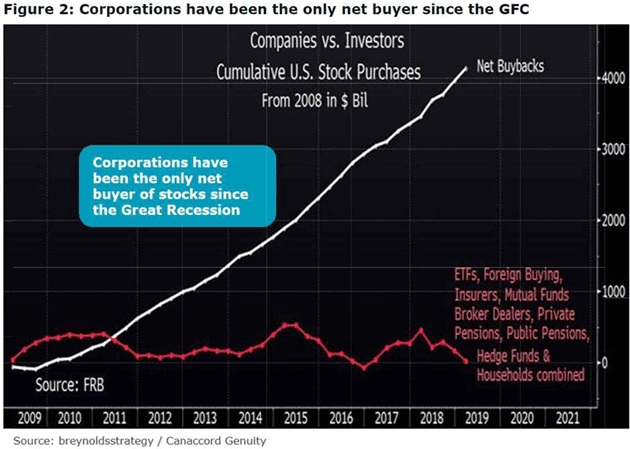
From 2009 to 2019, S&P 500 companies alone poured $5.29 trillion into share buyback programs (data from S&P)–more than double the $2.59 trillion from the 10 years prior. Dividend payments to shareholders saw a similar increase, nearly doubling to $3.53 trillion from $1.89 trillion.

As charted below, this has made corporations the only net buyers of stocks since the 2008 recession (white line), while inflows from outside investors have stagnated (red line). Ponzi anyone?

Now as stock prices tumble in a bear market, the cash wasted on buyback evaporates into thin air, just as holes gap wide on income statements and loans are more expensive and difficult to find.

The timeless truth is that the public buys most at market tops and least at market bottoms.  But the same is true of companies.  As a cash crunch spreads and buybacks dry up in 2020, the stock market is losing buyers on both fronts, while those looking to sell leaps.  See If companies aren’t buying their own stock, who is?

Not surprisingly, numerous studies have confirmed that companies that retain profits and reinvest in better products, operations and cash buffers, are more stable and productive over time.

The WSJ video report below is a good summary of the factors at work here.

The stimulus package aimed at addressing the coronavirus pandemic includes a restriction: any company that takes aid will have to swear off stock buybacks while receiving government funds. WSJ explains share buybacks and how they became targeted in the bailout. Here is a direct video link.

The video report mentions that proponents argue buybacks benefit workers by driving up the value of their pension assets too, not just executive compensation.  But clearly this is a joke.  If that were true, then CEO pay would not have risen to 300x average worker pay in recent years.  Pension deficits would also not be soaring with companies dumping secure benefit plans in favour of gamble-and-hope contribution plans.

The time-proven best way to build a strong workforce is to invest in their health and education, pay them well, and build excellent products produced where your customers live.  At the same time, strong balance sheets enable companies, employees (including executives) and the economy to survive the setbacks and cycles that recur, without bankrupting governments on endless bailout pleas.

Posted in Main Page | Comments Off on Make North America great again: invest in workforce and innovation

Bear market bounce (aka short-covering and sucker’s rally)

A lot of shorts getting covered today across most risk assets and yields and this has driven yet another dramatic rebound day. These are expected given the rapid price declines between Feb 19 and March 23.

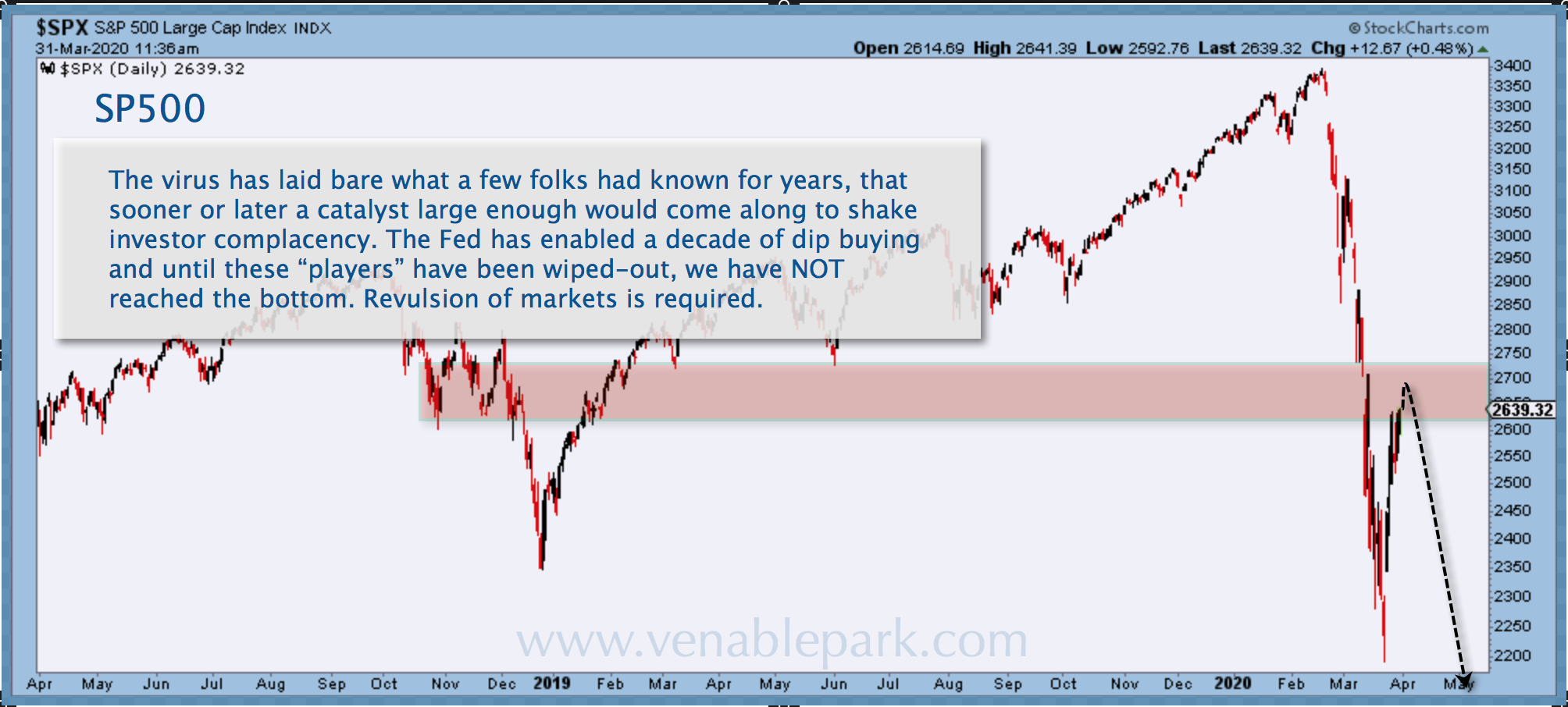
On March 31st, my partner Cory Venable highlighted 2625 to 2725 as a rebound test for the S&P 500 (pink band below).  At 2661 this afternoon, we are nicely into the zone.


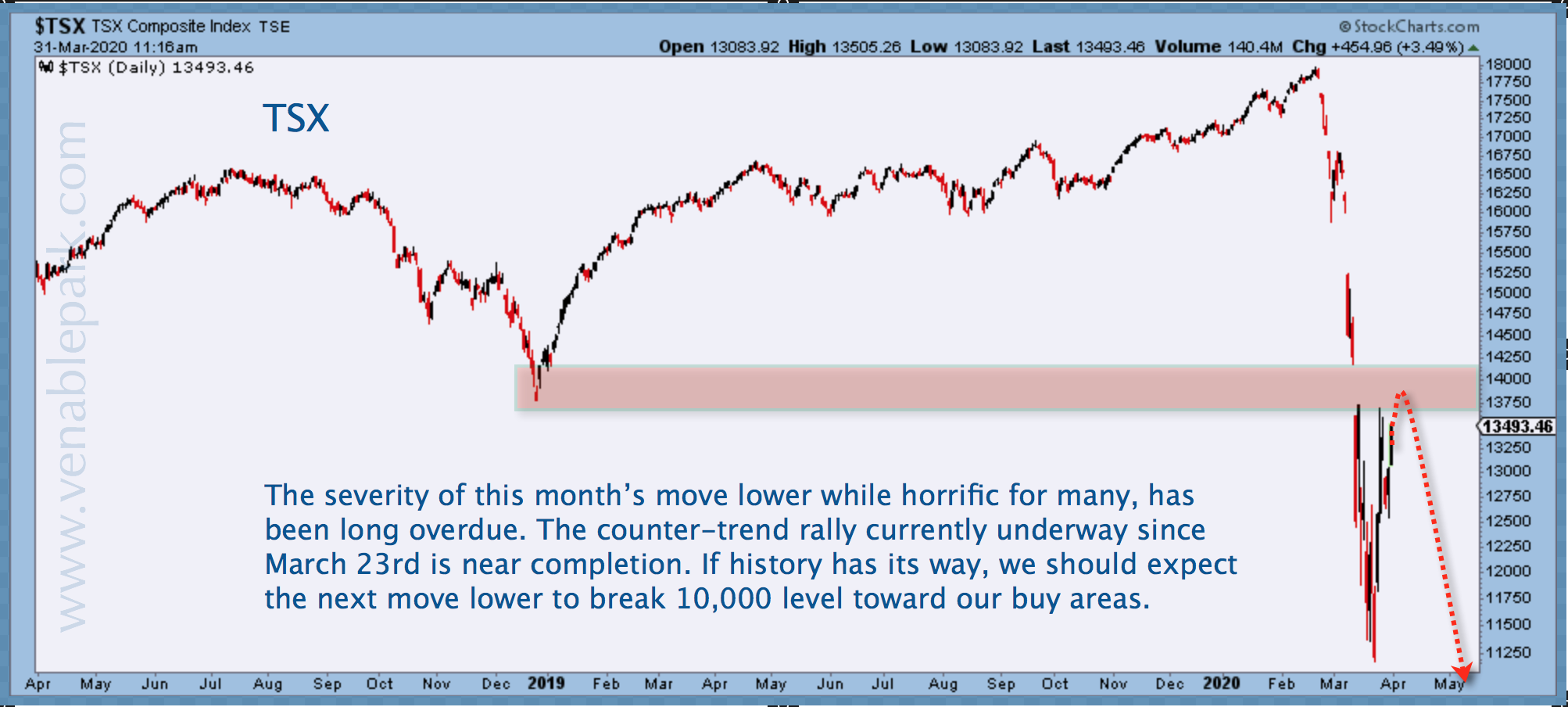
For Canada’s TSX, resistance is the 13750 to 14250 area (pink band below in Cory’s chart).  At 13505 this afternoon, further headroom remains.  It should be noted that these are daily charts.  The weekly and monthly downtrends remain unaltered by these bounces.

Posted in Main Page | Comments Off on Bear market bounce (aka short-covering and sucker’s rally)