
Re-steepening yield spreads and CEO sentiment

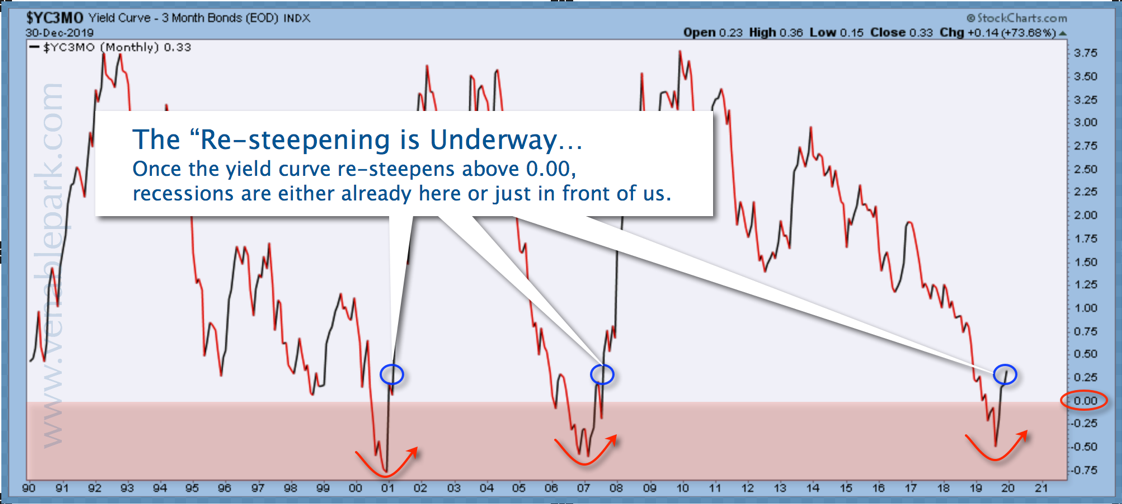
In our December 31 client letter, we discussed the re-steepening in the US 10-year and 3-month yield spread that has been underway since 2019, as the US Fed began cutting its policy rates once more.

An inversion of the 10-year-3-month spread has preceded each of the last eleven US recessions, and in particular, it is the re-steepening after the inversion that marked the onset of recession by an average of 9 months.  Here is my partner Cory Venable’s chart showing the re-steepening turns in 2001, 2007 and August of 2019.

We also noted that 2019 marked a record year for CEO departures at Fortune 500 companies, with corporate insiders cashing out their personal stock holdings at the highest rate since the 2008 financial crisis.

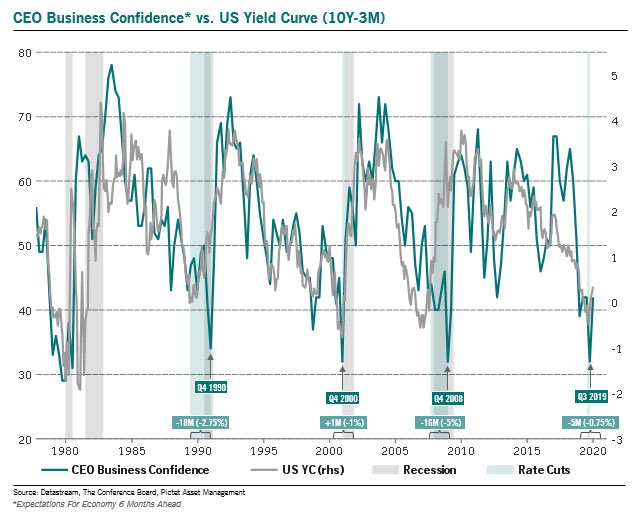
Picton Asset Management has captured these trends together on the below chart of US CEO business confidence in green since 1975, along with the US 10-year and 3-month yield spread.  Here we can see cycle lows in US CEO confidence (green line) aligned with re-steepening yield spreads (grey line), and the onset of the last 5 recessions (grey bars).

With the US Fed still engaged in ongoing QE, the question is will this manage to stall an incoming recession for another year?
Posted in Main Page | Comments Off on Re-steepening yield spreads and CEO sentiment

HBR: Why stock buybacks are dangerous for the economy

Two of the leading democratic candidate contenders have proposals to greatly curtail share buybacks as a form of illegal market manipulation.  Last October the International Monetary Fund’s Global Financial Stability Report, noted “debt-funded payouts” as a form of financial risk-taking by U.S. companies that “can considerably weaken a firm’s credit quality.”

This week a Harvard Business Review article draws the connection between buybacks and extreme dividends funded by debt and low corporate tax rates with weak productivity, shrinking R&D investment, financial fragility, soaring government deficits, and extreme income disparity.  See  Why Stock Buybacks are Dangerous for the Economy:

Why have U.S. companies done these massive buybacks? With the majority of their compensation coming from stock options and stock awards, senior corporate executives have used open-market repurchases to manipulate their companies’ stock prices to their own benefit and that of others who are in the business of timing the buying and selling of publicly listed shares. Buybacks enrich these opportunistic share sellers — investment bankers and hedge-fund managers as well as senior corporate executives — at the expense of employees, as well as continuing shareholders…

Whether it is corporate debt or government debt that funds additional buybacks, it is the underlying problem of the corporate obsession with stock-price performance that makes U.S. households more vulnerable to the boom-and-bust economy. Debt-financed buybacks reinforce financial fragility. But it is stock buybacks, however funded, that undermine the quest for equitable and stable economic growth. Buybacks done as open-market repurchases should be banned.

In short, buybacks are indefensible and policy change in this area is essential.

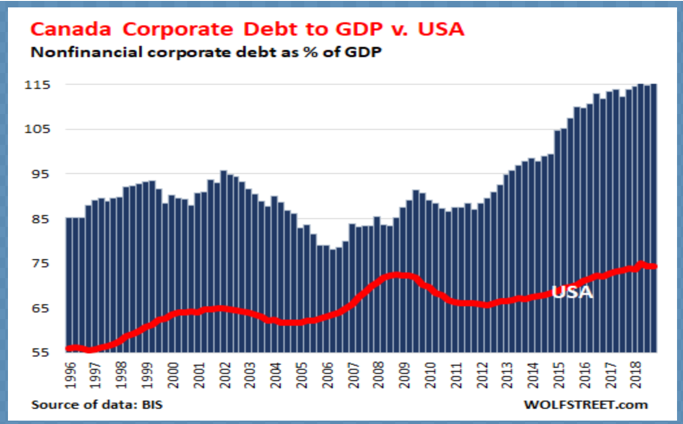
The buyback damage done to corporate balance sheets with record debt to GDP in both Canada and the US is evident in Wolf Richter’s chart below. Canada’s corporate debt to GDP hit a freakish 115% in 2018 versus 70% in the US, and compared with cycle peaks of 95% in Canada in 2002 and 85% in 2008.

Posted in Main Page | Comments Off on HBR: Why stock buybacks are dangerous for the economy

Overbuilt condo market weighing on Manhattan

A new report from Halstead Development Marketing says Manhattan has 7,050 unsold, newly built condo units and 85% of them — almost 6,000 — haven’t been formally listed for sale.  See Manhattan’s flood of new condos could take six years to sell:

The secret supply is a heavy weight on a market in which sales, especially of higher-end properties, have slowed to a crawl. It would take take 74 months — more than 6 years — to clear all of Manhattan’s unsold units at the pace of contracts in 2019, the report shows.

The glut is a product of a post-recession construction boom aimed at globe-trotting investors, who now show little interest in collecting lavish Manhattan homes. And most newly built apartments are out of reach for the majority of New Yorkers.

Et tu, Toronto and Vancouver?


Posted in Main Page | Comments Off on Overbuilt condo market weighing on Manhattan






