Ontario handing off pot distribution to private sector

The Ontario Cannabis Store (OCS), following New Brunswick’s announcement last week, says that the government-owned agency is planning to let the private sector operate its distribution network.  OCS will also work with cannabis producers interested in taking on direct delivery for their products.

As Canada’s most populous province, home to 39% of Canadians, Ontario is the nation’s largest cannabis market. There are presently 24 licensed cannabis stores in operation as well as the government-run online store. Another 69 stores are currently in the licensing application process.

Bottlenecking at the distribution level has been repeatedly cited by some Canadian cannabis companies as one of the main reasons why revenues had declined.  Over to you private sector. The province can now focus on regulation and tax collection.  We wrote a month-end letter on the Canadian cannabis industry in October 2018, which is available here.

Ontario follows New Brunswick in plans to allow the private sector to handle distributing cannabis from producers to retailers, a sign that the provincial government is beginning to reduce its legal pot exposure.  Here is a direct video link.
Posted in Main Page | Comments Off on Ontario handing off pot distribution to private sector

ECRI: Global data decelerating ‘hard’, decoupling not likely

ECRI’s Achuthan speaks with CNBC about the continuing cyclical slowdown in U.S. economic growth. On mobile, click here to view video interview.

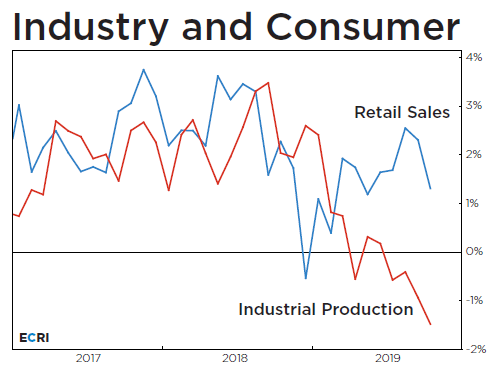
This economic trend could end Wall Street’s bullishness from CNBC.  For the U.S. there’s nothing to be optimistic about – except optimism itself. In other words, the risk-on rally is predicated on a revival in growth, including solid holiday sales. But, regardless of new market highs, there is little objective evidence in the hard data to support that view.

Posted in Main Page | Comments Off on ECRI: Global data decelerating ‘hard’, decoupling not likely

Canadian insolvencies accelerating at recession-like pace

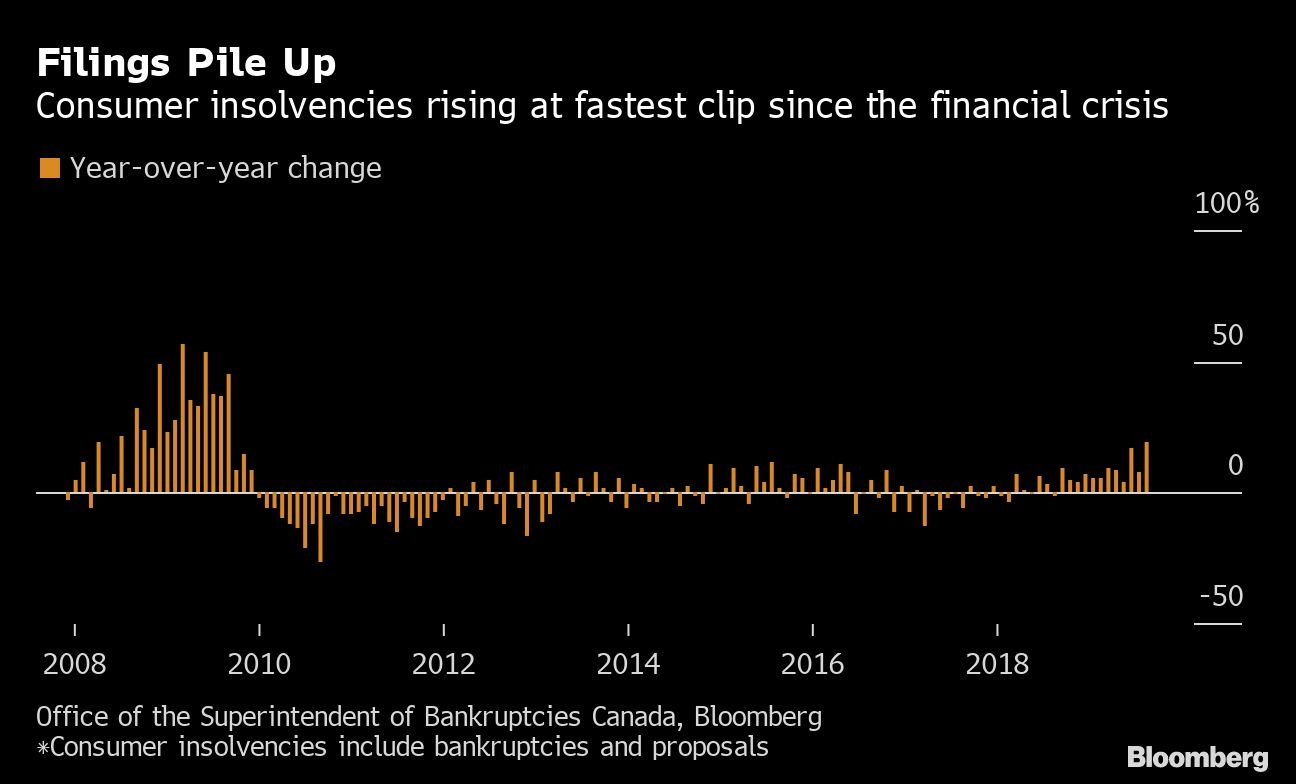
Insolvencies are accelerating at a pace that’s been associated with periods of distress: the start of the 2008-09 financial crisis, immediately before the 1990-92 recession, and during the period of pronounced economic weakness in 1995-96 that was tied to the Mexican peso crisis. Here is a direct video link.

The below chart shows the recent rise in national insolvency filings compared with the past 11 years.  Noteworthy is the fact that consumers are today hitting the wall even though unemployment and interest rates remain near record lows; a tick up in either will magnify default trends.

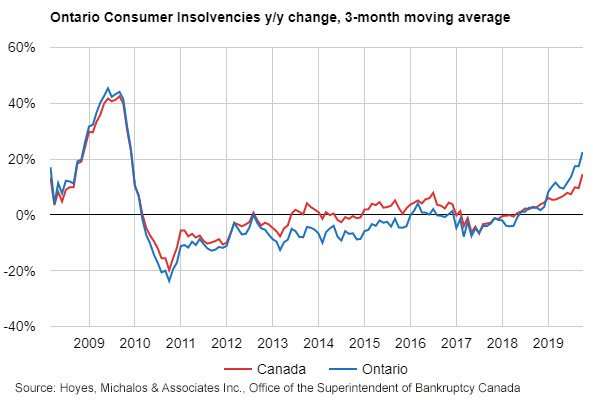
And filings are certainly not just rising in Alberta, Ontarians with our unaffordable housing and record household debt are leading national insolvency filings, as shown below.  Insolvency trustee Doug Hoye explains as follows:

The pace of growth is rapidly accelerating, an indication that the consumer debt bubble is beginning to implode. Ontario has posted double-digit growth in 7 of the last 9 months and the 3-month moving average pace has now accelerated to 22.5%, while the 3-month growth rate for Canadian insolvencies increased to 14.6%. The majority of consumer insolvencies in Ontario continue to be filed by non-homeowners as seen by the relatively flat trend in our Homeowner’s Bankruptcy Index. Non-homeowners with high consumer debt are increasingly unable to sustain their monthly debt payments yet do not have the equity capacity of homeowners to refinance.

Posted in Main Page | Comments Off on Canadian insolvencies accelerating at recession-like pace