Food scraps to fuel Toronto garbage trucks in 2020

This is what smart resource management looks like.  See Make Way for Biogas:

Food scraps will be used to fuel garbage trucks in the City of Toronto. Anaerobic digesters take materials from food scrap bins and turn it into solid or biogas, a type of biofuel that is naturally produced from the decomposition of organic waste. The city has been working on biogas since 2015, as a way to turn food scraps into something useful. Starting March 2020, the biogas system will be ready for use.

Thanks to a new plant at a solid waste facility, the city is ready. And it’s the first one in North America to do it. The same trucks that pick up waste will be fueled by it. After trucks pick up the trash and bring it to the waste facility, trucks will get filled up with the same biogas from the scrap digester. It’s a true circular system.

Carlyle Khan, director of infrastructure and resources management at the City of Toronto, said of the reduced emissions through biogas, “It’s one of the most significant actions the city can take… because we’re not using resources to withdraw and clean fossil fuels, we’re using the waste that’s already produced.”

Not only will the estimated 55,000 tonnes of waste each year fuel trucks, but the biogas produced will also be injected into the natural gas grid.  This is key as we move to replace methane spewing natural gas as the main heating and fireplace fuel in North America.

Posted in Main Page | Comments Off on Food scraps to fuel Toronto garbage trucks in 2020

Low savings and high debt are problem without higher interest rates

Interest rates are headed lower as the economy weakens, but lower rates will not alleviate the strains that are binding households.  Good real-world discussion in this clip.

Household debt levels remain at stratospheric levels, putting some Canadian households in a bind.  Here is a direct video link.

Posted in Main Page | Comments Off on Low savings and high debt are problem without higher interest rates

Air pollution is an undeniable case to go emission free

It took decades for us to comprehend that smoking in one room or section of a vehicle or building exposes all inhabitants to health harm.  Of course, tobacco companies invested billions to muddy the obvious connection and maintain apathy for years after facts were clear.  It was not until massive class-action lawsuits for damages went public that laws for tighter controls and warnings were finally mandated.  We need to broaden this revelation.

Fine particulate matter in the air from fossil fuel emissions can damage our respiratory system, accumulate in the brain and send people to the emergency room. Soaring autism and asthma in children are some of the costs. In older people, rising dementia and cognitive decline have also been linked to PM2.5 concentration in the air.  Aware or not, we all pay a heavy price in our taxpayer-funded sick care system, as well as lost productivity and diminished quality of life.

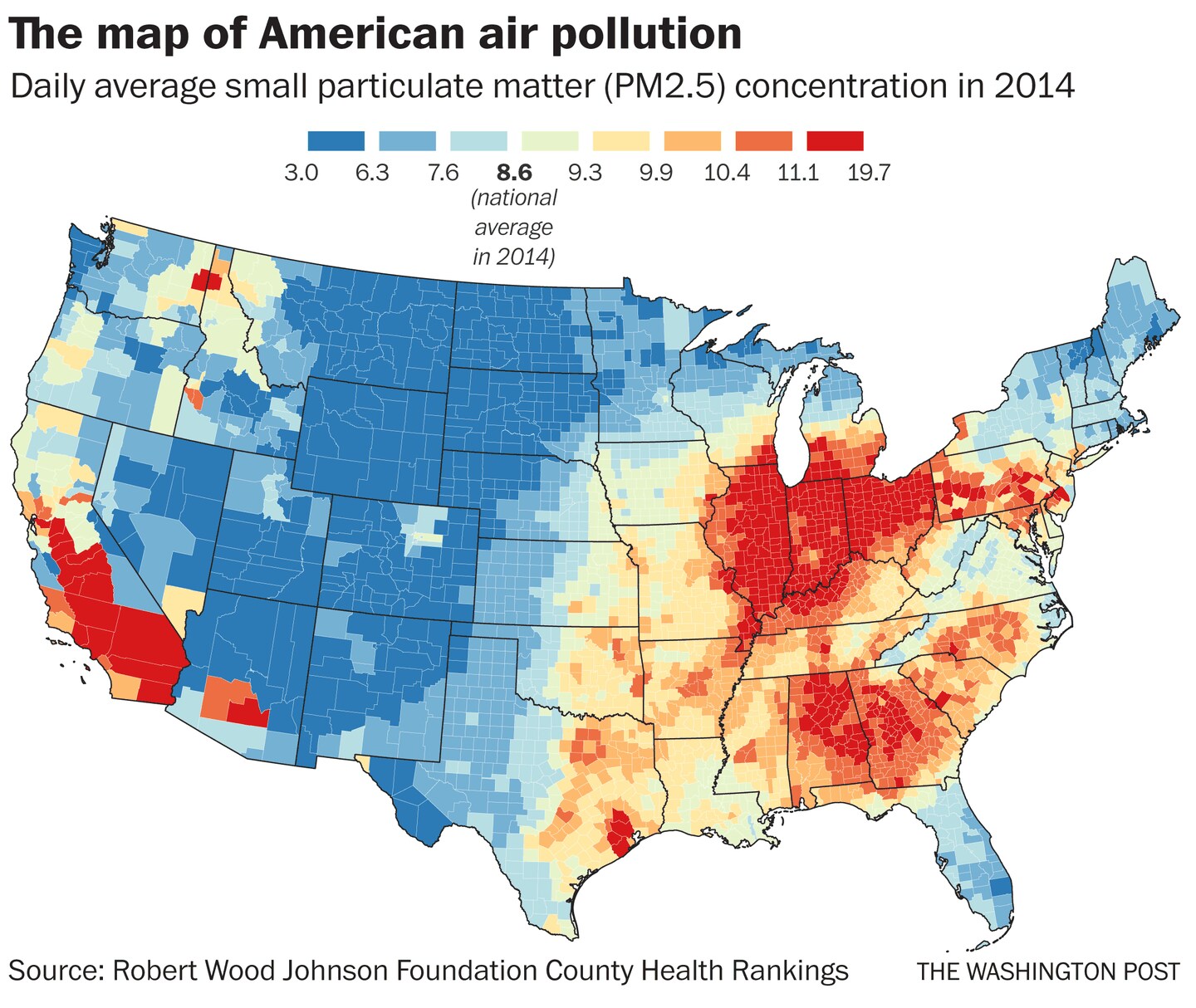
Emissions are cumulative and not contained by borders.  The map below shows the level of small particulate air pollution in America in 2014.  It’s gotten worse since and, naturally, we’re breathing these emissions all over Canada even as we compound them with unnecessary emissions of our own.

In 2018 alone, eroding air quality was linked to nearly 10,000 additional deaths in the U.S. relative to the 2016 benchmark.  According to researchers at Carnegie Mellon University, the primary culprits were rising natural gas use as well as more use of internal combustion engine (ICE) vehicles, which more than offset the benefits realized by less coal burned for electricity generation.

In 2018, the US EPA Administrator Andrew Wheeler disbanded the expert academic panel that reviewed and advised the agency on its standards for small-particle air pollution and replaced them with hired consultants linked to the fossil fuel, pharmaceutical and tobacco industries.

You don’t need to believe in climate change to appreciate the fundamental importance of clean air and the need to transform our transportation and electricity systems to run on emission-free energy.

On top of all the health benefits and productivity savings, it is now cheaper to operate electric vehicles than ICE and to build wind, solar and storage than new fossil fuel-powered systems.  There is no smart business case to do otherwise.  We have the technology, it’s time to mandate it.

Posted in Main Page | Comments Off on Air pollution is an undeniable case to go emission free