
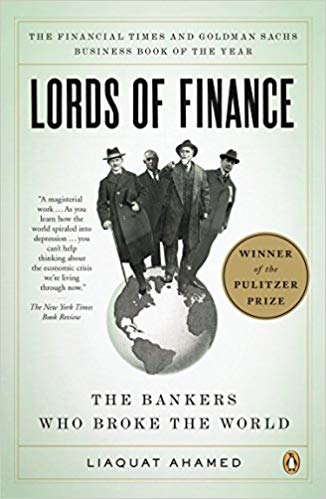
Important book: Lords of Finance

I recently finished reading Lords of Finance by Liaquat Ahamed.

Published in 2009, the book details the rise and fall of central banks in the western world from the early 1900s through the end of the Second World War.  More than 500 pages, it offers a detailed account of the personal relationships and policies which have shaped modern history.

To understand where we are, it is helpful to understand from whence we have come.

Exceptionally well-written and engaging, this work offers important context for our present era of monetary policy run to the end of its efficacy.

This quote offers a hint at the book’s warning to present times:

“The quartet of central bankers did in fact succeed in keeping the world economy going but they were only able to do so by holding U.S. interest rates down and by keeping Germany afloat on borrowed money.  It was a system that was bound to come to a crashing end.  Indeed, it held the seeds of its own destruction.  Eventually the policy of keeping U.S. interest rates low to shore up the international exchanges precipitated a bubble in the U.S. stock market.  By 1927, the Fed was thus torn between two conflicting objectives:  to keep propping up Europe or to control speculation on Wall Street.  It tired to do both and achieved neither.  Its attempts to curb speculation were too halfhearted to bring stocks back to earth but powerful enough to cause a collapse in lending to Germany, driving most of central Europe into depression and setting in train deflationary forces throughout the rest of the world.  Eventually in the last week of October 1929, the bubble burst, plunging the United States into its own recession.  The U.S. stock market bubble thus had a double effect.  On the way up, it created a squeeze in international credit that drove Germany and other parts of the world into recession. And on the way down, it shook the U.S. economy.”

For further insight on some similar parallels over the last decade, watch Panic:  The Untold Story of the 2008 financial crisis.  This story is not over yet.

HBO looks at factors that led to the 2008 financial crisis and the efforts made by then-Treasury Secretary Henry Paulson, Federal Reserve Bank of New York President Timothy Geithner, and Federal Reserve Chair Ben Bernanke to save the United States from an economic collapse. The feature-length documentary explores the challenges these men faced, as well as the consequences of their decisions. Here is a direct video link.


Posted in Main Page | Comments Off on Important book: Lords of Finance

Must read report: Rethink Food and Agriculture

RethinkX is an independent think tank that analyzes and forecasts the speed and scale of technology-driven disruption and its implications across society, helping investors, businesses, policymakers and civic leaders make wiser decisions.

Their newly released report on Food and Agriculture is available for download here in full and executive form and is critical reading for everyone wanting to anticipate and propser amid the rapid change presently sweeping our economy.   Here’s an overview:

By 2030, the number of cows in the U.S. will have fallen by 50% and the cattle farming industry will be all but bankrupt. All other livestock industries will suffer a similar fate, while the knock-on effects for crop farmers and businesses throughout the value chain will be severe.

Rethinking Food and Agriculture shows how the modern food disruption, made possible by rapid advances in precision biology and an entirely new model of production we call Food-as-Software, will have profound implications not just for the industrial agriculture industry, but for the wider economy, society, and the environment.

In particular, this report offers a warning to Canada on the massive disruption coming to our economy over the next 10 years and beyond.  Accepting reality and transitioning to new carbon sequestering and renewable energy farms and away from cash crops, livestock and fossil fuels is critical.  The opportunities are enormous but require fresh thinking.

These should be ‘the’ issues of this election cycle in Canada and the U.S., and yet most people are, so far, fast asleep.

The 2018 report Retinkx Transportation is also mandatory reading for thinking people.  Here’s the overview:

By 2030, within 10 years of regulatory approval of Autonomous Vehicles (AVs), 95 percent of U.S. passenger miles traveled will be served by on-demand autonomous electric vehicles owned by fleets, not individuals, in a new business model we call “transport-as-a-service” (TaaS).

Rethinking Transportation shows how TaaS disruption will have enormous implications across the transportation and oil industries, decimating entire portions of their value chains, causing oil demand and prices to plummet, and destroying trillions in investor value — but also creating trillions in new business opportunities, consumer surplus and GDP growth.

Posted in Main Page | Comments Off on Must read report: Rethink Food and Agriculture

Canada is wasteful and we can’t afford it

Canadians consume more than 5x more energy per capita than the global average, and 5.8x the amount of natural gas.  Most of this is thanks to our fossil fuel-intensive industry and transportation sectors which will be increasingly subject to higher taxes, penalties and liability for pollution caused.  See 10 Handy Facts about Canadian Energy that you Probably Want to Know:

“…51 per cent of Canada’s energy is used by industry for things like oil and gas, refining, mining, pulp and paper and chemicals. Another 23 per cent is used in transportation: freight trucks, passenger cars, airplanes.

That leaves only 14 per cent for residential and 12 per cent for commercial. In other words, it’s the big factories, mines and refineries that are using most of our energy — yet they’re often the same entities which receive exemptions or subsidies for emissions.

Given the industrial sector’s large dependence on fossil fuels to make or extract stuff, this has meant that Canada has an extremely high amount of energy required per dollar of GDP — higher than even China.”

The world is in the midst of a necessary turning point in energy use and efficiency, which will only intensify from here.  With record debt, stagnant household incomes and now weakening revenues for many companies and all levels of government,  finding ways for Canadians to reduce operating expenses is imperative.

The obvious low-hanging fruit in becoming more environmentally and financially sustainable is to focus consumers, business and governments on reducing energy consumption and waste, while dramatically increasing efficiency in our transportation, buildings and food systems–right now, at all levels of policy and plans.  At the same time, we need to tax the waste and harm we seek to reduce.  A carbon tax is part of that. This is economics 101.

One of the biggest issues in this election is whether the current federal carbon tax will survive after the votes are counted. How did Canadian conservatives turn against carbon pricing? Why is Ontario trying to fight it in court? What are the alternatives? We take a hard look at what it means to pay for climate change. Here is a direct audio link, starting at 11:30 on the playbar.

Posted in Main Page | Comments Off on Canada is wasteful and we can’t afford it



