Rate cuts coming to Canada too, but more will be needed

On this first day of August 2019, a day after the US Federal Reserve blinked and launched into its first rate-cutting cycle in a decade and abandoned plans to run down its QE-bloated balance sheet (via QT), it will not be long before the Bank of Canada follows suit.  Some key themes are driving the sound of inevitability here:

A report from the Institute for Energy Economics and Financial Analysis (IEEFA) has found that BlackRock has eroded the value of its $6.5tn funds by betting on oil companies that were falling in value and by missing out on growth in clean energy investments…

The report follows a stark warning from the Bank of England over the “significant risks to the economy and to the financial system” posed by fossil fuel investments.

The Bank has estimated that investments worth $20tn could be left “stranded” as governments set more ambitious climate targets.

Thirty-five years of slashing interest rates and increasing debt to stimulate consumption are now out of meaningful torque.  Going forward will require heavier lifting in the form of diversified investment and innovation away from traditional engines like housing and oil and into new rapidly growing sectors in high demand.  Just one such example: the global movement toward plant-based foods is an opportunity for Canada, see Pulse of the Nation:  How Beyond Meat could turn this humble pea into Canada’s new gold.
Posted in Main Page | Comments Off on Rate cuts coming to Canada too, but more will be needed

Permanent and cyclical shifts undermining oil demand

Most of the plastics presently in use are made from crude and are not recyclable and non-biodegradeable.  Most people are just realizing this now. As word spreads, banning plastic straws and bags are barely a beginning.  Much broader bans and demands for reuseable and biodegradable packaging types are inevitable because doing otherwise makes zero sense and thinking people see that.

Canadian grocers Sobeys will remove plastic grocery bags from all of their stores by the end of January.  Here is a direct video link.

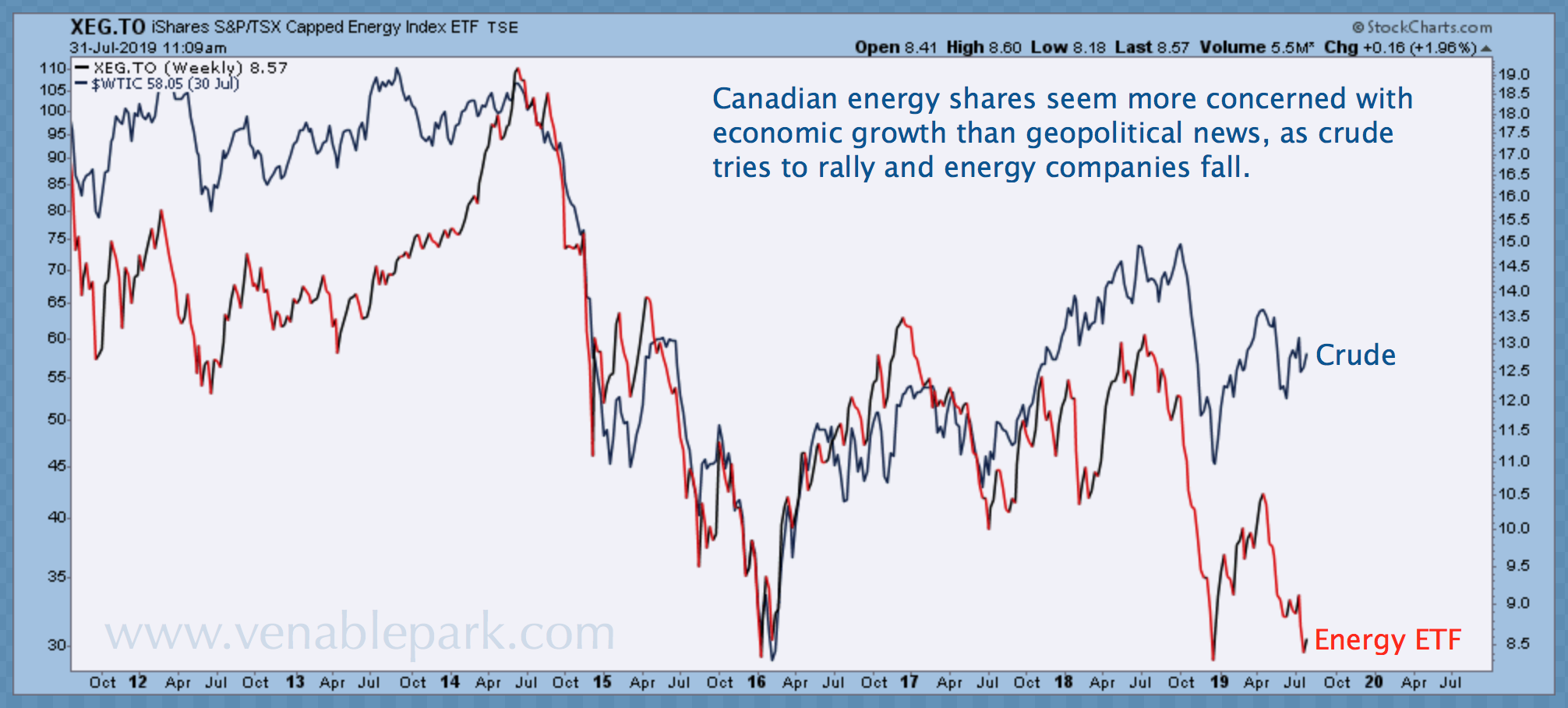
These trends, along with others like rising energy efficiency, renewables and electric vehicles are permanent shifts that will continue to detract from crude oil demand going forward.  In addition, the price of crude (in black below) and energy company shares (red) are digesting the cyclical reality of the global economic downturn now underway.  Both are shown here since 2011 in my partner Cory Venable’s chart.

Canada needs to embrace reality and ramp up investment in alternative fuels and bio-plastics so the economy can skate to where the puck is going. See The war on plastic will dent crude oil demand more than anticipated:

Using the IEA World Energy Outlook as a benchmark, decreased used of plastics and increased recycling could diminish oil demand from petrochemicals in 2040 by more than 20%, bring projected peak oil demand forward by a decade and diminish the need for oil-based petrochemical production capacity by 20 per cent. The dent in oil demand by 2040 would exceed the one that the IEA predicts would accompany the introduction of electric cars.

As usual, the status quo is fighting to resist necessary evolution here see How the plastics industry is fighting to keep polluting the world.

Posted in Main Page | Comments Off on Permanent and cyclical shifts undermining oil demand

Improbable, high-risk return assumptions increase odds of financial hardship

The average US public pension plan (similar in Canada) is assuming it will net an average 7.4% annually going forward. Even on that rosy presumption, the average pension today has a 27% capital shortfall and 73% of the assets needed to fund payouts promised to retirees. To meet planned withdrawals, most retirement plans–pensions and individuals–need to do some or all of the following:

  • increase contributions
  • reduce planned withdrawals
  • defer the start age for withdrawals
  • cut expenses and overhead
  • net significantly more than 7.4% a year on savings invested

The first four options are wildly unpopular. The last is highly unlikely. Most people are banking on improbable returns anyway. As I recently explained in High fees and risky bets, not in best interests of Canadians this opens up the likelihood of financial disappointment and hardship later in life, when fixes and time to recover are hard to come by.

As the WSJ explains in America’s public pensions are stuck in the clouds, the rise in asset prices since 1987 has been unusually high by historical averages, and that means returns from present levels are set to be lower than average. To wit: in 1987 a 30-year government bond yielded nearly 9%, and stocks were moving off a 20-year low in valuations in 1982 that started from single-digit multiples and dividend yields north of 8%.

Today, 30-year treasuries are yielding 1.7% in Canada and 2.6% in the US, and stock and real estate valuations are at the very top of historical occurrences. Just one example: the Shiller cyclically-adjusted price-to-earnings ratio (CAPE) which has proven one of the best predictors of medium-term stock returns, is above 30 today compared with 16 at the end of 1987. This matters. Historically when the CAPE has been above 25, subsequent stock returns have averaged 4.1% a year assuming no fees or withdrawals of any kind were taken along the way, and every dividend was reinvested. Since this is rarely, if ever, possible, real-life compound returns averaged much less than 4.1%.

The reality is that based on presently elevated security prices, a portfolio aggressively allocated 70% to equities and 30% to corporate bonds might be expected to gain 3.8% gross per year over the next decade–again assuming no fees or withdrawals to detract from compound growth are taken. Anyone trying to withdraw income from this portfolio would underperform the hypothetical 3.8% return target significantly while having to hold through steep bear markets and wait many years for principle to recover in between. Most, at or near retirement, will not be able to do any of this.

We have to make our financial decisions based on the real-time facts and probabilities at hand. Holding stocks and corporate bonds (or funds of them) today with the capital we will need to fund retirement or other needs within the next ten years is a volatile, high-risk, and poor-return prospects plan.

Minimizing exposure to extremely over-valued assets today and keeping principle secure and liquid so that we can buy after they’ve repriced to the lower end of historical ranges once more, makes reaching financial goals not only possible but probable.

Posted in Main Page | Comments Off on Improbable, high-risk return assumptions increase odds of financial hardship