Canadian government bonds rising as growth stalls

The government bonds in our portfolios have appreciated for many months now as economic data disappoints and central bank rate cuts come to fruition once more.

Although the Bank of Canada (BOC) is presently on hold, rate cuts by the US Fed will force the BOC to follow suit.  The rally in government bonds is likely to continue as Canada’s ten-year treasury yield (shown below) falls from 1.54% today towards 1% in the months ahead.
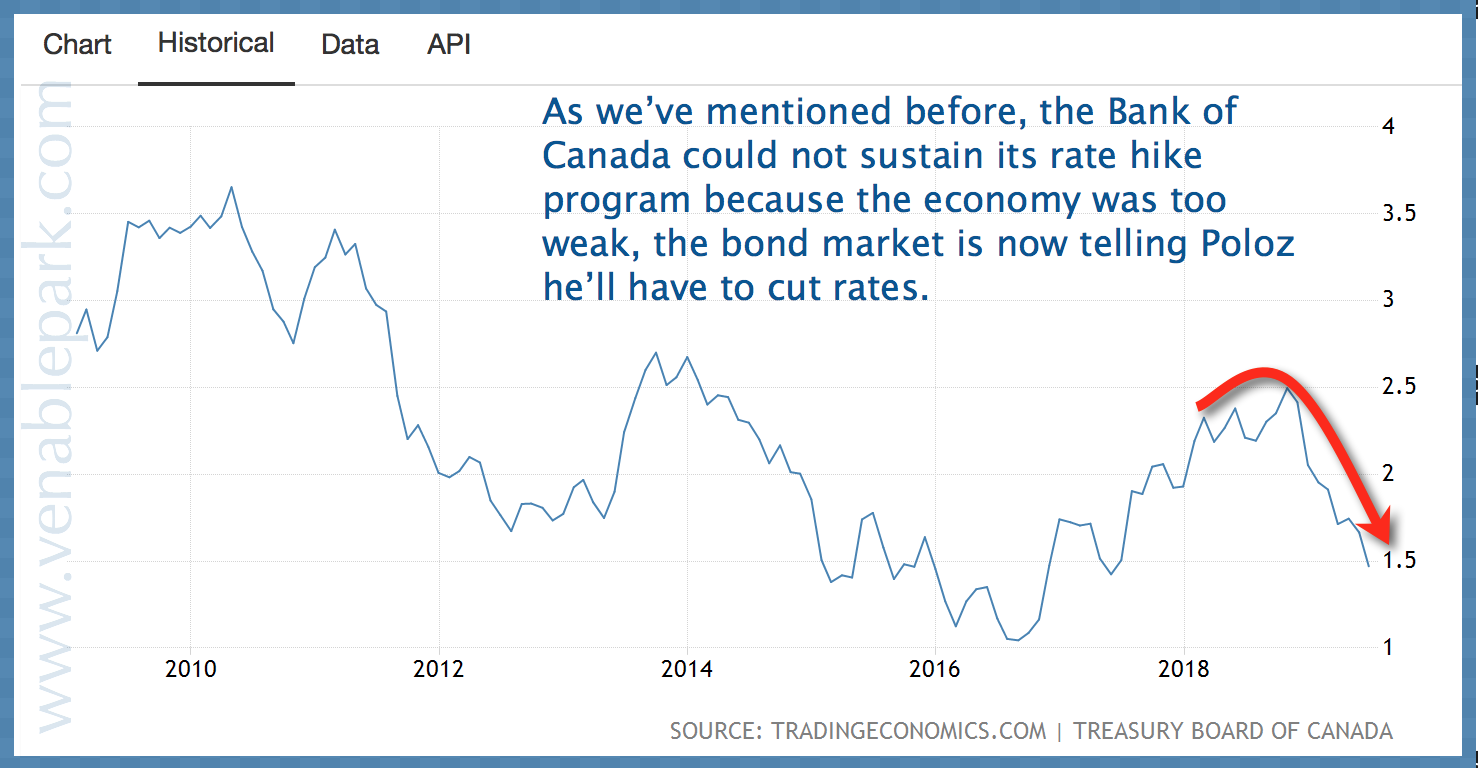
On a risk-adjusted basis, now very late in this credit cycle, North American treasuries are a far more prudent allocation than stock markets near cycle highs.  But since government bonds and funds pay relatively little in commissions and fees to financial advisors and product sales firms, most portfolios hold little to none of them.  Sad fact.

Posted in Main Page | Comments Off on Canadian government bonds rising as growth stalls

The race for environmentally friendly air travel

As ticket prices have plunged, air travel globally has increased by an amazing 50% in the past six years and become a major source of pollution and harmful emissions.  If airlines and passengers were required to pay for their environmental impact, ticket prices would be much more expensive than present.  When pollution pricing is mandated, vehicles, including airplanes, that use clean power sources are most economical.  More efficient, less-polluting airplanes are another capital-intensive innovation and growth opportunity for the new economy. 

Pollution from air travel can be reduced by being more fuel-efficient, or eliminating fuels entirely with electric planes.

Electric vehicles are on the ground, and soon, electric airplanes, which are free of emissions, could be taking off. They can help save money on fuel and save the environment. Redmond Shannon has a closer look at e-planes and how Canada is leading the way.

Posted in Main Page | Comments Off on The race for environmentally friendly air travel

Time for clean shipping fuel

If shipping was a country, it would be the sixth-largest global air polluter.  Bunker fuel used in shipping emits sulphur and particulates that can cause respiratory illness, as well as greenhouse gases, including carbon dioxide and methane.  At present, about 3% of global emissions are released by ocean freight shipping and with current fuel, the industry is projected to produce more than 15% of global greenhouse gas emissions by midcentury.

In response, the international body responsible for shipping regulations set new emission limits starting in 2012, and by this January 2020 requires ships to significantly cut the amount of sulphur pollution they emit near land.  For the U.S., the regulations apply anywhere within 200 miles of its coastline.

Proving again that regulation helps drive technological evolution, hydrogen fuel cells are now being implemented as a clean fuel for shipping.  It takes three to five years to build a new ship, but existing vessels can also be retrofit with hydrogen power systems.  See The Dawn of Low Carbon Shipping:

Using hydrogen to generate electricity is very clean. Hydrogen fuel cells combine hydrogen with oxygen and create electricity and water. The electricity can be used to turn a propeller, for example. The exhaust from fuel cells is moist air — with no greenhouse gases…”The technology is all here,” Pratt says. “There’s no reason why we couldn’t make all these vessels zero-emission today.”

Posted in Main Page | Comments Off on Time for clean shipping fuel