
Canadian credit cycle on course for a hard landing

Statscan recently reported that from 1999 to 2016, median levels of mortgage debt for Canadians as a whole, rose from $95,400 to $190,000 (measured in 2016 dollars), and the ratio of debt to after-tax family income increased from 94% to 165%.  Meanwhile, as shown in the table below, in Toronto (Canada’s most populous city), debt-to-income levels doubled to 210% and went to 230% in Vancouver.
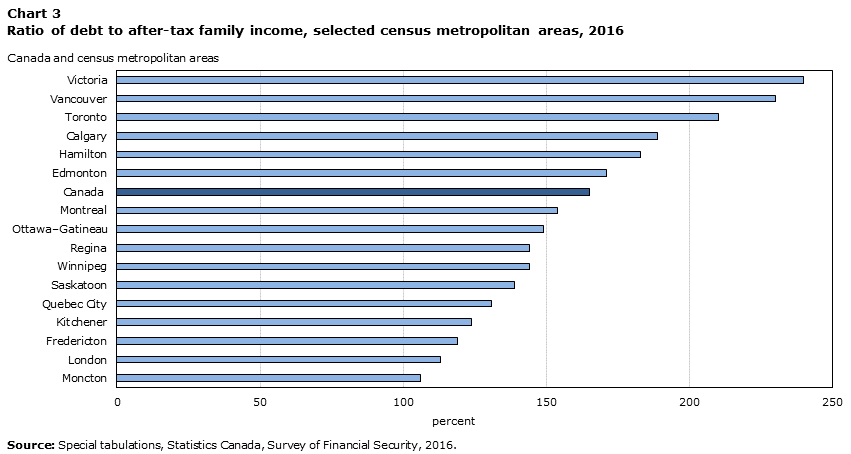
Given the record duration and size of Canadian debt-building over the past decade, in particular, no one should be surprised that Canadian consumer insolvencies began climbing in 2018, and are on pace for double-digit growth in 2019.   Hoyes, Michalos consumer solvency expert Scott Terrio explains these trends today in an article here and points out the heightened economic risks as this cycle moves to its natural conclusion.  Here’s somes Coles notes:

In recent years, Canadians have proven incredibly resourceful at shifting their debt around, in effect kicking the problem down the road.

As a result, the insolvency industry has gone several years beyond what would otherwise be expected to be a natural systemic purge….

Does this mean that the next (current?) insolvency filing tide will be much higher? I tend to think so, for several reasons.

One, there is a pent-up consumer debt bubble that didn’t really have a full reckoning in a normalized debt cycle a few years ago…

Two, almost every study shows very little savings in the hands of Canadians. They have no cushion, no room to maneuver

Three, much of the asset base is illiquid. Tough to just up and sell your home in an expensive housing market…

Four, young people are in deep. They are now the fastest-growing debt accumulators and insolvency filers. Our ‘next generation’ is behind the 8-ball financially. And with the student loan burden getting worse, it’s not a stretch to think many Canadians entering their 40’s – which would traditionally be the start of their highest-earning years – will be making ends meet for a decade or so with underemployment rampant…

All in all, I believe the credit correction is inevitable and it’s not a good scenario for a gentle landing.
Posted in Main Page | Comments Off on Canadian credit cycle on course for a hard landing

Danielle’s weekly market update

Danielle was a guest with Jim Goddard on Talk Digital Network talking about recent developments in the world economy and markets.  You can listen to an audio clip of the segment here.

Posted in Main Page | Comments Off on Danielle’s weekly market update

Loonie and Canadian stocks historically follow US rates lower

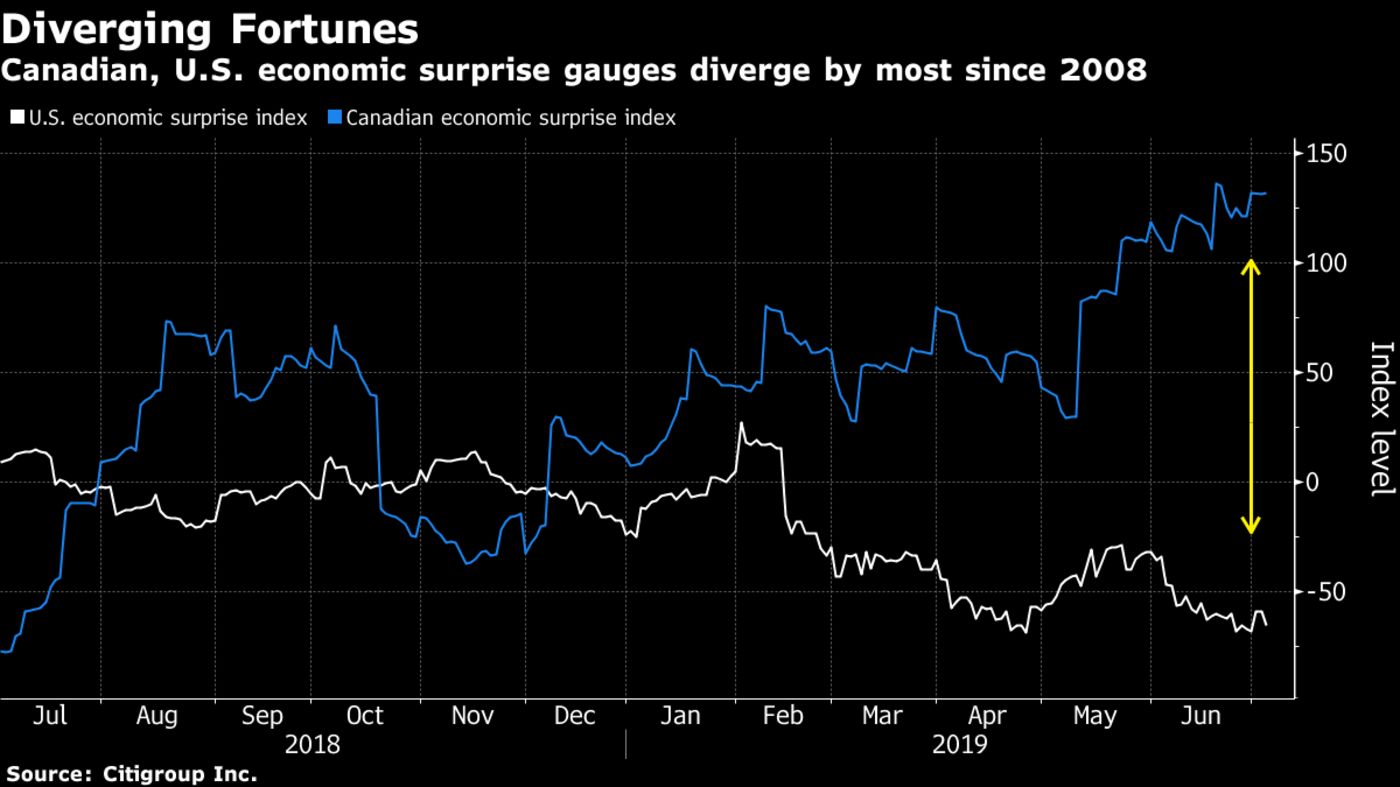
The Canadian dollar has gained 4.3% against the U.S. dollar since the start of 2019 for reasons that include, a softer greenback on expectations of US rate cuts, some rebound in commodity prices as the U$ has weakened, stronger Canadian gross domestic product for April (backward-looking) and a trade surplus in May (backward-looking) for the first time in ten months.   See:  Loonie soars as the Canadian economy firms while the US wobbles.

Indeed, as shown below, the divergence between Canadian and US economic surprise indicators has widened year to date by the most since the onset of the 2008 recession.

In reality, the Canadian economy and Loonie do not hold up for long once its largest trading partner enters a persistent downturn.  Thus when the US Fed responds to falling demand and tanking stocks with rate cuts, the Bank of Canada is never far behind.   Even in 2001, when Canada did not follow the US into an official recession, the Bank of Canada slashed its policy rates to weaken the loonie and boost exports, but the Canadian stock market–including Canadian bank shares–still dropped by 50%.

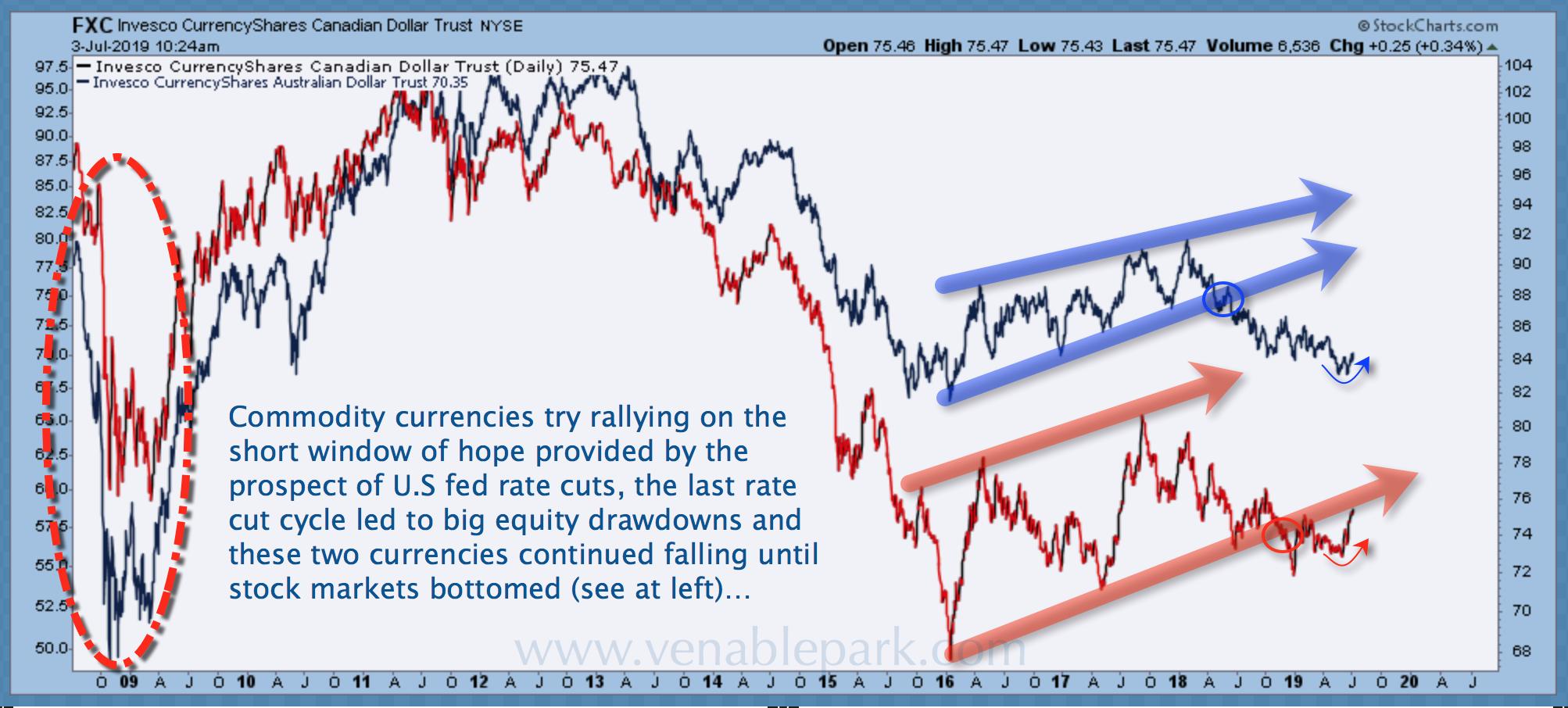
As shown in the chart below from my partner Cory Venable, in late 2007 similar patterns emerged as commodity currencies, the Australian and Canadian dollar, initially held up as the US Fed turned dovish, and then tanked with stocks and global demand as the BOA and BOC deployed every monetary tool they had, for years thereafter.  They wish they had the same policy room today, alas they do not.


At the same time, Canadian and Australian households are world record holders for indebtedness–far worse than at the outset of either of the last two US recessions.

We can hope for unprecedented decoupling from the US dowturn this time, but the odds aren’t compelling.

Posted in Main Page | Comments Off on Loonie and Canadian stocks historically follow US rates lower





