
Loose lending standards are the cancer not the cure

The Bank of Canada (BOC) last week flagged the fragile nature of highly indebted Canadian households and said 42% of households would struggle to refinance their mortgage if home prices fall 20%.  While mortgage and real estate brokers are calling for a re-softening of lending standards in the face of housing weakness, BOC head Stephen Poloz said he does not support such ideas.  Since record debt is already plaguing Canadian households (and businesses), making it easier to add more, is not an idea that rational minds can endorse.  See:  ‘I would frown upon it’:  Poloz on calls to loosen mortgage rules.

A chart of the BOC data below, confirms, as I have mentioned for some time, that the percentage of households with debt above a precarious 350% of income (blue bars) is highest in the most populous provinces–Ontario and BC–where shelter prices rose the most over the past decade. See: Why so many Canadians could be in so much trouble in an economic shock.
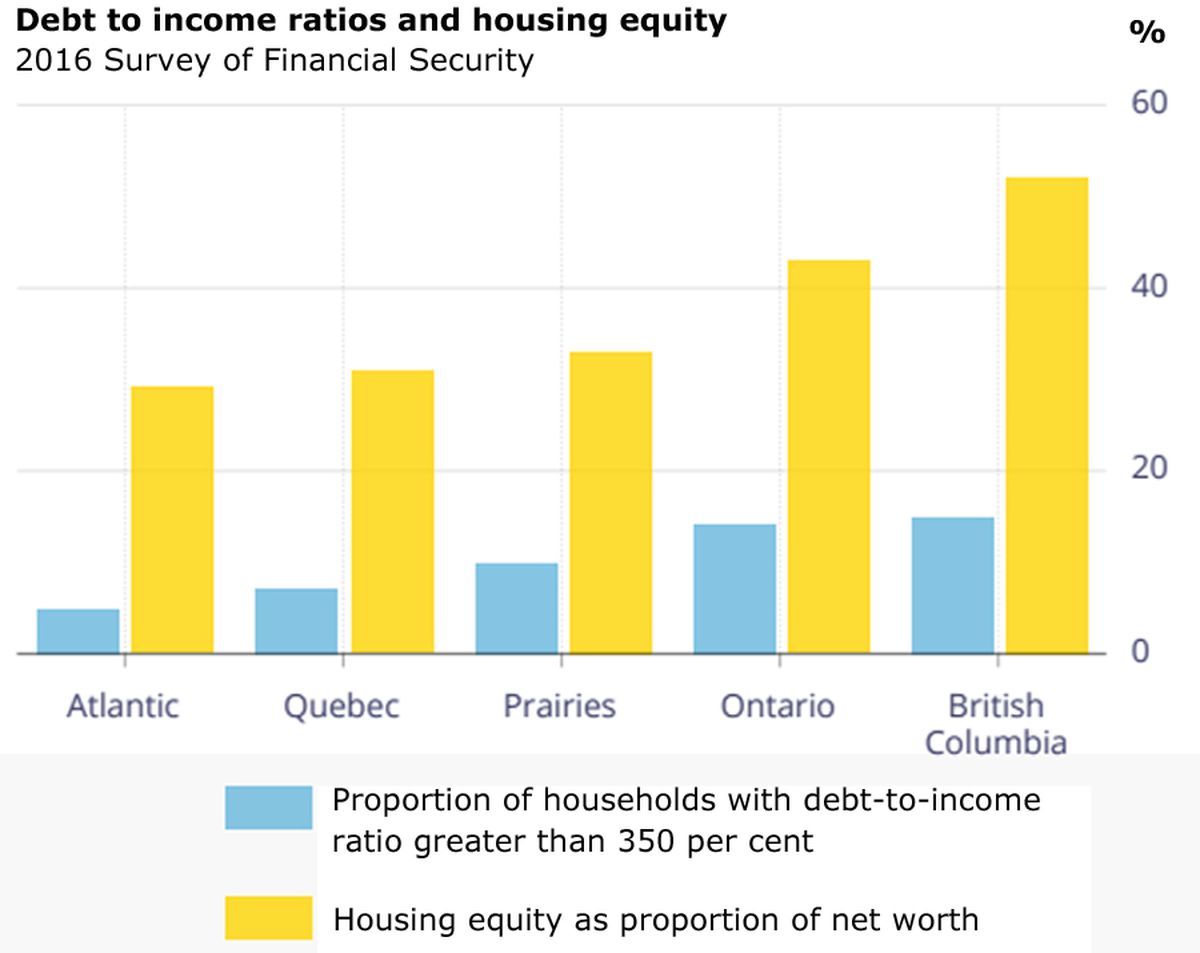
For the same reasons, housing equity makes up 40% and 50%+ of net worth in both provinces (gold bars).  As home prices and related costs leapt, households have funded them at the expense of other savings and investment. This balance sheet–and economy–concentration in real estate serves to intensify negative shocks as property prices can quickly and dramatically retreat and debt levels do not.  There is no quick fix; deleveraging cycles have their own timeline and take back capital from speculators and the unprepared as they go.

Posted in Main Page | Comments Off on Loose lending standards are the cancer not the cure

Australia leads Canada in mean reversion of household leverage bubble

Seeing reality and recognizing self-destructive behaviour in others is usually easier than seeing our own.  Canadians have an opportunity for objectivity in observing Australia.  Many similar factors are weighing down the Australian and Canadian economies today as their shared 2001-2011 commodities boom cycle and 2002-2017 secular real estate/credit expansion proceed through an equal and opposite period of mean reversion in both countries.

In this video, Martin North of Digital Finance Analytics goes over the latest news & data points affecting the Australian Housing Market. This is our monthly segment to dig a bit deeper into what is taking place in our backyard. We’ll also examine the Australian economy and what we can expect moving forward. Here is a direct video link.

Also see the Globe’s article yesterday Bubble trouble: in Vancouver’s housing market, pain has set in.

Posted in Main Page | Comments Off on Australia leads Canada in mean reversion of household leverage bubble

Industrial commodities and the Canadian Loonie

This clip offers a good review of the close linkages between non-exchange traded commodities (driven more by global demand than financial market speculation), the Canadian dollar and the North American economy.

Lakshman Achuthan, COO of the Economic Cycle Research Institute, discusses risks of a global economic slowdown and its impact on commodities demand from Canada. Here is a direct video link.

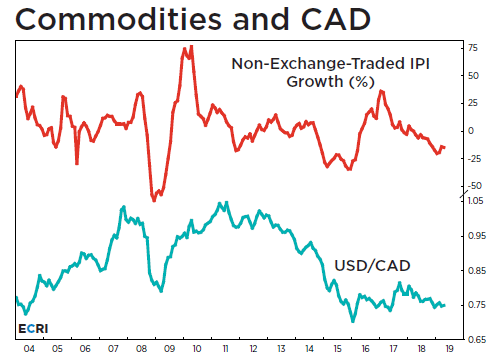
Also see ECRI’s article Industrial Commodities and the Canadian Loonie and their chart showing that non-exchange-traded commodity price growth tends to lead the USD/CAD exchange rate, suggesting the CAD will remain under pressure for the forseeable future:

“This is because non-speculative industrial commodity price inflation is related to the value of the Canadian dollar, which is perceived to be a “commodity currency.”

Posted in Main Page | Comments Off on Industrial commodities and the Canadian Loonie




