
Quantifying ‘wealthy’ and the capital value of income streams

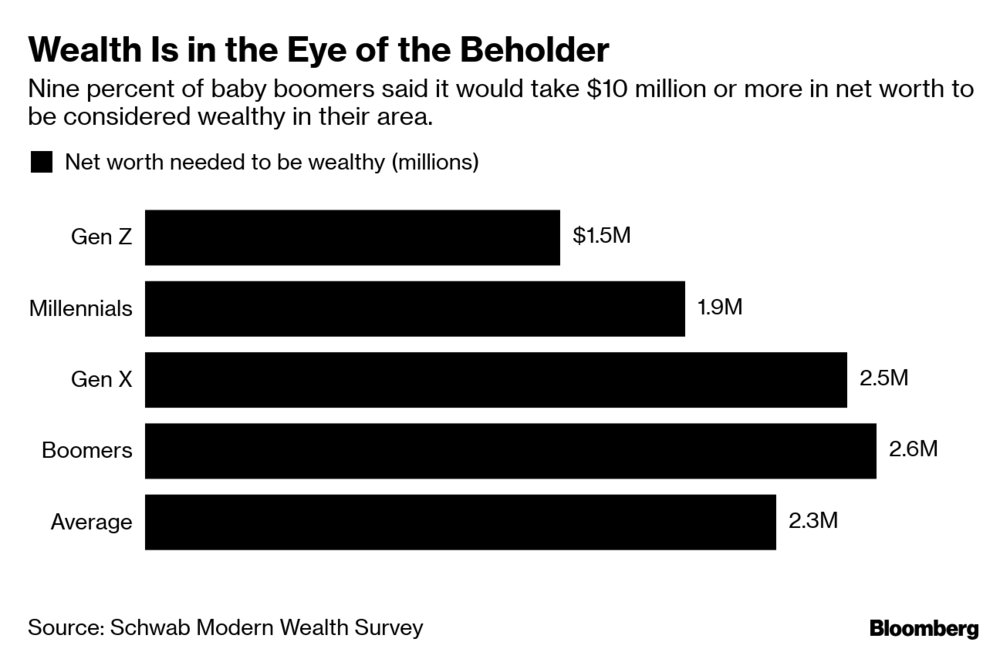
A recent Charles Schwab study asked different age groups to estimate the net worth needed to feel ‘wealthy’ where they live.  Not surprisingly, the amount estimated was higher for those aged 50+ than those in their 20’s–older folks tend to have more carrying costs and obligations.  See:  How much money do you need to be wealthy in America?  But all age groups tend to dramatically underestimate the capital value needed.

As charted below, those age 14 to 24 (Gen Z) estimated net worth (including one’s home) of 1.5 million U$ made one wealthy, while those aged 24 to 38 (Millenials) guessed $1.9 m was needed.  Gen X (those 39 to 53) and Boomers (54 to 73) estimated $2.5-2.6m was the magic number.
Meanwhile, the average household income in the US today is about $60k a year, and $C 70k a year in Canada.  If the average household were to stop working and replace that same level of income from interest earned on capital-secure deposits today (paying 2.5% and less), one would need–outside of any home equity–at least $C 2.8m in Canada, and $U 2.4 m in America.  And yet, few households earning 60 to 70k a year in pre-tax income today would think of themselves as wealthy.

Other studies report that half of the people over age 55 in North America have zero savings for retirement, and the half that does has a median amount of $104,000.  One hundred and four thousand will produce a retirement income of about $2,600 a year.

Ten percent of those over age 50 have a defined benefit pension plan from their work.  This fortunate group also tends to dramatically underestimate the capital value of it.  When I ask people if they or their spouse have a pension, it is common for them to dismiss it as ‘just 30k a year’ or whatever the number.  When I point out that a guaranteed income of 30k a year is like having 1.2 m in savings today, most are surprised.  At the same time, the maximum US old age security income of 34k a year, and maximum CPP and OAS in Canada of 21k a year, also have large capitalized values of about 1.3m and 840k respectively.

Under-estimating the capital needed to reliably produce retirement income has resulted in widespread saving shortfalls over the past two decades.  Trying to fix deficits with higher and higher-risk capital bets has the overwhelming probability of making shortfalls larger over time–and this is precisely what’s happened.

Financial/life plans that assume attainable yields along with pragmatic saving and withdrawal targets have a much higher probability of meeting our goals and needs. The sooner we accept and adopt honest math the better.


Posted in Main Page | Comments Off on Quantifying ‘wealthy’ and the capital value of income streams

Amazon re-purposing malls it helped vacate and widening tax deficits in the process

Two decades of easy credit and hyper-consumption from North American households have encouraged a massive overbuild in the retail sector and commercial real estate.

In the process, retail–which includes on-line giants like Amazon, eBay, big-box chains, and smaller brick and mortar entities–became the largest North American employer accounting for 12% of Canadian, and 10% of total US employment (source:  World Atlas) and 6% of US GDP.  According to the National Retail Federation (NRF), retail supports one in four U.S. jobs or 42 million working Americans.

However, as US household debt peaked in 2006, an aging population and migration to on-line shopping have all worked to reduce store traffic over the last 12 years.  With the credit cycle now contracting afresh, empty retail space is continuing to mount.

In some urban areas, Amazon has been re-purposing the space (that it helped to vacate) into warehouses.  At first blush, this sounds like good recycling of superfluous space and much-needed jobs.  Warehousing employment has risen by nearly 50% since 2008, highly correlated with Amazon’s job growth. The Wall Street Journal  explains further in this direct video link.

By some industry accounts, fulfillment centers pay 26% more than general retail jobs, and warehouse wages are currently growing twice as fast as the national average.  That figure, however, doesn’t jive with independent data reports from the Bureau of Labor Statistics which puts Amazon wages 15% below the average wage in 11 metro areas, at $11.96 an hour–roughly equivalent to the average retail wage.  Analysis by The Economist found that workers earn about 10% less in areas where Amazon operates compared with similar workers employed elsewhere.  According to a report by Policy Matters Ohio, one in ten Amazon employees are on food stamps.  See What Amazon Does to Poor Cities and also Amazon reportedly uses boxing machines to replace people.

One fact is irrefutable:  property taxes to municipal governments are tumbling in this process.  Not only does Amazon typically negotiate decade and longer tax holidays when moving into new locations (see Amazon is thriving thanks to taxpayer dollars), but miles of empty malls have worked to suppress assessed property values and prompt surviving retailers to win 50 to 85% reductions in their municipal taxes too, see After the retail apocalypse, prepare for the property tax meltdown:

Big-box defenders argue that the “sales approach” (what someone recently paid for a similar property) is the best way to determine a building’s value. And in many states, including Wisconsin, sales are supposed to be the first variable in the valuation equation, whenever possible. Therefore, retailers’ lawyers say, a Sam’s Club valued at $11 million is overvalued, because its neighbors are selling for a third of that amount. In a real estate market that’s oversaturated with retail closures, bankruptcies, and vacancies galore, they insist, no one wants a big box store anymore. If you just look at the sales prices, they are often not wrong.

The problem is that taxpayers have invested billions in upfront infrastructure spending on the development of these properties, and continue to be on the hook for providing essential services like roads, water, sewer, fire and other emergency responders.  This along with loopholes and cuts that have allowed corporations to greatly reduce state/provincial and federal income taxes over the last decade, have enabled their record after-tax profits as public deficits have soared.

While migration to online retail seems an unstoppable and more efficient space evolution, the current tax system is not sustainable.  The idea that the promise of jobs is enough to justify years of corporate tax gifts, holidays and ‘free’ resources is antiquated and fundamentally flawed.  The math does not add up.  The resources to support businesses, customers and essential services have a basic funding requirement dependent on reliable inflows.

We don’t need more loopholes and complexity ripe for gaming, just a minimum tax rate levied by each level of government to fund their respective services, implemented for all businesses, regardless of their size, online, or physical operation locations.


Posted in Main Page | Comments Off on Amazon re-purposing malls it helped vacate and widening tax deficits in the process

Designing financial plans for self-preservation

One of the biggest problems with most financial advice/plans is that asset management conversations and recommendations tend to start and end with how to increase risk exposure to savings (and thereby fees for the managers), while dangerously ignoring the fact that human life is already full of great risk everyday.  This is like focusing on the potential top speed of a car without any concern for its safety and soundness or the likelihood of getting to one’s desired destination intact.  Solid finances, that serve to shock-absorb and mitigate life’s daily risks, are built and preserved from the bottom up.  This segment does a good job of discussing some of these issues.

Protecting Yourself Financially for Unexpected Life Events: Debt Free In 30 – A Personal Finance Podcast. Ep. 222 The death of a spouse and divorce bring an emotional burden, but sadly such catastrophic events also create financial consequences. In fact, the death of a spouse or divorce are both common reasons why people file bankruptcy. Without proper financial planning, my clients find themselves unable to cope with existing debt and often take on new debt to pay the bills. Doris Belland, our guest today was left with $400,000 in debt after the death of her spouse. After struggling to repay that debt and rebuild her finances, she embarked on a mission to learn more about how to cope financially with a traumatic event like a death or divorce and now works as a financial literacy educator to help people be prepared when it comes to money. Our advice today is good for anyone struggling with debt or who want to be prepared financially for any unexpected life event including job loss, illness, divorce or the death of a spouse. Here is a direct video link.

Posted in Main Page | Comments Off on Designing financial plans for self-preservation