Reusable packaging: the new (old) big thing

Top consumer brands like Nestlé and Unilever are partnering on a new service called Loop that lets customers buy household items in innovative reusable containers and return them once they’re finished. Here’s how it works. Here is a direct video link.

Posted in Main Page | Comments Off on Reusable packaging: the new (old) big thing

First quarter job cuts confirm economic weakness spreading

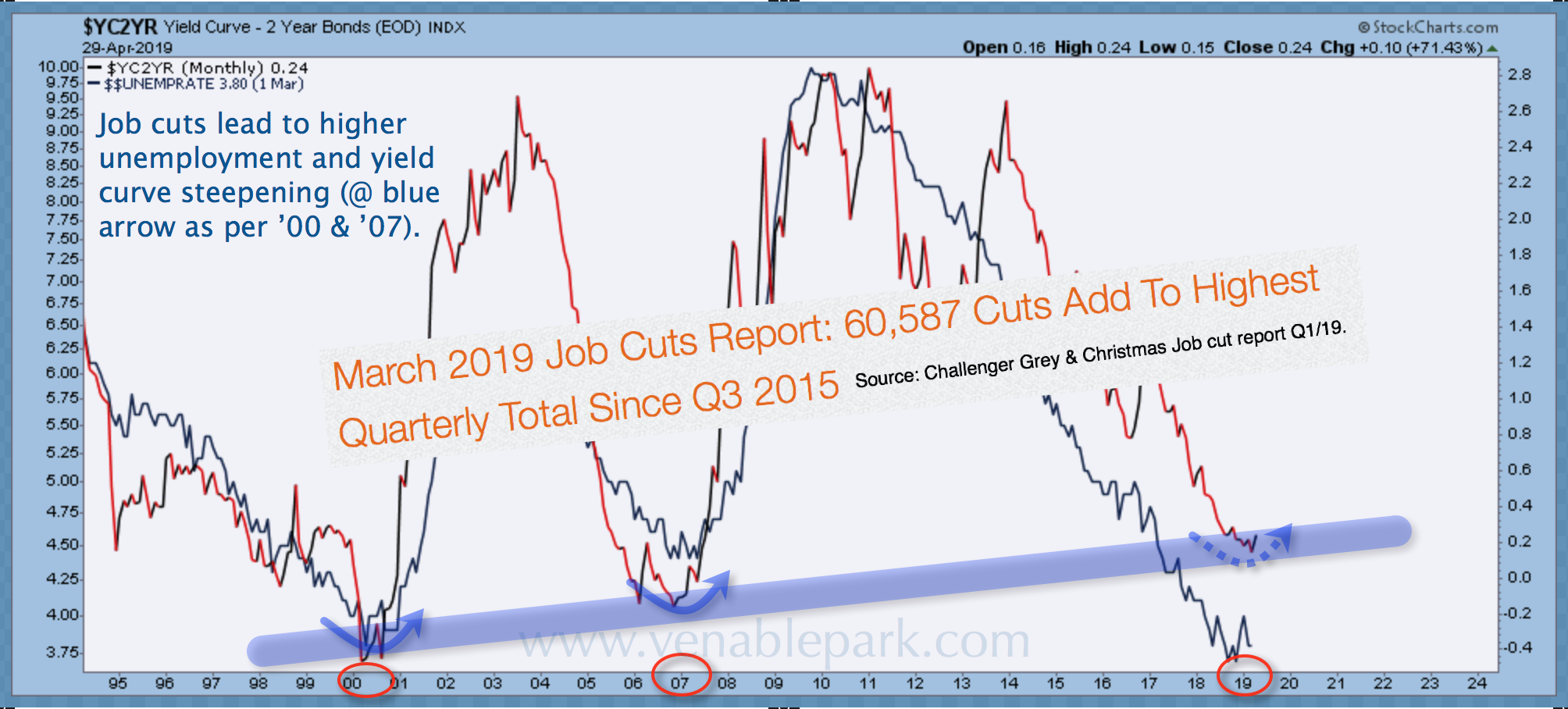
The US Challenger jobs report this week offered some insight into our economic cycle as well as ongoing upheaval in the energy and automotive sector.  US job cuts in the first quarter were 190,410, 10.3% higher than in the final quarter of 2018 and 35.6% higher than the same quarter last year.  This was the highest quarterly total since the first quarter of 2015 and the highest first-quarter total since 2009 (during the last recession).

Notably the economically sensitive and consequential auto and energy sectors were the largest job cutters in the midst of mean-reverting auto sales and “consumer demand for more efficiency”.  See Challenger Q1 Job Cuts Report:

“Both Auto and Energy companies are pivoting in response to advances in technology and consumer demand for more efficiency. Companies in these sectors are attempting to attract talent who can compete with tech companies, like Apple and Tesla, which are beginning to compete in this space,” said Challenger.

The majority of cuts this year are due to “restructuring;” 49,868 cuts have been announced due to this reason. Bankruptcy claimed another 40,218 this year, a 33.8% increase over the first quarter of last year. Another 27,380 cuts were due to plant, unit, or store closings, 104.7% higher than the 13,374 cuts due to closings through this point last year.

“Several indications, such as the number of companies filing for bankruptcy or closing operations, suggest we’re heading for a downturn. The recent proposal to close the southern border adds to the uncertainty and may contribute to more cuts as companies try to adapt,” said Challenger.

As noted in my partner Cory Venable’s chart below, a cyclical upturn in unemployment  (blue line below since 1994) is overdue and appears to be underway since 2018. If that is the case, economic weakness will continue to spread and short-term interest rates move lower in the months ahead, re-steepening the ten minus two-year Treasury yield spread (red line below) as happened heading into both the 2001 and 2008 recessions.

Posted in Main Page | Comments Off on First quarter job cuts confirm economic weakness spreading

Turning food waste into biodegradable plastics

With poor countries now rejecting our mountains of plastic waste, and plastic particles already contaminating water and food systems worldwide, the need to reduce packaging while also producing environmentally friendly plastics is one of the most urgent issues of our time.

While there are many efforts underway, non-petroleum based plastics are still less than 2% of those in use, and many remain chemical, enery and resource intensive while not actually biodegradable.  A lot of people are working on solutions and a team of brothers from California have developed a process they say ticks all of the boxes needed.  See Turning food waste into bio-plastic:

“Full Cycle Bioplastics manufactures polyhydroxyalkanoates (PHA) bioplastic by using organic and cellulosic waste as the feedstock. We take the waste, put it into a modified digestion unit, let everything break down and accelerate it, so we get a very strong wastewater intermediate. We take that liquid form, feed the fatty acids to bacteria, which convert them into PHA, which is basically micro-fat that can be sculpted into various shapes such as packaging or forks. No petroleum, no chemicals involved. It’s an organic process.

…The brothers’ goal is not to eliminate conventional plastic altogether. For some items that are meant to last long, let’s say medical equipment, or the hard shell of a laptop, you probably don’t want to experiment with compost. But it’s especially absurd to use a material that does not disintegrate for hundreds of years for things we discard quickly, such as packaging, plastic bags, and single-use cutlery. Roughly half of our plastic production is for single-use items – and less than a quarter of them get recycled.

Posted in Main Page | Comments Off on Turning food waste into biodegradable plastics