Plant-based demand growing amid slumping retail sales

With financial strain in the masses building, retail sales have been slowing in most countries.  But just as electric vehicle sales are a rare growth star in a world of weakening ICE sales (internal combustion engines), plant-based foods are bucking the trend of weaker food sales.  The trend is clear: where people are offered plant-based options that taste as good or better than the animal-based versions, plant-based demand is growing.  The common theme here is a growing interest in cleaner, healthier options.  See Vegan Beyond Burger Boosts Sales at A&W 10%:

The growth is all down to a few menu changes, including the addition of the vegan Beyond Burger, which launched in restaurants last summer and promptly sold out in several locations on the first day. In Vancouver, some restaurants even reported higher sales of the vegan burger than beef burgers…“I would say that innovation is the biggest driver of our business,” CEO Senegal told Yahoo Finance. 

Plant-based food is also a much-needed hot-bed of innovation and start-ups, like this restaurant in Brooklyn, NY, bringing affordable, healthy food to urban areas where diet-related disease has become an epidemic. Here is a direct video link.
Posted in Main Page | Comments Off on Plant-based demand growing amid slumping retail sales

In other news: ‘Synchronized global growth has collapsed’

This morning we learned that US private payrolls posted another disappointing month in March as the job market continued to slow, and Deutsche bank analysts warn that order backlog growth at Caterpillar–maker of earth movers and construction equipment and global-growth bellwether– appears to be turning negative. Negative back-log growth historically precedes a negative earnings revision cycle by three months, and during these cycles, earnings estimates typically get cut by 45%, and shares fall 40% from the peak.  Deutsche explained that while Caterpillar management has done a solid job, the global demand cycle has turned against them, see ‘Synchronized global growth has collapsed’:

“Synchronized global growth has collapsed, the China Land Cycle is rolling over (and will continue to weaken despite the single positive data point this week), Europe is slowing more than expected and the US is oversaturated with construction equipment,” analyst Chad Dillard said in a note to clients late Tuesday.”

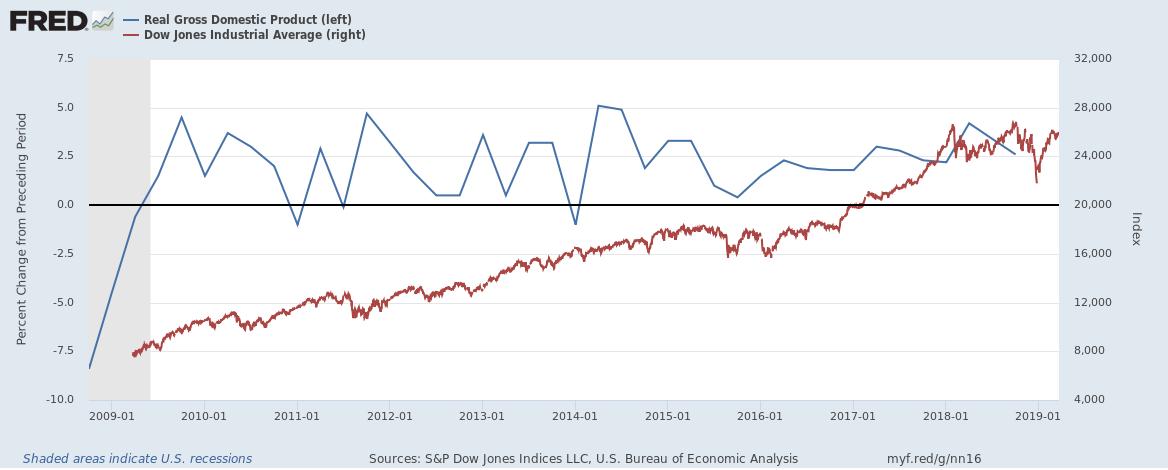
So, while every hopeful headline about an imminent US-China trade agreement or Brexit resolution sparks rallies in algo-driven stock markets, the truth is that countries are negotiating how to share a steadily shrinking pie of global revenues and demand was already tepid coming into this downturn.  The below chart of US GDP growth since 2009 (in blue) confirms the lacklustre trend for the last nine years, as well as the latest rollover since 2018 and the sideways move in stocks since (Dow Jones Industrial Average in red).


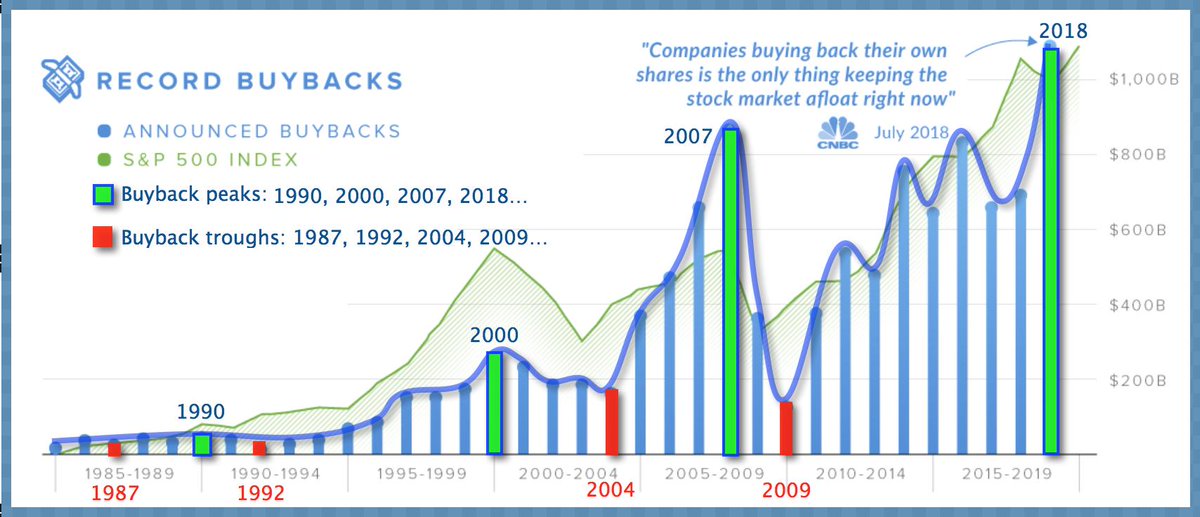
This is particularly noteworthy since the flatline in stocks has happened while US corporations have continued to plough record amounts of borrowed funds and cash flow into the black hole of share buybacks (at record valuations), below in green in 2018 compared with other market tops in 2007 and 2000, and buyback troughs near market lows in 2009, 2004, 1992 and 1987.

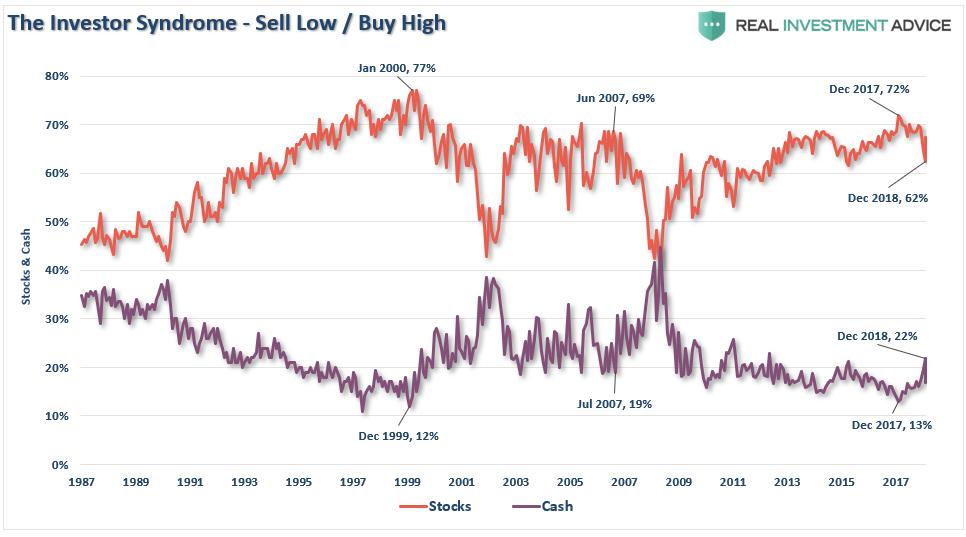
This sustained buying pressure enabled by central bank rate suppression was finally successful in enticing outside buyers back into risky assets late this cycle. As shown below, the percentage of savings allocated to stocks hit 72% (orange below) at the end of 2017, with liquid cash just 13% (in purple, similar to the 12% all-time low in December 1999).

The bottom line is that corporations, individual investors and pensions have never been more exposed to the incoming contraction in global spending and risk markets, and so financial pain will compound as this cycle moves to its natural conclusion.

Posted in Main Page | Comments Off on In other news: ‘Synchronized global growth has collapsed’

Paying for the crazy years: home prices leading economy down

The largest headwind for Canadian households, lenders and the economy in 2019-20 is the same force that worked as a tailwind in the decade before:  real estate.  Naturally, the leaders of the boom years–the greater Vancouver and Toronto areas– are now also leading the deflation cycle. And a popular plan to ‘list this spring’ suggests homes on offer are set to rise significantly in the weeks ahead.

Spring listings come to market as Vancouver already had 12,774 homes for sale in March, 52% more than a year ago and 10.2% more than a month earlier.  Although 8% cheaper than last March, the benchmark composite index price for a Vancouver home is still $1.01 million today–an impossible 12.5x the $80,000 median household income in the city.

The Real Estate Board of Greater Vancouver (REBGV) reported today that a total of 1,727 homes sold in the region in March–the lowest sales total for the month since 1986–down 31% from a year earlier and 46% below the 10-year March sales average.  See:  Prospective home buyers remain on the sidelines in March.

Of course, the REBCV President blames governments for higher lending standards and new taxes that deter speculation, rather than the un-affordable prices and the decade-long credit party that burdened the nation with debt servitude that’ll take years to alleviate.

Canada is a stand out in this problem, but we’re not alone.  According to Knight Frank, a London-based real-estate consulting firm, inflation-adjusted home-price gains have significantly outpaced income growth over the last five years in 18 of 25 world cities.  See:  Affordable housing crisis spreads throughout the world.

Now as prices fall, sellers tend to hold high and hope for a rebound.  But new buyers have every reason to wait and watch as prices come back in line with long-term affordability metrics.  Paying for the last ten years of crazy is going to take some time.

Posted in Main Page | Comments Off on Paying for the crazy years: home prices leading economy down