Government bonds offer a rare shelter in bear markets

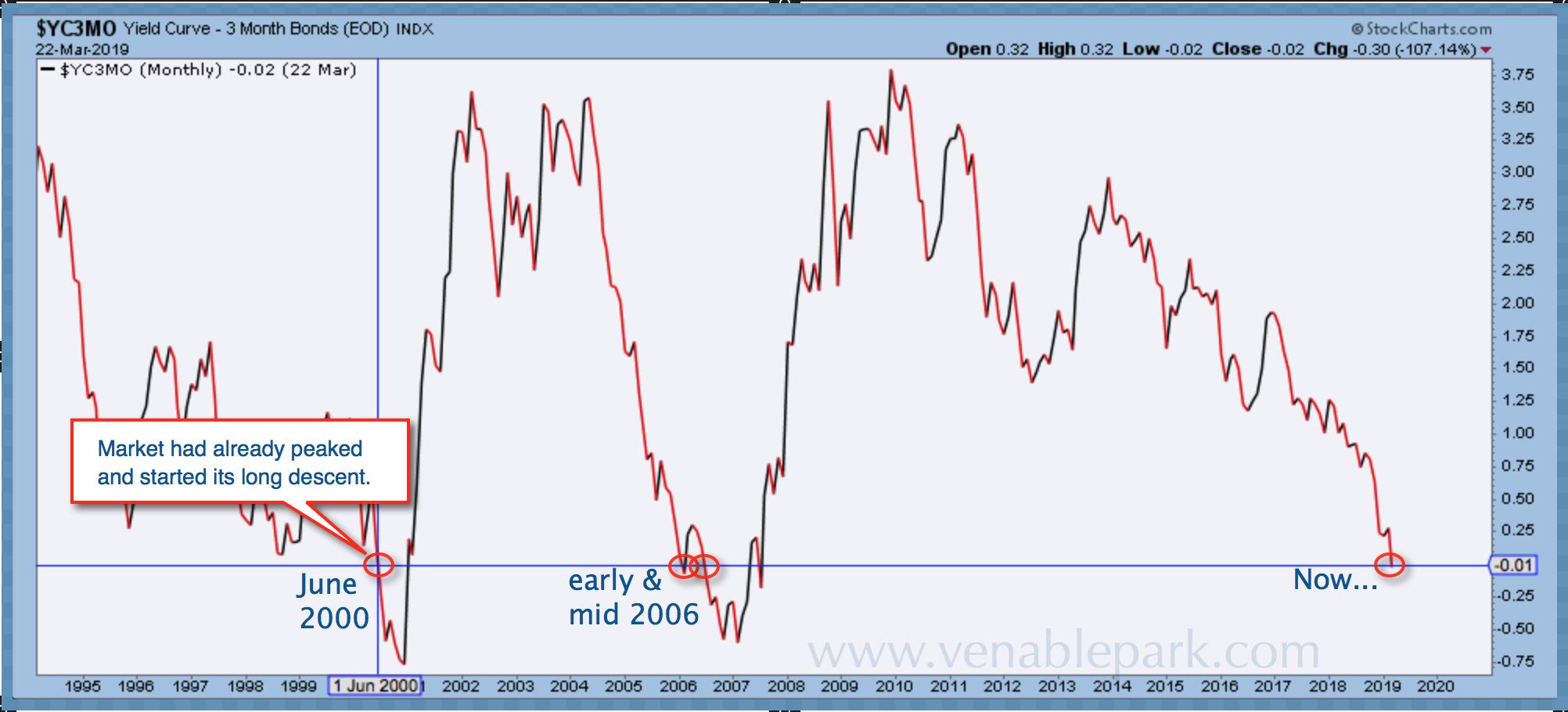
On Friday, markets were spooked when the yield on the US 3-month treasury bill rose to 2.44% while the 10-year treasury yield moved below it to 2.38%.  Since investors normally require higher yields for loaning money over longer terms than shorter, this ‘inverted’ yield spread signals a belief that the economy is heading south, and central banks will soon move to cut their short-term bank lending rates to prod more borrowing.

Risk-sellers and long-always financial managers don’t like to talk much about yield curve inversions because as shown in my partner Cory Venable’s chart below since 1995, when this spread goes negative, bear markets for corporate bonds and equities have followed.

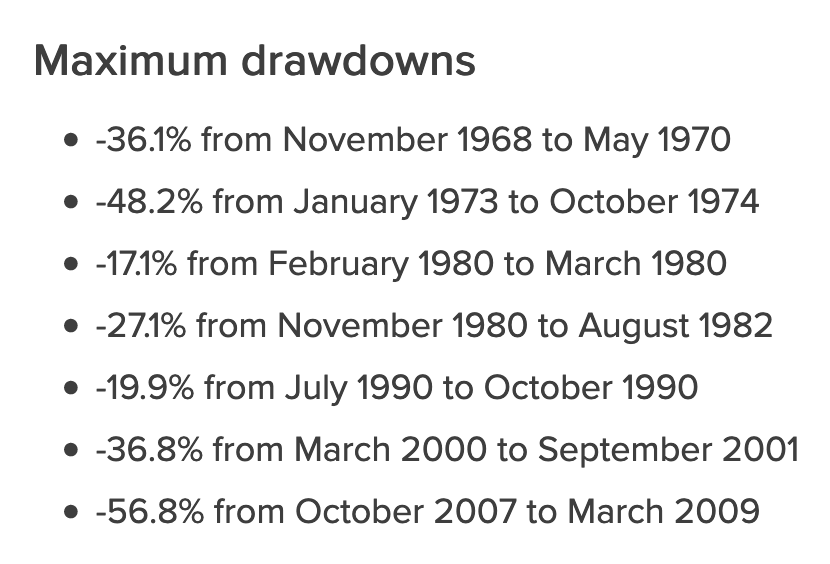
As shown in this table from Charles Schwab, other episodes since 1968 have also marked large in coming loss cycles for stocks (below shown for the S&P 500).
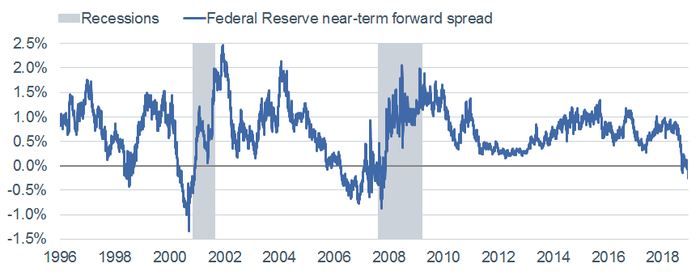
In June 2018, US Fed economists presented a paper highlighting that inversions between the current 3-month yield and the implied forward 3-month yield 18 months from now, is an even stronger indicator of incoming recession than the more commonly followed 3/10 spread.

As noted by authors Engstrom and Sharpe, when negative, the market expects monetary policy to ease in response to the likelihood or onset of a recession.   As shown here from Charles Schwab this spread is today also at a level of inversion last seen in 2008 and 2000.

Perhaps this time is different, but those with savings to lose should be very defensive here.

In general, government bonds or treasuries are little used or explained by mainstream financial types because capital in them usually pays advisors/managers lower fees than allocations to corporate securities, and few have developed any expertise in how to buy and sell them.  But treasuries are where institutional money hides when other markets and economies are faltering, so they tend to not only preserve principal and pay their interest coupon, but also rise in value as other assets tank.  This makes them one of the few valuable holdings in present conditions.

This clip courtesy of the Wall Street Journal offers more education on the subject.

Amid a shaky marketplace, investors are eyeing the yield curve for signs of economic stability. History shows that when the yield curve inverts, a recession may soon follow.  Here is a direct video link.
Posted in Main Page | Comments Off on Government bonds offer a rare shelter in bear markets

WWF: Plant diversity key to health for humans and the planet

The World Wildlife Fund notes that a 60% decline in wildlife populations since 1970 proves that working to protect animals is no longer enough to save them. We have to reverse the forces driving habitat loss and a huge part of that is coming from how we are eating:

  • 75% of it’s now from just 12 plants and five animal sources.
  • Nearly 60% of plant-based calories in most diets are from just three crops — wheat, corn and rice and we are plundering the earth’s natural biodiversity to grow them.
  • Meanwhile, diet-related illness are plaguing our population and bankrupting sick care systems with one third of our kids now headed for obesity.

The new report from WWF and Knorr called Future 50 Foods reminds of 50 diverse, nutritious and affordable food types that most are overlooking, and why it’s essential we evolve our eating habits to sustain our environment and feed the growing global population.  These are foods that humans have always eaten, but most of us have forgotten what they look like and how to prepare them.  If we’re going through the effort of cooking, we might as well make food that’s delicious and health enriching, right?

Adopting new-old eating habits is a win-win-win because plant-rich diets are best for us, the earth and our taste buds–these are mind-blowingly delicious foods to eat.  As the report explains:
“What’s exciting about this is some of the biggest issues we face – climate change and human health – are coming together and the solutions are deeply aligned…What’s good for us is also better for the planet… consumers can just as easily drive the solutions as the problems. And don’t worry if you’re not familiar with foods like fonio grain or salsify root. You can start by cutting back on meat and eating more beans.”

Posted in Main Page | Comments Off on WWF: Plant diversity key to health for humans and the planet

Harbour Air converting all seaplanes to electric

Taking a float plane between Vancouver and Vancouver Island is a very memorable Canadiana experience.  Moving about that magnificent backdrop with quiet, non-polluting electric engines, is next level awesome.  See:  Harbour Air to convert all its seaplanes to electric for the first all-electric airline:

“Seaplane operator Harbour Air and electric aviation company MagniX have announced plans to make Harbour Air’s entire commercial seaplane fleet all-electric.

Being billed as the “world’s first all-electric airline,” the partnership will see MagniX convert all of Harbour Air’s more than 30 seaplanes to electric. The planes will be powered by MagniX’s magni500, a 750-horsepower all-electric motor.

Harbour Air operates the largest all-seaplane fleet in North America. It flies 12 routes in the Pacific Northwest in Canada and the U.S., from cities like Seattle, Vancouver, and Victoria and smaller destinations. The company says more than 500,000 passengers fly on its 30,000 commercial flights each year.”

Producing different types of renewable energy to feed the grid and charge electric vehicles and other equipment is a massive growth area that is already creating tons of good jobs.  This is all much needed as the world pivots away from destructive models and technology toward new investment-worthy themes.

Posted in Main Page | Comments Off on Harbour Air converting all seaplanes to electric