
The push back from smartphones and return of attentive humans

The Canadian Press is reporting today that Ontario will issue a directive this week to ban cell phone use in public school classrooms starting in the 2019-20 school year. This is a positive development in the quest to replace smartphones with attentive, present people.  Anyone who travels will know that cell phone obsession has become a worldwide problem.

As I discussed here last year, not only is compulsive smartphone use working to make workers less productive and increase fatalities from distracted driving, there is also growing evidence linking screen time with rising anxiety and depression among users, especially young people.  See The Risk of Teen Depression and Suicide is Linked to Smartphone Use.

As with all things, adults must exhibit personal discipline themselves if they are to help lead young people to healthy habits.  This is difficult when many adults are not yet managing their own use productively.  More awareness and effort is needed.

The first step to recovery is acknowledging one’s vulnerability and risk of abuse.  Many are now also taking the next step and moving back to cell phones with limited or no internet or social media browsing ability.  See: Smart phone addicts’ new tactic to break their habit:  buy a second phone:

“Smartphone-fatigued consumers are renegotiating their relationships with their devices. A growing contingent is embracing a new crop of minimalist phones, priced around $300 to $350, to wean themselves off premium models that keep them constantly connected.

Some are concerned that social media-usage is robbing them of interpersonal connections and making them less attentive. Others are annoyed by recent data privacy scandals at large internet and social-media companies—or they want the simple practicality of carrying a smaller phone.”

This is good news for the rise of human consciousness, personal interaction and intellectual development.  It’s bad news for social media and technology companies that have grown to dominate and influence an unhealthy amount of human life over the past decade.  Business models built on abusing trust and personal information while manipulating addictive impulses are moving out of favour once more–this is encouraging.

Posted in Main Page | Comments Off on The push back from smartphones and return of attentive humans

The indefensible predatory business of payday loans

The Consumer Financial Protection Bureau (CFPB) is a US government agency that was founded in 2011 with the laudable mandate of making sure banks, lenders, and other financial companies treat consumers fairly. In practice, however, it has been infiltrated and directed by lobbyists from the very financial sector it is meant to oversee.

A case in point, the CFPB has acknowledged that two-thirds of payday lender customers could not afford to repay the loan when they received it and if the “ability to repay” test is required, then nine out of every ten payday loan storefronts would shut down.

Recent journalist investigations revealed that the CFPB met with and relied on the payday lending industry before it gutted consumer protection rules in this area and then lied about the meetings. Moreover, according to the reports, the CFPB has relied on at least two industry-purchased reports masquerading as independent academic studies (classic industry practice).  See more in Dennis  latest article:  Keep industry insiders out of the payday loan rulemaking process.

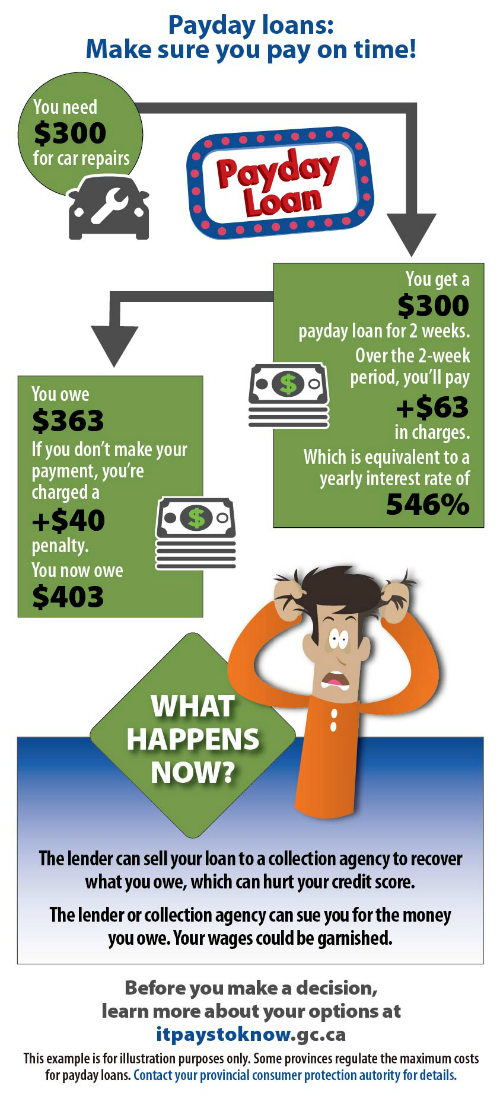
Predatory loan franchises have also been doing a booming business in Canada over the last decade.  And as shown on the left, the government of Canada’s website warns that payday loans equate to an annual interest rate of 546%.

The obvious question is how such franchises are allowed to operate in a country where usury laws define (compound) annual interest rates above 60% as criminal?

The answer is that in 2007 the Federal Government amended the Canadian Criminal Code (s. 347.1) to exempt payday loans from criminal interest rate limits where provinces enact legislation to govern them. For their part, the provinces have universally failed their duty of consumer protection in favour of profits for predatory lenders.

There is little wonder then that consumer trustees are reporting 4 in 10 bankruptcies in Canada today involve payday loans.  See: Can I file bankruptcy for payday loans in Canada?

We will not be able to rebuild the financial strength and stability in society and the crucial middle class until we stop letting financial predators strip-mine vulnerable people and leave social wreckage for taxpayers to underwrite.  We must stop enabling criminal interest collectors as legitimate business operations; we cannot afford to continue.

Posted in Main Page | Comments Off on The indefensible predatory business of payday loans

Property markets and the road back to affordable shelter

The latest stats on the Vancouver property market are showing encouraging signs of necessary mean reversion. See Vancouver’s cooling house market shrinks price of a house by $1-million:

  • The average price of detached houses sold in Vancouver has fallen 33% to $2m in February from $3m in October 2017–more than $1-million in the last 16 months.
  • Total residential sales last month in Greater Vancouver declined 32.8% compared with a year earlier to 1,484 transactions.
  • Total listings for detached homes, condos and townhouses in the region have risen 48% over the past year to 11,590 properties for sale in February (Real Estate Board of Greater Vancouver (REBGV)).
  • Within the City of Vancouver, the average price for detached properties sold last month declined 22% compared with February 2018.

While owners watch hundreds of thousands in notional market value fall off their balance sheets, lower prices are needed to restore rational valuation and affordability metrics in an area that has been an epicentre of unproductive speculation and money laundering over the past decade.

Tighter lending standards and the recent speculator’s tax are catalysts at work here. Under the new rules, if a foreign owner leaves their property vacant, Vancouver can tax the owner for 1% of the property’s assessed value and the province can claim another 2%.

Another factor is stepped up efforts by the Chinese government to stem outflows of domestic capital to foreign land banks. See more on this in China’s Bid to bring cash back home will impact these three places.

On the upside, owner’s of previously empty properties are now opting to rent so they can avoid the speculator’s tax and the Vancouver area is seeing a rise in more affordable housing options. This is all part of the road back to restoring some sanity for shelter costs.

The global credit bubble of the past 15 years, enabled prices and rents to soar along with homes that are irrationally large and expensive to maintain. I have long thought that this, coupled with the natural impulse of aging boomers to downsize overhead and upkeep, would culminate in a correction phase where McMansions are turned into multi-dwelling units for young and old. It seems that is underway now, see Why are hundreds of luxury mansions being rented for cheap? Similar trends are spreading in other over-valued property markets as well.

In Vancouver, where sky-high real estate prices have made ownership impossible for many, it’s suddenly not too difficult to live like a king.

Last week, author and housing advocate Kishone Roy found approximately 800 Vancouver-area mansions for rent on Craigslist for prices well below what they would normally command.

Many of the mansions have ocean views and offer luxury amenities such as swimming pools, in-home cinemas, built-in saunas and wine cellars. In several cases, the homes are fully furnished. Here is a direct video link.

Posted in Main Page | Comments Off on Property markets and the road back to affordable shelter




