High-end property inventories leaping

It is typical of dramatic price appreciation cycles, for people to believe that those with the means to buy expensive assets are somehow impervious to credit cycles, and will continue to buy and not sell, regardless of stresses that may impact the masses.

Until recently, for example, it was common for people to say that Vancouver and Toronto realty prices were unlikely to decline because the cities were world class and high-end buyers don’t care about mundane things like down payment requirements, interest rates and taxes.  History attests that this just ain’t so.

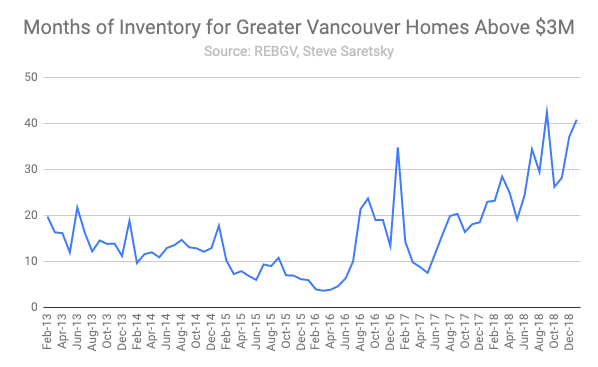
To the contrary, expensive properties are generally the most illiquid and vulnerable to a correction as buyers retreat and owners look to raise cash and downsize costs.  Case in point, see:  Vancouver’s luxury home market accumulating a logjam of inventory:

 As is typical in all housing corrections, luxury properties are the first on the chopping block while also suffering the steepest of price discounts. This is ultimately the result of a much smaller buyer pool that, when it shrinks, creates liquidity constraints. As the housing cycle turns, and liquidity dries up the luxury market becomes extremely prone to volatility and wild price gyrations. As a result, bank credit also seizes up, further hampering liquidity when it is most needed.

It appears this phenomenon is playing out in the Greater Vancouver housing market. With global growth slowing, and Chinese capital controls becoming even more severe, luxury home sales have ground to a halt.

As shown below, at the present rate of sales in the $3m+ price category, the Vancouver market now has 41 months of inventory today compared with four months worth at the peak of the buying frenzy in early 2016.
As always, the cure to high prices ends up being high prices, and it’s very likely that this much overdue correction phase is only just begun.

Posted in Main Page | Comments Off on High-end property inventories leaping

Central banks and debt make global downturn worse

Steen Jakobsen, chief investment officer at Saxo Bank, discusses global growth momentum and the possibility of a recession. Here is a direct video link.


Posted in Main Page | Comments Off on Central banks and debt make global downturn worse

Two decades of monetary largesse are the harm not the cure

The US Fed has led the world in 20 years of progressively more extreme monetary interventions to inflate debt and asset prices at all costs.  Each time that US stock markets have dropped more than 10%, central banks have moved to ‘ease’ volatility with more and longer monetary ‘accommodation’.  Nevertheless, in both 2001 and 2007, despite slashing some 5% off benchmark interest rates, recessions arrived, and stock and corporate bond prices fell by half.

It took a drop of just 14% in the S&P 500 in 2018 for the US Fed to switch from telegraphing rate hikes through 2019, to promises of further patience and pause.  Not satisfied, many market participants are already calling for central banks to abandon ‘normalization’ goals and switch back to cutting rates and ‘supporting’ asset buying once more.  See The Fed’s “First do no harm” policy is harmful from Economic Cycle Research Institute’s Lakshman Achuthan to wit:

“Removing the risk of a recession and sparking a renewed acceleration in economic growth – never mind reigniting inflation pressures – will require much more than the doctrine of primum non nocere, meaning first, do no harm. The Fed would actually need to start a rate cut cycle.”

At the same time, Achuthan acknowledges that the global slowdown now underway is an overdue part of the cycle, set to continue for many months, no matter what the Fed does next:

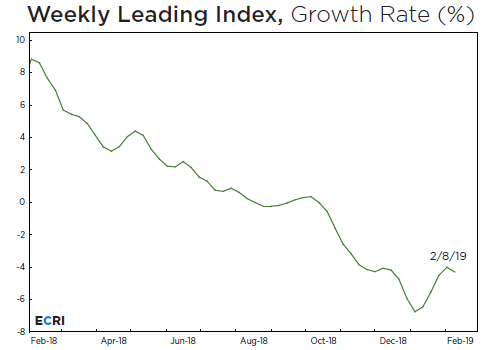
The problem is that, regardless of what Powell has said, the cyclical drivers of economic growth continue to wind down, meaning that the slowdown is set to continue. That’s the objective message from the same array of leading indexes that we used to predict the current U.S. economic slowdown in the context of a global slowdown last year. A case in point is the publicly available U.S. Weekly Leading Index, whose growth rate remains in a cyclical downswing.

The fact is that in always wanting to accommodate further debt and risk-taking, central banks have inflicted great harm on the world economy, financial strength, and stability.  Politicians and sales firms have urged them to do it, to be sure, and consumers commonly fail at personal discipline, but the actors at central banks are supposed to be the impartial, prudent experts working to smooth economic cycles so they are less damaging as a whole.  In this, they have failed utterly.

I have zero faith that central banks will change course now.  I also understand that the downcycle is due even as central banks attempt to ease further in the months ahead.  Policymakers have failed in their mandated duties of care and control.  Like children who realize their caregivers are not up for the task, individuals must look out for their own best interests.

Posted in Main Page | Comments Off on Two decades of monetary largesse are the harm not the cure