
What went up the most is coming down the most–bank on it

As I have explained frequently, asset prices that went up on the same low rates, lax lending, speculation and foreign capital flows the past decade are now coming down together all around the world.  In the process, the assets, markets, cities and holders that rose the most, now have the most to lose–it’s pretty straight forward.

What makes this cycle likely to be more damaging than average, is the historically rare combination of real estate, corporate securities and many collectibles moving through synchronous decline all at once.

In addition, the world has never been more indebted and levered on falling asset prices.

The bonus will be clearance sales across the board for those with cash waiting to buy; the shock will be the loss of net worth by present holders.  Recall that Toronto and Vancouver areas came into this downturn as two of the top four most overvalued realty markets in the world.  That said, It’s not just Toronto and Vancouver:  a synchronized global slowdown is here:

What’s interesting is that the slowdown seems primarily to be affecting “world class” cities — those that attract large numbers of people and money from abroad, especially the wealthy…

In a report last year, the IMF noted that house price trends from Toronto to Sydney to London are becoming increasingly synchronized. The “global factor” now accounts for a third of the house-price change in a city like Vancouver, it estimated.

Posted in Main Page | Comments Off on What went up the most is coming down the most–bank on it

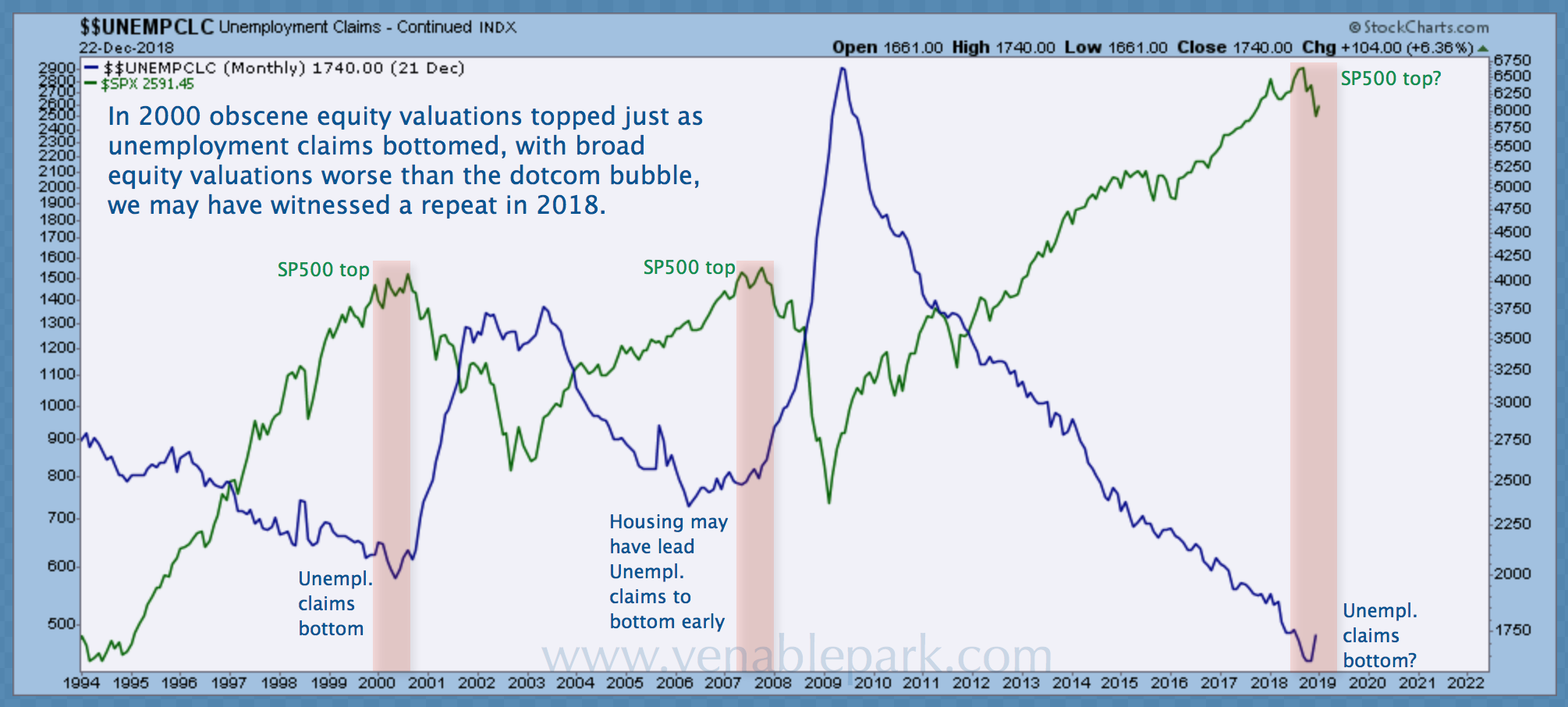
Please note, unemployment lows go with stock market tops

While the financial sales force likes to declare low unemployment as bullish for the economy and stocks, my partner Cory Venable offers the below chart to remind of the negative correlation between US unemployment cycles (in blue) and S&P 500 price cycles (in green) since 1994.  Word to the wise:  both lines are ripe for mean reversion, as they did in the last two recessions (pink bands); i.e., unemployment headed up and stocks down.
Thanks to destructive incentives that encourage people to save little and borrow and spend too much, along with harmful advice from the financial industry, most workers have debt and little savings to fall back on when unemployment moves back up.  What savings most do have is generally funnelled into baskets of stocks and corporate bonds that tank in value just as their owners need cash to pay their bills.  Forced liquidations during the downturns then amplify financial turbulence and loss for individuals and the economy.

It doesn’t have to be this way.  Market cycles are a regular recurring part of human life.  Proactive planning and risk management are critical if we are to thrive through the cycles of our finite lifespans.

Posted in Main Page | Comments Off on Please note, unemployment lows go with stock market tops

Overdue insolvency cycle underway in Canada

Even though the Bank of Canada paused in hiking its policy rates in December and yesterday, many Canadians are already contending with a doubling of interest rates on their unsecured lines of credit in the past year. At the same time, realty prices are falling,  making it harder to refinance unsecured debts into a lower rate mortgage on their home.  Not surprisingly, insolvencies are rising sharply.

Canadians are increasingly feeling the pinch from rising rates, with insolvencies back on the rise. For more on how consumers can avoid falling into dire straits, BNN Bloomberg spoke with Scott Terrio, insolvency trustee at Hoyes, Michalos and Associates. Here is a direct video link.


Posted in Main Page | Comments Off on Overdue insolvency cycle underway in Canada




