Highly coupled global growth engines slowing all together

As shown below, just released German industrial activity fell for a third month in November 2018 and raised the risk that Europe’s largest economy is slipping into recession. See: Trade hopes trump dismal German data for European equities.

At the same time, the Chinese economy–the world’s second largest and another important barometer of global demand–is also weak. China’s industrial output in November grew 5.4% from a year ago — the slowest pace since January to February 2016.  See:  China just reported ‘ugly’ economic data.

While China’s officially reported GDP growth rate was 6.5% in the third quarter of 2018, this was the slowest since February 2009 during the last global recession.

Other on the ground indicators, like consumption tax revenue fell 71% in November (beside in red) and passenger-car sales (in yellow), fell for a 5th straight month, as disposal income per capita (green) has flat-lined and the off-balance sheet debt of local governments and corporations has soared.  See:  Chinese retail apocalypse now?

Similarly in North America, even with record employment levels (at cycle highs) and still historically low-interest rates, consumer spending has weakened, with home and auto sales declining since 2017.  See: More people are going broke in Canada, as interest rates rise and  Housing Market is canary in interest-rate coal mine.

There is one common theme connecting all of these countries and trends:  years of ultra-low interest-rates and flat wages among the masses, enabled by the same reckless central bank/government/corporate policies have rendered a highly interconnected financial fate dependent on the impossible presumption of perpetually low rates, rising debt and rising corporate profit margins, ad infinitum.

This was always impossible even as it managed to continue far past rational expectations.  But now, debt-financed spending that rose everywhere all together is also falling everywhere all together.  Denial is dangerous; no one should be surprised.
Posted in Main Page | Comments Off on Highly coupled global growth engines slowing all together

Pomboy: Fed could cut rates by summer and end QT before then

Many good observations in this segment.

MacroMavens President Stephanie Pomboy on Federal Reserve policy, the state of the U.S. economy. Here is a direct video link.

Posted in Main Page | Comments Off on Pomboy: Fed could cut rates by summer and end QT before then

Irrational exuberance comes with payback phase baked in

Years of undisciplined monetary and fiscal policy have enabled the worst financial habits and highest debt abuse the world has ever known, and the payback period is now weighing on the world economy and asset prices.

International Monetary Fund executives are warning that the world is unprepared for the slowdown, and yet it’s here all the same–because reckless behaviours have earned it.

The US central bank has tightened its policy rate 900% in the last three years, but at just 2.5% today it meets this cyclical downturn with less than half its historical rate-cutting room on hand.  Also, central bank balance sheets globally have already swapped cash reserves for trillions in assets purchased to prop up prices over the past eight years.

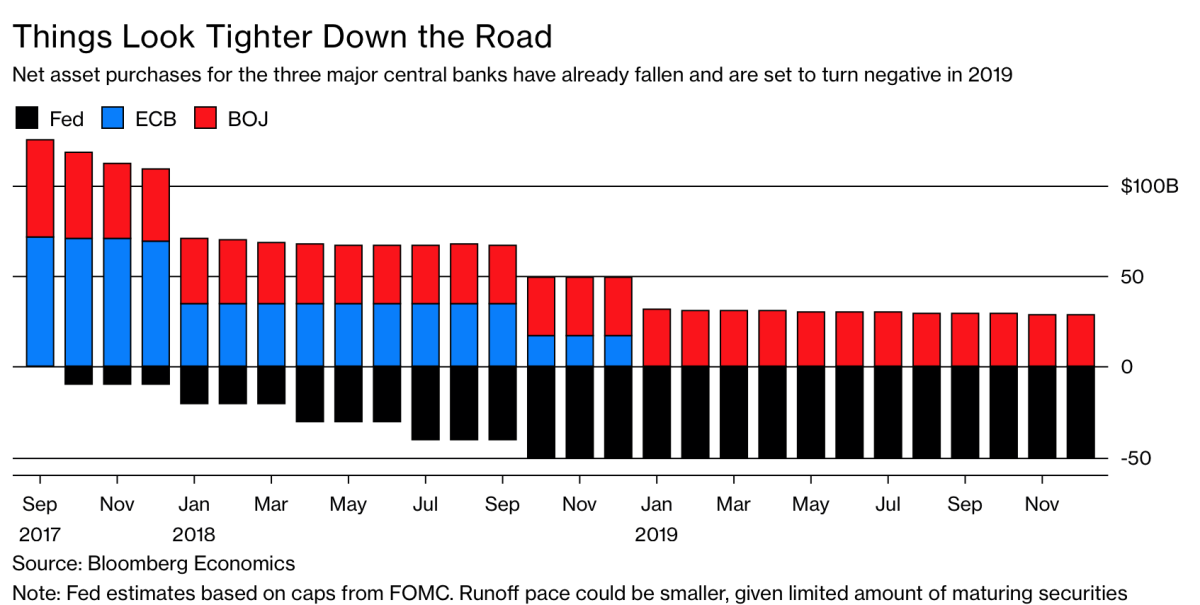
While the US Fed, ECB and Bank of Japan were collectively buying well over $100 billion in assets a month a year ago, now they withdrawing about $50 billion from global markets monthly as shown below.  See:  Stock market investors, it’s time to hear the ugly truth.

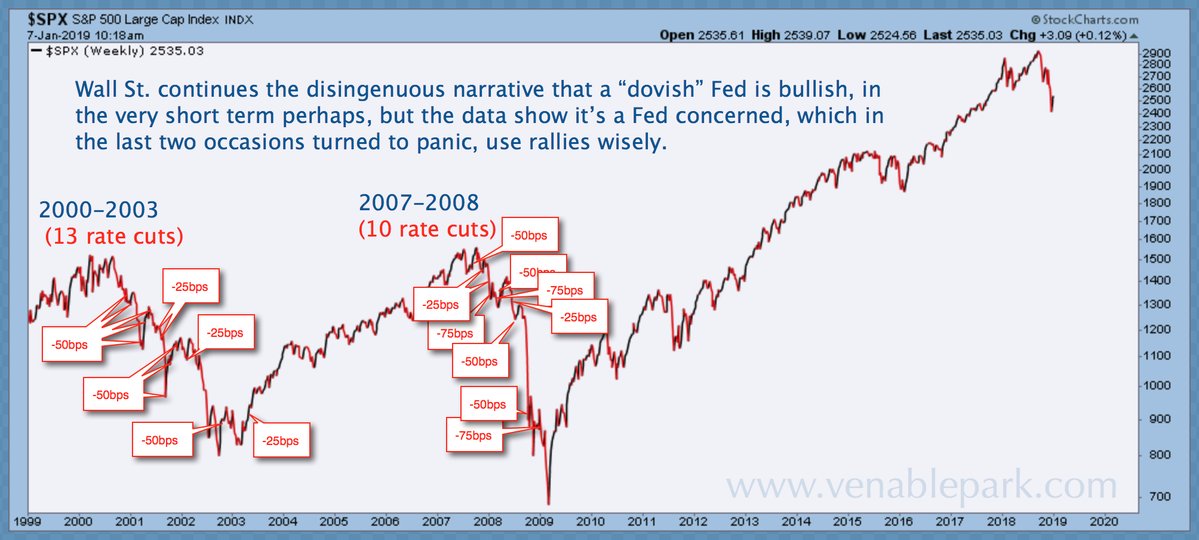
For those those who believe that central banks remain all-powerful and that a switch back to looser policies in the months ahead will be enough to stop asset prices from deflating, my partner Cory Venable offers the below chart of the S&P 500 since 1999 (20 years of the most notorious ‘easy money’ in history).   He notes that while rate cuts start when stock markets decline, they do not prevent the losses.

Even when the US Fed slashed more than 5% off policy rates in the last two declines (compared with the minuscule room they have today), stocks lost 50%+.  Bear markets typically bottom months after rate-cutting cycles have been in process for several quarters, and so far, this cycle, central banks are still in a self-proclaimed hiking mode.

It is important not to lose the plot here:  economic downturns start because demand cycles are driven by credit and credit expansions cannot continue indefinitely any more than trees can grow into outer space.  Market bottoms come not because rates are suddenly lower, but because sentiment that was far too optimistic at the top becomes far too pessimistic near the bottom and asset prices finally fall to levels that attract prudent cash investors once more.

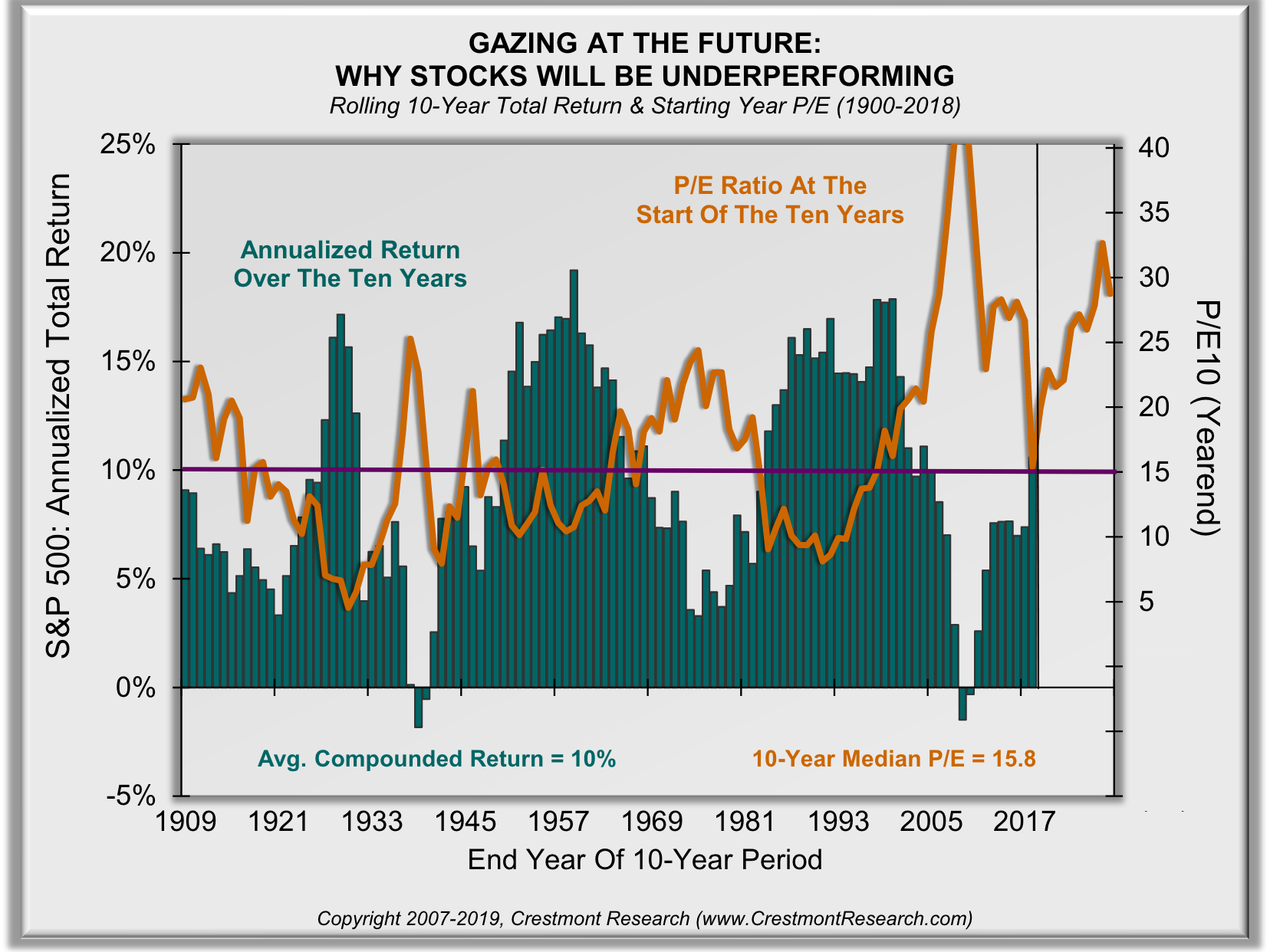
It is also critical to understand that as shown in the chart below from Ed Easterling at Crestmont Research, the very few times that stocks have been so dramatically over-valued as today (orange line below) the total annualized returns (including dividends) from those levels were negative for a decade after that (in green).  See Serious Implications:  forecast skew over the next decade and Gazing at the future:

The starting valuation matters! When P/Es start at relatively lower levels, higher returns follow — paying less yields more. When investors have P/Es that start higher, subsequent returns are lower. This graphical analysis presets the compounded returns that follow over the subsequent ten years based upon the starting P/E ratio. It’s compelling, primarily because it’s fundamental — starting valuations directly impact subsequent returns. From the current above-average valuations, below-average returns are likely to follow for the next decade or longer.


Those who manage their exposure to minimize the correction/loss cycles and preserve liquidity to deploy cash after prices have mean-reverted, on the other hand, can buy in at the best yield and return prospects in decades.

What we decide to do in response to present facts will impact our financial progress for years to come.  None of us are helpless, wise choices are ours to make.

Posted in Main Page | Comments Off on Irrational exuberance comes with payback phase baked in