
Even bear winters should have green spells

As gratifying as it is has been to watch the portfolios we are managing gain in 2018 while everything else is dropping, we should also expect strong counter-trend rallies to keep punctuating the downtrend–for days, even weeks at a time.  That is how bear markets typically move, and mental preparedness is critical.

A change to more dovish language in today’s Fed announcement, or a political tweet on trade, could easily prompt animal spirits to run another lap or two.  That said, interim rallies are likely to be fleeting since the global downturn is so deservedly underway; and like never before, central banks, with still negative real rates and bloated balance sheets, have minuscule sticks to throw at it.

There are no quick Houdini-style escapes from what ails debt-heavy, cash-lite individuals, companies and market participants today.  Payback, write-down periods tend to be hard work–arduous and seemingly relentless.

At the same time, price-discovery has been suppressed for so long, and participants have become so reckless and illiquid this cycle, that selling waves are likely to keep coming longer than anyone thinks possible.

Once those who could be seduced into irrational markets have already bought, only pent-up sellers remain.  That is, at least until prices fall deep enough, and sentiment becomes so bleak, that sober capital finds risk worth-taking once more.  We’re not there yet, but the cycle is definitely moving in the right direction.  Best to stay calm and keep measuring.
Posted in Main Page | Comments Off on Even bear winters should have green spells

Balance sheets should help backstop income cycles

The Keynesian thesis is that central banks and governments can help smooth financial cycles by adding liquidity and enabling spending when downturns come, and then working to rebuild savings and reduce debt through the economy when times are good.

Suffice to say, for many years now, politicians and policymakers have focused on just half of this equation, increasing debt to support spending, but not the opposite.  Thanks to this destructive mindset, today we have households, corporations and governments who pay out all and more of their income during good times, so that they have little savings and high levels of debt when times turn rough.

Moreover, any savings most do have is mindlessly funnelled into securities, real estate and collectibles at every price, under the auspices of ‘investing’, with little care for the critical importance of maintaining principle security and liquidity.

Hence, when personal and economic strains inevitably arise, not only are most vulnerable on the income and cash flow side, but whatever savings they do have are held in subjectively-priced assets that fall in concert.  This accelerates the rush to raise cash and sell as prices slide into a self-fulfilling avalanche.  It also leaves few with the ability to buy once prices have become advantageous once more.

Realty, corporate debt, equities and commodities, art and other collectibles–everything that rode the tidal wave of ‘easy money’ up the past 8 years–are now coming back down together.

Holding the bulk of our net worth in highly correlated asset classes is a dangerous way to manage a financial cycle.  While banks and other big corporations may count on taxpayer- funded bailouts for their mistakes, individuals and smaller businesses bear our own financial risk.

Take a look at your balance sheet.  If most of your assets have been falling in 2018, you are structured poorly and vulnerable to unnecessary financial trauma.  It’s not too late to fix that.

Posted in Main Page | Comments Off on Balance sheets should help backstop income cycles

Rajan on the three biggest problems in the Indian economy

India’s nearly 1.3 billion population is running a close second to China’s nearly 1.4 billion in terms of the world’s largest.  Both economies averaged a fast 7% in annual GDP growth over the past decade and both are now weakening.

Even before rising trade tariffs however, lax lending, excessive domestic debt and ‘hot’ investor flows into the country’s property and financial markets since 2008, have left it vulnerable as flows are now retreating.  Meanwhile, a higher US dollar and interest rates have weakened the rupee, ratcheting up commodity prices and debt service costs, which reduces funds available for domestic spending and investment.  A cash crunch is now spreading.  While India’s stock market has outpaced other global markets since 2008, it is now falling with the rest thanks to over-valuation, falling growth and retreating liquidity globally.

The below is an interesting discussion from an Indian perspective on the social and economic challenges facing India which its former central bank chief defines as agrarian distress, the ailing power sector and crisis in the banking system.

Former Reserve Bank of India Governor Raghuram Rajan spoke to NDTV’s Prannoy Roy on a range of challenges in front of the Indian economy today. Dr Rajan said the three biggest problems for the Indian economy today are the agrarian distress, the ailing power sector and the crisis in the banking system. The 55-year-old economist, who was the first RBI governor to not seek a second term in nearly two decades after his tenure ended in 2016, said government interference in institutions could affect both global and domestic investment. Mr Rajan’s comments come amid a row between the central bank and the government over its autonomy. Here is a direct video link.

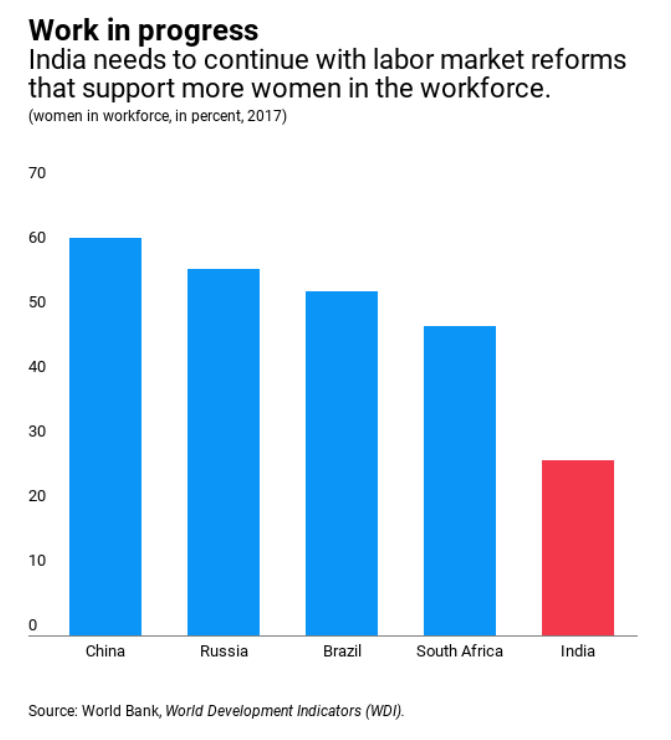
This chart showing low female workforce participation rates speaks volumes on the progress yet to be done in order to lift up household incomes and productivity in India and other developing economies.

Posted in Main Page | Comments Off on Rajan on the three biggest problems in the Indian economy





