US election result likely to magnify global slowdown

For financial markets and the economy, the most relevant outcome of last night’s reweighting in the US Congress may be that further tax cuts and unfettered deficit spending are less likely over the next two years.

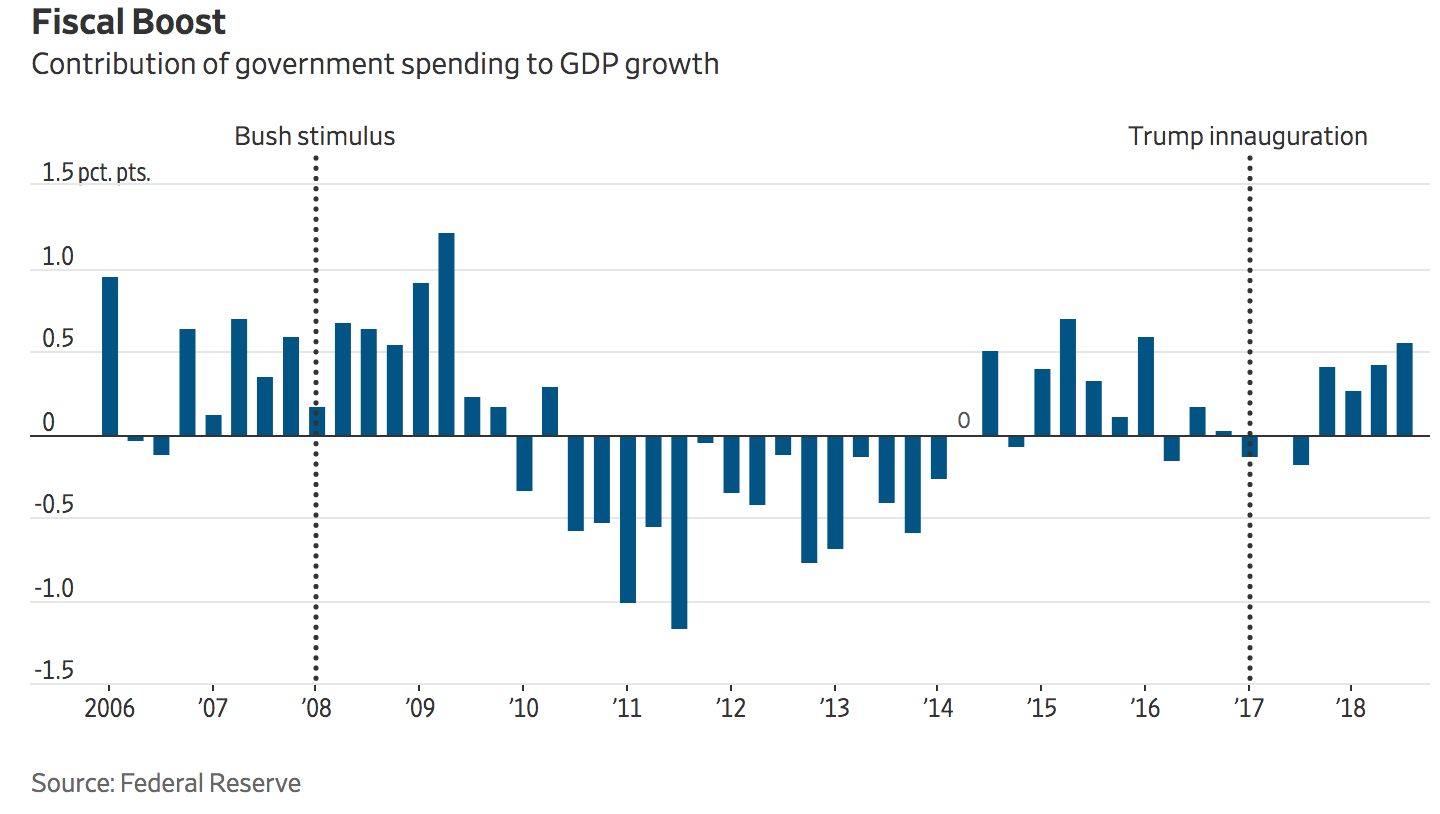
While this should mean lower US debt accumulation going forward (a good thing), it also suggests less near-term fiscal stimulus from government spending.  This is noteworthy because as shown below, the contribution to US GDP growth from the federal government over the last year under Trump has been significant.   See more here courtesy of the Wall Street Journal.

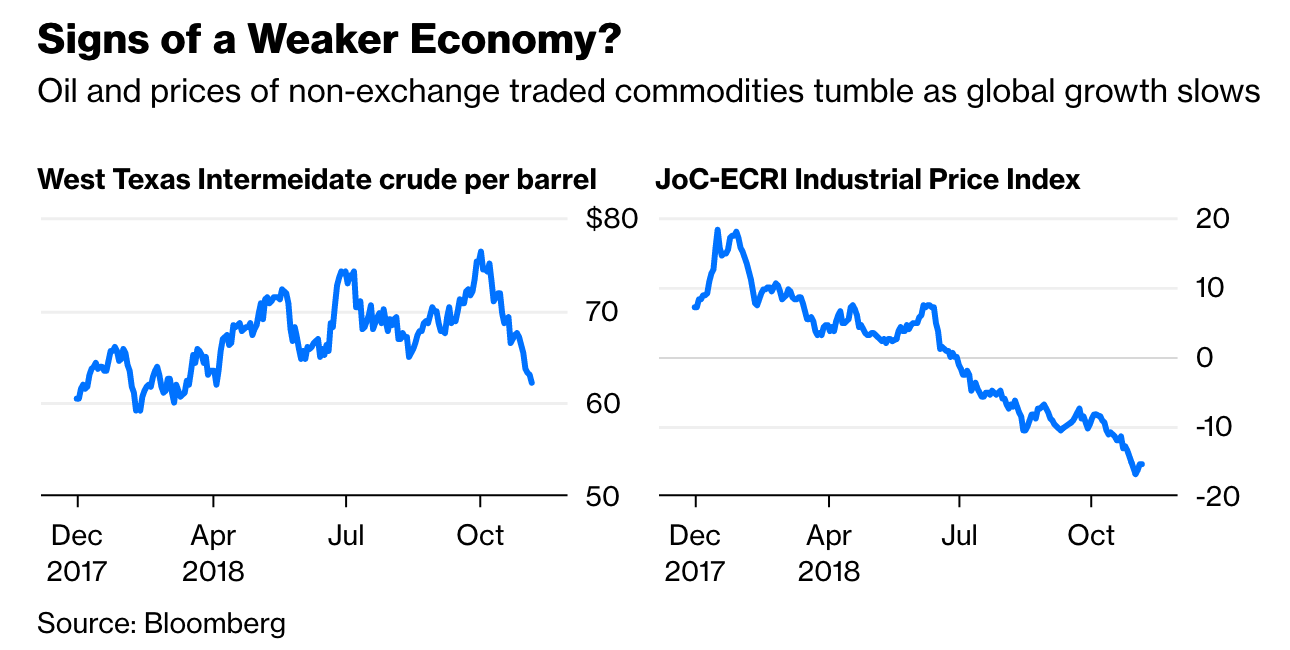
Even amid significant fiscal and monetary stimulus, oil and other non-exchange traded commodity prices have fallen over the past year with world demand as shown below courtesy of Bloomberg.  Most are lower this morning as well, along with higher government treasury prices in North America–another signal of lower growth and less Fed rate hikes probable.
The bottom line is that the global economy was already in the midst of a cyclical downturn before the US mid-terms and before any further rate hikes or quantitative tapering (QT) from the US Fed.  Last night’s election outcome is likely to magnify that slowing trend.

Economic Cycle Research Institute’s Lakshman Achuthan discussed the global cyclical slowdown in process a couple of weeks ago on Bloomberg:

Bloomberg Daybreak Asia speaks with ECRI’s Achuthan about ECRI’s U.S. slowdown call, including housing and inflation downturn calls, and some China related details.  Achuthan also explains that a global cyclical slowdown was already underway before trade sanctions arrived delivering a one-two punch.  Here is a direct video link to the full 6 minute segment.

Posted in Main Page | Comments Off on US election result likely to magnify global slowdown

Understanding the spreading retirement crisis

The 48-minute segment below explains how the world has come to the present capital deficiency crisis and why financial markets and an aging population are more at risk today than in past cycles.  I have been speaking and writing about these themes for over 15 years; it is good to hear another analyst connect the dots well.

Downsizing and de-risking are due to be the dominant themes of the next decade+.  This offers great opportunity for the prepared, but also great pain and shock for those who are caught flat-footed.

Time will soon show once more, that most financial advisors and asset managers are conflict-full, discipline-free speculators, toxic to the financial health of their clients over time.  Valuable financial management can only come from a fiduciary focus on the recipient’s individual facts, goals, timelines and best interests, with the strategic allocation flexibility needed to navigate through the real-time capital and business cycles at hand.

In this hard-hitting Real Vision special, Raoul Pal presents the single most important financial topic of a generation — the Baby Boomer retirement crisis. He asks the hard questions: Can you afford to retire? How will the coming crisis impact your life? What risks are you unknowingly taking with your retirement? Moreover, will the insufficient retirement savings of the largest generation in history cripple the economy? Raoul also explores how savvy retirees might avoid — and even profit from — the threatening crisis. In addition, Raoul also offers a glimpse of a brighter future, in which smart millennials take control of their own financial destiny and side-step the crisis.  Here is a direct video link.

Posted in Main Page | Comments Off on Understanding the spreading retirement crisis

Taleb on how the world is more fragile today than 2007

I am just finishing Taleb’s fifth book in his Incerto, “Skin in the Game”, which covers key insights on how and why the levered and lawless financial world has become a monster undermining global strength and stability.  Taleb is more articulate on paper than in conversation, but this segment is still worthwhile.  As higher rates and shrinking cash flows swamp the unprepared, the largest casualties-in-waiting remain real estate, corporate debt, and equity prices.  The concerted hit to balance sheet assets will reveal years of mal-investment and insufficient saving rates, and be life-plan altering for many.

Nassim Nicholas Taleb, scientific advisor at Universa Investments, discusses the factors causing global fragility, hidden liabilities in global markets, and what he sees as safe trades in the current market.  Here is a direct video link.

Posted in Main Page | Comments Off on Taleb on how the world is more fragile today than 2007