Rising rates retreat when consumption drowns

The US Central Bank hiked benchmark rates last week for the 8th time since their tightening cycle began in December 2015.  Starting from the all-time low of .25%, the federal funds rate now tops 2%+ for the first time in a decade.

In the longer run, higher rates are critical for a stable financial system that’s dependent on savers and productive investment.  On the flip side though, corporate and consumer credit, that’s priced off the fed funds rate, has now seen this relative cost of carry leap 800% in 33 months.  This is no small matter for a world today servicing the highest debt levels in history.  In a speech this week, IMF head Christine Lagarde noted that the total value of global debt is up 60% in the last decade to an all-time high of $182tn and increasing the risk of another financial panic.

Accommodative central banks stoke debt-fueled expansions, and then they take them away. The latter’s happening now.  As shown below in my partner Cory Venable’s chart of the 10-year Treasury Yield since 1984, lesser relative rate spikes preceded the onset of consumption contractions (recessions) and stock market downturns in the much-less indebted peaks of 1987, 2000 and 2007.  Central banks are pretending not to know this, maintaining their perennially optimistic growth forecasts, because they’ve boxed us into low-rate purgatory with no painless paths out.

The truth is that today more than ever before, rising rates will drown debt-encumbered economies and central banks will seek to ease once more.  By then though, the necessary hit to spending and employment, as well as stock and corporate debt markets, will already be done.  We should beware of false prophets expecting unprecedented outcomes.

Posted in Main Page | Comments Off on Rising rates retreat when consumption drowns

If Everyone is in ETF’s, What Could Possibly Go Wrong??

Our firm has been using Exchange Traded Funds (ETFs) for cost-efficient equity exposure in portfolios since 2000. Great idea except when bought or held at record high valuations, in positively correlated global markets, that have been simultaneously hyper-extended on QE and reckless leverage.

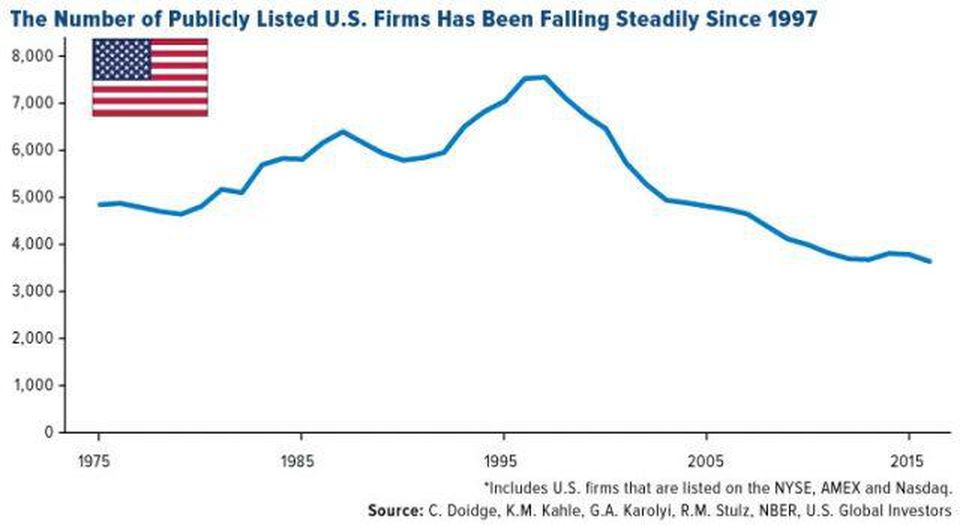
At the same time, two decades of increasingly ‘easy money’ has ballooned the number of ETFs and index-tracking managers while the pool of publicly-traded shares that they hold has halved since 1997 (as charted below).  See:  The pool of publicly traded stocks is shrinking.  In short, much less diversification and higher concentration risk.

The below segment from Lance Roberts does a good job of explaining the liquidity and principle risk inherent in these conditions. But there are two additional points here that should not be missed:

  1. Even managers, investors, and funds who style themselves as ‘active’ today are mostly long-always, equity-index-trackers.  In other words, they buy and hold equities of one color or another at all times, often with a max cash weight of just 5-10%.  This means they are virtually fully invested in equities, even when, like today, principle-loss odds far outweigh the prospects of lasting gains.
  2. Secondly, while many managers say that they get ‘defensive’ by moving from one sector or area like emerging markets to others like ‘dividend-paying’ or ‘tech’ stocks (as Lance says his firm did below), the reality is that as we saw in the 2000-03 and 2007-09 bear markets, there is no effective hiding place in equity markets that are highly correlated and move lower ensemble during risk-off waves.  While most today are still holding equities for fear of missing out on upside, they do so with the unlikely hope they will be able to get out ahead of a liquidating crowd.  This is a dangerous game of chicken to play with life savings.

Clarity Financial Chief Investment Strategist Lance Roberts takes a look at market history to illustrate the dangerous ground on which passive investors are standing.  Here is a direct video link.


Posted in Main Page | Comments Off on If Everyone is in ETF’s, What Could Possibly Go Wrong??

Corporate execs using tax breaks to pump and dump

As government revenues fall, deficits compound and debt levels leap, corporate executives have been directing the corporate cash freed up from recent tax breaks to pump up their company share prices with buybacks, while dumping their own personal holdings into the strength created.  ‘So long suckers’, indeed.  Buyers and holders beware, your longer-term financial interests are not a priority here.  See Executives are selling off their company stock at the fastest pace in a decade:

“Companies this year have announced $827 billion in spending to purchase their own shares — well above the buybacks that took place during all of 2007, which set the previous annual record.

‘Insiders have been committing lots of money for stock buybacks, and they’re not doing buybacks because they think stocks are cheap. They’re doing to it to pump up the stock so they can sell it,’ said David Santschi, director of liquidity research at TrimTabs.

…what we are seeing is that executives are using buybacks as a chance to cash out their compensation at investor expense.” In June, a group of senators asked the SEC to review its buyback rules.

Said Santschi: “Insiders are doing one thing with their own money, and another thing with shareholders’ money.”

Posted in Main Page | Comments Off on Corporate execs using tax breaks to pump and dump