
Pot is the new dot.bomb

As cryptocurrencies and their companies continue to plunge–the sector’s down 68% since January 1, 2018–stories abound of individual would-be-investors gamblers that have been wiped out.  Again.  It doesn’t have to be this way.

There’s nothing new here, just all the usual suspects:  a hot idea heavily sold to the gullible, who bet money they can’t afford to lose on the hope, against all odds, that they might win.

As one bubble crashes others are always being born, and most recently it’s in the area of marijuana.  Pot-related companies are buying up the booths and sponsorship on financial media and investment conferences the way that crypto-cos did last year, and commodity companies in 2008.  Everywhere we turn, people are selling others on the dream of striking gold in pot.

There’s no doubt that legalized pot is an idea whose time has come to North America and there will be companies who profit greatly.  That said, statistics warn that some 80% of current start-ups will have vanished within 5 years, and the vast majority of shareholders in this space will lose money.

Like dot.com stocks in 2000, precious metals and the China bubble in 2007,  pot is just the next speculative mania waiting to pummel the unsuspecting.

To survive the madness of crowds, we must never forget that great products and ideas are frequently bad investments. And risk rules that control any exposure amount and timing are the most defining criteria of our longer-term financial success or failure.

We discussed these concepts in our November 2017 client letter (available here) written 2 months before the crypto-bubble burst, and they are directly applicable to pot stocks today:

“…great ideas or products frequently prove devastating investments depending on the price paid and timing.  It is one thing for IBM, Credit Suisse or governments to allocate portions of their Research & Development budgets to develop blockchain and improve their operating efficiency.  It is something else entirely for individuals to bet their savings that shares of one or another developer, service provider, or alt-coin, may go up in value before they need or want to sell it.

With no income flow or asset backing of any kind, cryptocurrencies can’t be valued as an investment and are the very definition of speculation. If one is interested in speculation, then like when heading to a casino, it is critical to limit our wager to a defined amount we feel comfortable losing, without any negative effect on lifestyle, future goals or peace of mind.

As usual, the loudest proponents of a financial product or investment theme are typically those in the business of selling it to others (in exchange for our cash). As in all things, if we are taking our buy advice from those who are paid to sell us the products, we are putting ourselves and capital in harm’s way.”

Posted in Main Page | Comments Off on Pot is the new dot.bomb

Chinese government encourages share buybacks as bear market deepens

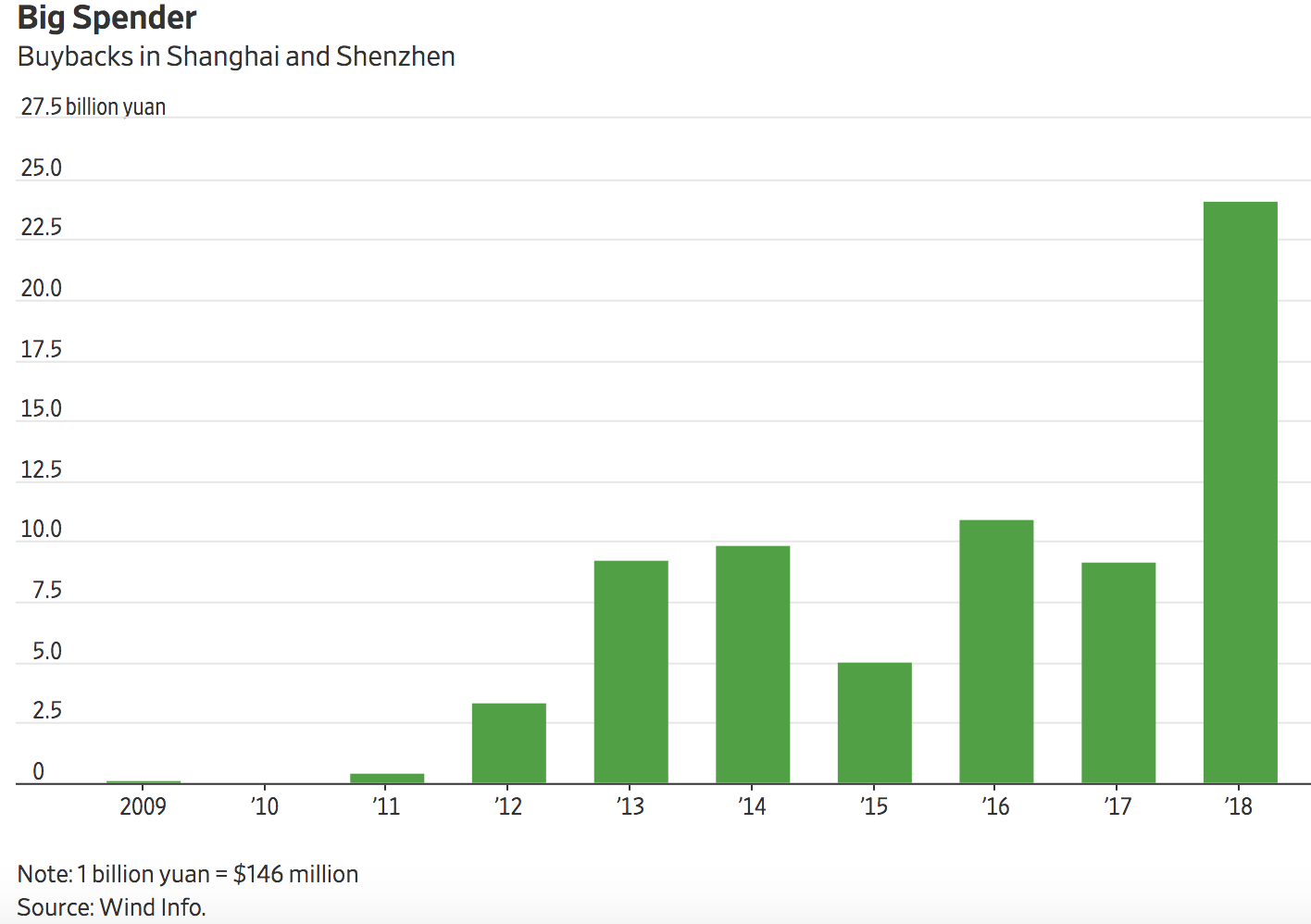
Rivets are starting to blow once more on the debt-on-debt Ponzi driving Chinese markets.  Following the lead of western companies, corporate buybacks in China have surged in 2018 (see left).  This is the latest desperate effort to stop asset bubbles from following their natural destiny to implosion.

See the WSJ’s Record Buybacks Don’t Mean Buy in China. Chinese companies are spending record amount on buybacks. This is not a sign of confidence:

One reason some Chinese companies are doing buybacks is because Beijing has been encouraging them to do so in the hopes of boosting the Shanghai Composite Index, which has slumped 25% since its January peak. The country’s stock-market regulator last week proposed rule changes to make it easier for companies to repurchase their shares.

Another factor behind the surge in buybacks relates to the sheer amount of stocks used as collateral for loans in China. Major shareholders of Chinese companies have collectively pledged some $700 billion of stocks in return for loans, according to Wind Information. With many small companies’ shares having fallen 30% or more this year, a further drop could trigger margin calls on those loans—hence the need for buybacks to support stock prices. Around a third of the companies that have bought back shares this year have more than 30% of their stock used as collateral for loans.

It’s ironic that The Wall Street Journal article points out buybacks are not a sign of confidence in China, because they aren’t in America either.  In both places, buybacks at record valuations are a sign of too much debt-manufactured liquidity with too few legitimate investment opportunities in a slow-growth economy–short-term gimmicks to buy longer-term capital losses.

Posted in Main Page | Comments Off on Chinese government encourages share buybacks as bear market deepens

Must read: The Biggest Legacy of the Financial Crisis is the Trump Presidency

I have upset liberal circles for years now in saying that as President, Barack Obama failed his leadership calling–the one history needed most from his tenure–when in the aftermath of 2009, his administration failed to break up the banks and prosecute corporate executives for profiting from criminal activities that brought the world economy to its knees.

That failure remains a lasting legacy a decade later and counting.  Rather than help move the world onto a more productive, stable path, the failures and actions of the Democrats –as well as Republicans– helped to usher in the even more lawless corporatocracy that plagues us today.  And we are nowhere near done paying the price for all this.

This article connects the dots well, at last, see The Biggest Legacy of the Financial Crisis is the Trump Presidency:

[Giethner] and Obama saw the crisis primarily as a macroeconomic event that could be solved through a series of aggressive technical fixes. As they arranged the mergers, bailouts, and Fed lifelines that rescued corporations from Citigroup to General Motors to Goldman Sachs, they prided themselves on their ability to tune out the public’s justified anger at the greed and recklessness exhibited by financiers and mortgage lenders. This extended even to some clear-cut abuses of the public trust that occurred on their watch, such as when American International Group Inc.—by then a ward of the state—decided to hand out bonuses.

What was so surreal about this period was not Obama’s conviction that growth was a magical elixir that would set everything right. It was his belief that achieving it required him to protect, rather than punish, those who’d driven the economy into the ground. Summoning the chief executive officers of the major banks to the White House in the spring of 2009, Obama told them, “My administration is the only thing between you and the pitchforks.” Like flagellants, he and his economic team were willing to absorb the lashing that should rightfully have been directed at his Wall Street guests, in the belief that shielding them advanced a higher purpose.

Ten years after the crisis, it’s clear Obama was foolish to think public sentiment could be negated or held at bay.

Posted in Main Page | Comments Off on Must read: The Biggest Legacy of the Financial Crisis is the Trump Presidency




