
Worthwhile read: US stocks are in a bubble

A useful piece with some illuminating charts from Jesse Colombo this week, read US stocks are in a bubble. This comment on passive investing is the critical point that long-always advocates recklessly ignore:

The proponents of passive investing point out that the passive approach is much cheaper than the active approach in terms of management fees, brokerage commissions, and other costs.

They also posit that few active investment managers consistently beat the major stock indices over the long run, so investors are better off holding index funds or ETFs. While the proponents of passive investing make some valid points, they are ignoring a glaring risk of their approach:they never sell out of the market, even when it is extremely overvalued as it is currently.

This issue should not be taken lightly because…it takes an average of twenty-two years for investors just to break even if they start investing at high valuations like we have today. Twenty-two years is a very high percentage of the time most investors have to build up a retirement fund, which is usually a few decades at most. Investing in stocks at the wrong time can completely ruin one’s retirement plans.

Extreme asset over-valuations and years of self-destructive policies and behaviors have assured that the next bear market will be of historic proportion and financial harm.

Whether it starts next month, or next year will be irrelevant in the end, because those exposed will see years of apparent net worth gains vaporized in months, and lack of preparedness, liquidity crunch and terror will force selling near cycle lows for many.

The vast majority of market participants today will end up far worse off than if they had kept their savings in cash and guaranteed deposits for the last 20 years, and all the recent boasting about ‘performance’ will be moot. Centuries of history are ours for the noting.

This chart from Jesse’s article showing the Tobin Q valuation ratio (total stock market value divided by the total replacement cost of assets) for US stocks since 1900 is a beauty.
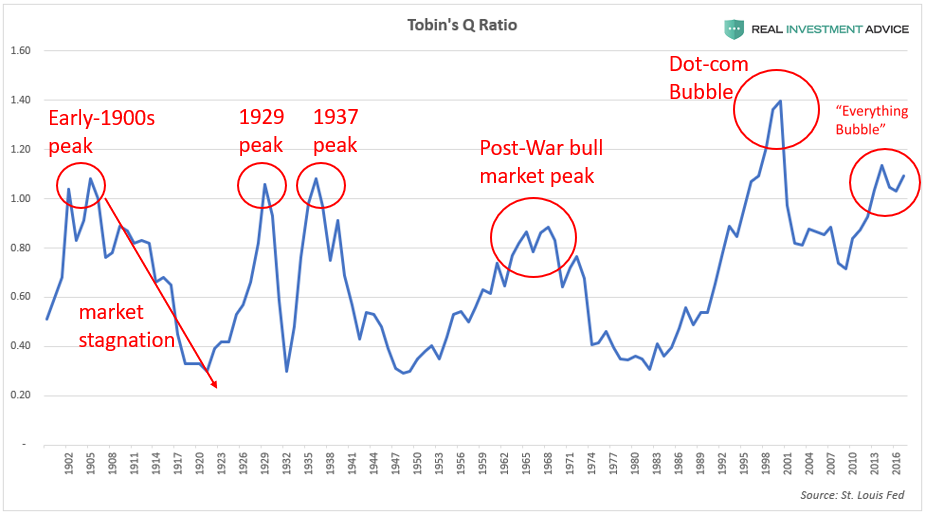
Bottom line: Financial markets have never been more manic than in the last 20 years, and never more capital dangerous than they are today.  Given these are the facts at hand, the question must be what is our plan to survive and thrive these conditions within our own finite time horizons? Wilful blindness and ignorance will not help.  Eyes wide open.

Posted in Main Page | Comments Off on Worthwhile read: US stocks are in a bubble

Must watch doc: What the Health

With record government debt and expenses compounding out of control in most countries, higher consumption and corporate taxes, as well as spending cuts are necessary for financial viability.  More efficient policy and operations around food and energy are the most obvious areas to focus.

To eliminate unnecessary (and unaffordable) costs while increasing productivity and quality of life for the masses, young and old, a food evolution is in process.

For an illuminating new documentary on this topic, we recommend “What the Health” now available on Netflix or for rent on vimeo here. Here is a link to the trailer.

“With heart disease and cancer the leading causes of death in America, and diabetes at an all-time high, the film reveals possibly the largest health cover-up of our time.

With the help of medical doctors, researchers, and consumer advocates, What the Health exposes the collusion and corruption in government and big business that is costing us trillions of healthcare dollars and keeping us sick.”

Posted in Main Page | Comments Off on Must watch doc: What the Health

Anxiety on the rise–we can use the catalyst

Recent reports cite mental health professionals noting an increase in people seeking help for anxiety and depression since Donald Trump’s election:

The American Psychological Association has recorded a rise in anxiety in the Trump era, with a five per cent increase (52 to 57 per cent) in politically induced stress levels over a six-month period before, during and after the 2016 election. Overall, stress levels were the highest they’ve been in a decade, according to the APA.

In an online survey in February 2017, two-thirds of Americans — including most Democrats as well as most Republicans — said they were stressed about the future of the nation. Most of the more than 3,500 people polled blamed the extreme political polarization for their anxiety. There was a strong correlation between stress levels and electronic news consumption.

I agree that we are living in anxiety inducing times, and I have great empathy for young people who feel that our future is growing more precarious by the day.  It is right now.

But this is not about Trump.  The habits and policies that have created our current strife have been unfolding for decades and across political parties of all stripes.

No doubt, Trump represents the unvarnished ugly of what humans can be, and having him as the leader of the free world is unsettling, to say the least.  But to make meaningful improvements from here, we need to see unvarnished ugly so that we can admit, repent, reform and recover.

Those who thought the election of Barack Obama had somehow fixed our self-destructive status quo were painfully naive, perhaps hoping for an easy way out.  The change we need to make here is big, not painless, and it must be driven by our individual action, not passive observation.

Positive steps and progress are the antidote to anxiety and fear.   In this sense Trump offers a powerful inverse mentor and catalyst.  We can use it.

Posted in Main Page | Comments Off on Anxiety on the rise–we can use the catalyst




