
The wrong way to use an economic expansion

Thanks to liquidity-pumping central banks, the globe-driving US economy is now in the 109th month of expansion without recession–second in history only to the unprecedented 120 months of expansion between March 1991 and March 2001.

Surely after this unbelievable period of emergency support, and unusual luck, the world has saved up enough rainy day funds to help buffer the next downturn or crisis, now overdue?

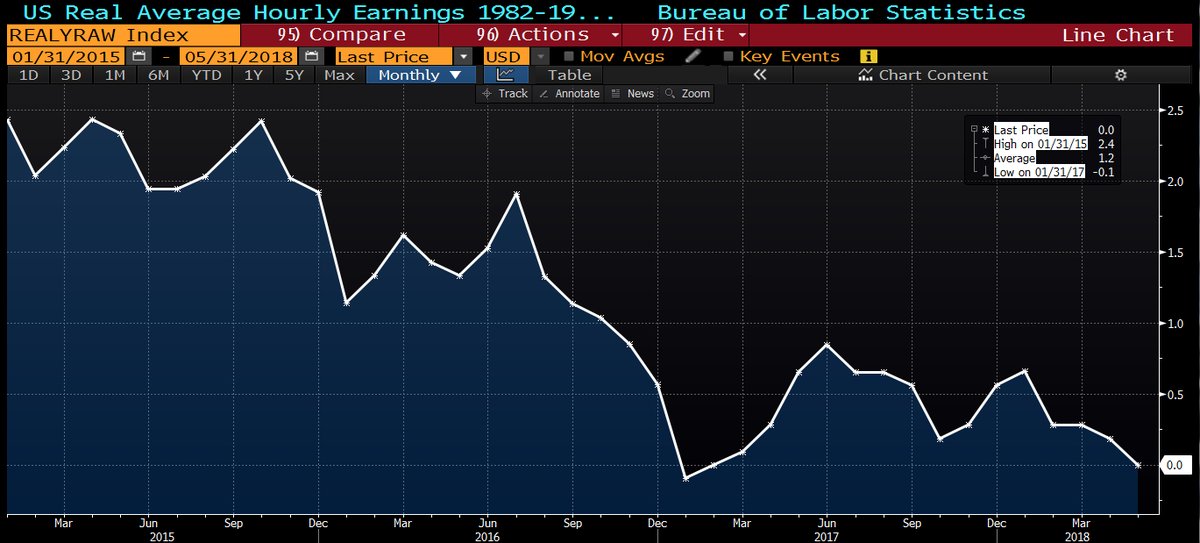
Nope, savings deficits have reached record highs as real wage growth has continued to fall (below since 2015) and the world is servicing the highest debt levels in human history. What financial progress?
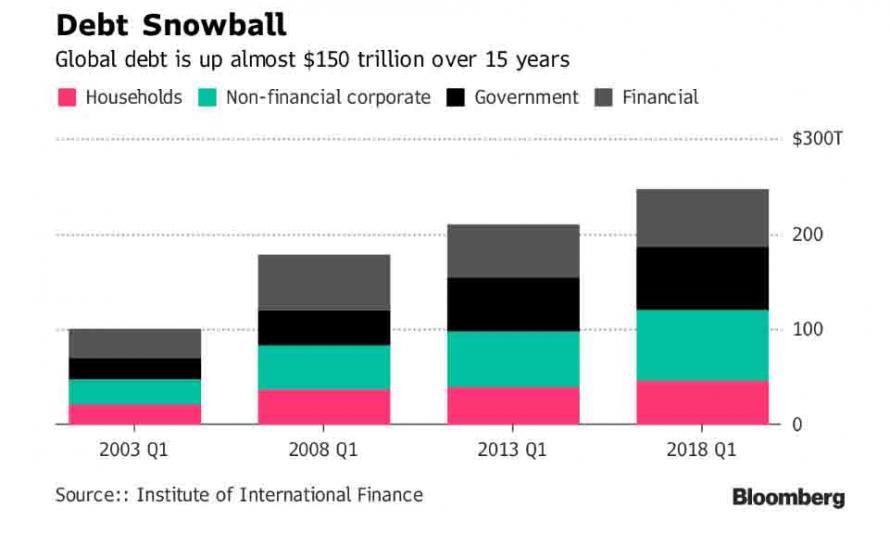
The Institute of International Finance published its latest quarterly update (link here) on the amount of global debt.  As at March 31 st, the total climbed $8 trillion to a new all-time high of $247 trillion (1/4 of a quadrillion!) and up $30 trillion from the end of 2016. Non-financial corporate and household debt have reached record highs in Canada, France and Switzerland.

Now at 318% of global GDP, debt has risen globally in every sector: non-financial corporate debt: $74 trillion, up from $58 trillion in 5 years; government debt: $67 trillion, up from $56 trillion; financial debt: $61 trillion, up from $56 trillion; household debt: $47 trillion, up from $40 trillion.  Here is there chart, courtesy of Bloomberg.

Spending obligations for an aged but long-living population have continued to mount even as tax revenues has been falling for the past couple of years already.  This is no way to prepare for an inevitable downturn.  If the plan is hoping that no downturn or bear market comes, a new plan is needed.  See Many states are likely unprepared for next downturn:

State revenues have been held back by sluggish wage growth and by changes in people’s consumption patterns. Households are shifting spending away from brick-and-mortar stores, which collect state sales taxes, to shopping online, which until recently largely escaped those taxes…And some states, such as Kansas or Oklahoma cut taxes during the expansion, slowing revenue growth.

An aging population is also putting pressure on state Medicaid budgets and pension funds. State pension contributions were 78% higher in 2017 than in 2010, according to census data. And state Medicaid payments were 59% higher in 2016 than in 2010, according to the Centers for Medicare and Medicaid Services.


Posted in Main Page | Comments Off on The wrong way to use an economic expansion

Brokers still selling client orders for kickbacks and exchanges still ‘selling the flow’

Different sector than social media, but security exchanges (that used to be run like public utilities) have adopted a similar hi-tech, trust-abusing business model that sells customer information to be abused by third parties at the expense of the customer, and without their understanding or consent.

To improve the necessary integrity and stability of public markets, exchanges must return to being run like utilities and be banned from paying rebates to brokers for their clients’ order flow, and from selling that flow to third parties who profit on it.  This is parasitic hoax, posing as free markets.

The race to the bottom on transaction fees continues to cost legitimate participants and would-be-investors heavily.  Fair, transparent, competitive fees paid by investors for fair execution, is the only reasonable course.  Remembering, as always, that when we don’t pay a transparent fee for service, we are the product, not the customer.

The Securities and Exchange Commission unanimously voted back in March on a pilot program that would examine how transaction fees and rebates that stock exchanges use to attract trades impact the market and if they present conflicts of interest between brokers and their customers. IEX Group Inc. CEO Brad Katsuyama discusses the pilot program with Bloomberg’s Erik Schatzker in New York.  Here is a direct video link.

Posted in Main Page | Comments Off on Brokers still selling client orders for kickbacks and exchanges still ‘selling the flow’

Fines for offending mega-corps: cost of doing business, zero deterrence

This week Facebook was fined £500,000 by UK regulators for its part in the Cambridge Analytica scandal and failing to protect its users’ information.  This was the maximum fine possible under the Data Protection Act of 1998.  Meanwhile, in the first quarter of 2018, Facebook took in £500,000 in revenue every five and a half minutes.

Clearly, regulatory fines are wholly inadequate in deterring illegal activities once companies achieve massive scale in wealth and influence. This is why we must use long-standing anti-trust laws to break up too big to regulate corps and prosecute individual actors and directing minds with penalties that include clawing back executive compensation and significant jail terms.  See Facebook fined for data breaches in Cambridge Analytica.

Big corporations with big political influence have become the enemy of democracy and the Rule of Law essential for a free and civil society.  This is reality. What we do in response to these facts, will decide what happens next. Elizabeth Denham, the UK information commissioner this week acknowledged the larger challenges at hand in this way:

“Facebook has failed to provide the kind of protections they are required to under the Data Protection Act. Fines and prosecutions punish the bad actors, but my real goal is to effect change and restore trust and confidence in our democratic system.”

The below interview with a former employee and whistle blower at Cambridge Analytica illuminates the business and political entanglements involved in present conditions.

Christopher Wylie, who worked for data firm Cambridge Analytica, reveals how personal information was taken without authorisation in early 2014 to build a system that could profile individual US voters in order to target them with personalised political advertisements. At the time the company was owned by the hedge fund billionaire Robert Mercer, and headed at the time by Donald Trump’s key adviser, Steve Bannon. Its CEO is Alexander Nix.  Here is a direct video link.

Posted in Main Page | Comments Off on Fines for offending mega-corps: cost of doing business, zero deterrence



