
Financial resilience requires conscious steps to break from the herd

The Wall Street Journal runs this week with a detailed expose on the crisis of insufficient savings and income among Baby Boomers.  This problem will be an enduring international preoccupation from here, as older folks battle young folks and other critical social needs for increasingly scarce resources.  See: A generation of Americans is entering old age the least prepared in decades. Low incomes, paltry savings, high debt burdens, failed insurance—the U.S. is upending decades of progress in securing life’s final chapter.

This is what comes of poor planning, and of allowing financial sales wolves to shepherd masses of herd-following sheep–sheep who too easily abdicate personal discipline around their money habits and decisions.  Despite incessant tinkering at the regulatory edges no meaningful reforms, in our widely destructive and dominating financial sector, have been made thus far.  The farce of it all, is a sick joke.  For an important update see:  For big banks, breaking the rules is a trade secret.

Among the relentless barrage of fantastical marketing, it is crucial to comprehend that equities, and all the funds and products that are full of them, are routinely toxic investments when they are bought/held at rich valuations.

Indeed as shown in this excellent chart from Lance Roberts below, the total real return for equities (even impossibly assuming no fees and that all dividends were reinvested) have had four 20-year periods since 1900 of near zero returns (see periods noted in red below).  The fifth period, that began from all time obscene valuations in 1999, is still ongoing and poised to fulfill its zero return destiny in the next bear market, now overdue.  Whether one understands, acknowledges or ignores–these are the facts we are all navigating: pensions, governments, businesses and individuals.  There is no alternative reality planet to choose.
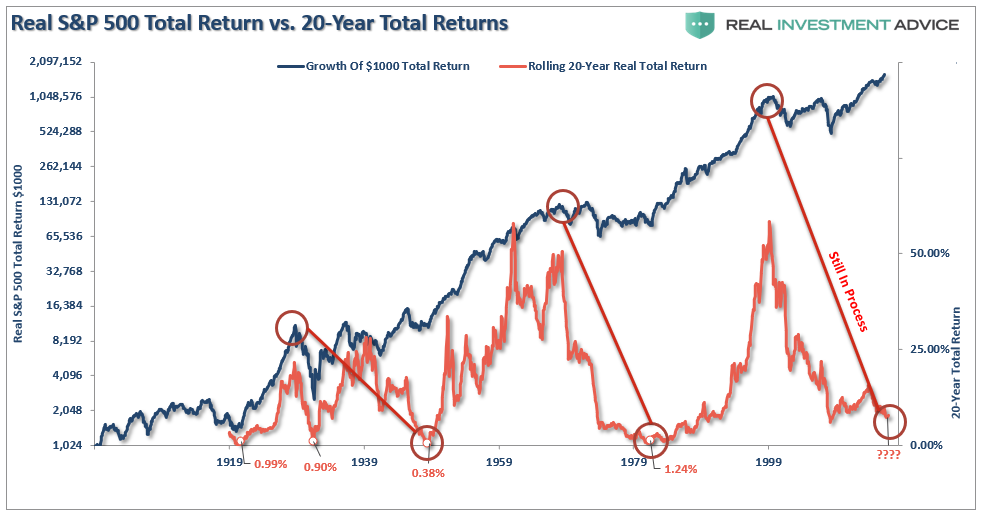
There are smart, self-disciplined, pragmatic steps that individuals can take to prosper through these conditions.  These are all focused on fiscal discipline:  on controlling and reducing spending, minimizing debt and over-valued investment assets, building and protecting savings, and preserving liquidity with a plan to buy what others will be liquidating.  These steps are all the opposite of what the mainstream and masses are doing.

As Lance concludes, in The Myths of stocks for the Long Run-Part IV:

The “power of compounding” ONLY WORKS when you do not lose money…after three straight years of 10% returns, a drawdown of just 10% cuts the average annual compound growth rate by 50%. Furthermore, it then requires a 30% return to regain the average rate of return required. In reality, chasing returns is much less important to your long-term investment success than most believe…

There is no reason to “benchmark” your portfolio to some random index. The index is a mythical creature, like the Unicorn, and chasing it takes your focus off of what is most important – your money and your specific goals.  Investing is not a competition and, as history shows, there are horrid consequences for treating it as such. This is why incorporating some method of managing the inherent risk of investing over the full-market cycle. I would question those who tell you not to do so as they are likely acting from a position of incompetence or self-interest. In the long run, you probably will not beat the index, but you are likely to achieve your financial goals which is why you invested to start with.


Posted in Main Page | Comments Off on Financial resilience requires conscious steps to break from the herd

New Study: carbon bubble burst coming, ready or not

As OPEC ministers agreed to increase oil production again last week, a new study published in the journal Nature Climate Change this month, shows that plunging renewable energy prices and rapidly increasing investment in low-carbon technologies could leave fossil fuel companies with trillions in stranded assets amid slumping market prices:

Several major economies rely heavily on fossil fuel production and exports, yet current low carbon technology, energy efficiency and climate policy may be substantially reducing global demand for fossil fuels.

This trend is inconsistent with observed investment in new fossil fuel ventures which could become stranded as a result…
Our analysis suggests that…would occur as a result of an already ongoing technological trajectory irrespective of whether or not new climate policies are adopted and there are clear distributional impacts, with winners (example, net importers such as China or the EU) and losers (for example, Russia, the United States or Canada, which could see their fossil fuel industries nearly shut down), although the two effects would largely offset each other at the level of aggregate global GDP.

Also see ‘Carbon bubble’ could spark global financial crisis, study warns:

“Contrary to investor expectations, the stranding of fossil fuel assets may happen even without new climate policies. Individual nations cannot avoid the situation by ignoring the Paris agreement or burying their heads in coal and tar sands.”

Mr Trudeau, please read this before you bail out anymore oil cos by buying antiquated pipelines off of them with scarce tax dollars.

Posted in Main Page | Comments Off on New Study: carbon bubble burst coming, ready or not

Capital hell unfolding for yield-reaching investors (again)

As the safest deposit and bond yields fell since the 2008 recession, people who could not afford/did not want capital losses migrated–willfully blind/desperate/greedily–into yield-reaching harm’s way.  One popular area has been ‘syndicated mortgages’ where borrowers find private lenders to loan money on properties instead of going to a bank.  Trouble is that most often these loans are subordinate to banks and other claimants already on the land and buildings.  No free lunch.  More pain and suffering coming in the Canadian mortgage market. See:  Fortress investors could face ‘significant losses.’

More than 11,000 investors – most in Ontario – invested $560-million to provide syndicated mortgage loans to Building and Development Mortgages Canada Inc., which raised the money to help finance 44 development projects for Fortress and its partners.

BDMC is owned by Ildina Galati, a former mortgage broker who surrendered her broker license in February as part of a settlement deal with Ontario’s financial regulator. BDMC was the principal mortgage broker for Fortress, and operates from the same office address. Vince Petrozza, co-founder and chief operating officer of Fortress, was also a registered mortgage broker with BDMC until his registration was revoked in February.

In its update, FAAN said it has spent much of its time as receiver dealing with applications from senior lenders who have priority claims on many of the development projects and are seeking to foreclose or seize the properties because of non-payment of their loans.

FAAN said it needs more time and money to do more appraisals of the projects to find the best potential outcomes for the syndicated lenders, whose loans often rank in third place or lower to those of other lenders.

Posted in Main Page | Comments Off on Capital hell unfolding for yield-reaching investors (again)



