
‘Buffett indicator’ screaming ‘fire’ to risk-blind stock holders

The financial press loves to flog viewers with bullish quotations at all times, but especially from Warren Buffett, and especially near cycle tops when valuations are the least attractive for investment.

In recent years, I have written a few times about Why Buffett won’t warn that stocks are in a bubble. With more than $700 billion in assets under management, and positions too huge to move out of easily, Buffett’s fund has become synonymous with buy and hold, long-always stock holdings, that move up and down largely in lock step with the S&P 500.

Trouble is that since 1998 we have been moving through a secular bear market born of the highest valuations and worst investment return prospects in decades of market history.  And valuations are the most definitive factor in determining future returns.  Case in point, Berkshire Hathaway shares lost half of their market value in both of the last two bear markets along with the broad markets, and spent five+ years thereafter, just waiting to grow capital back to even.

The latest Berkshire’s shareholders’ annual meeting extravaganza held on May 5 attracted the usual media scrum with lots of hopeful hype about stock returns looking forward.  The inconvenient truth however, is that on every metric, including Buffett’s self-named favorite valuation tool–being the total market capitalization of  US stocks divided by US GDP (shown below since 1950)–stocks are screaming capital loss prospects, higher than in 2008 and nearly as high as the tech bubble top in 2000.   See Jesse Felder’s article Buffett thinks bonds are a terrible investment, but stocks look even worse.
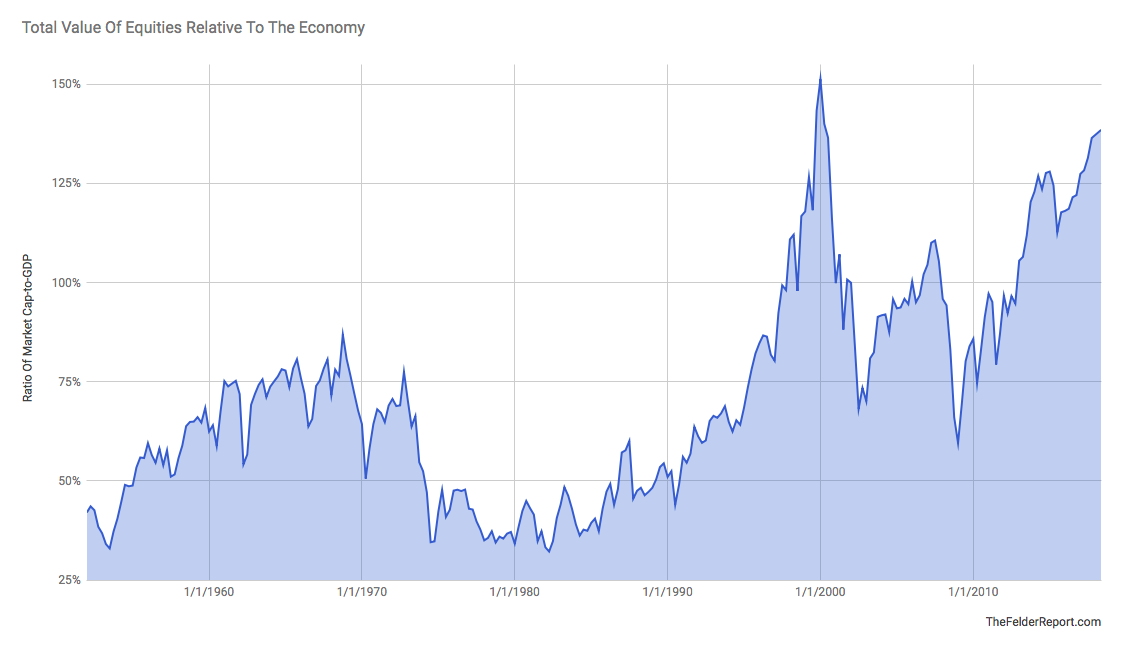
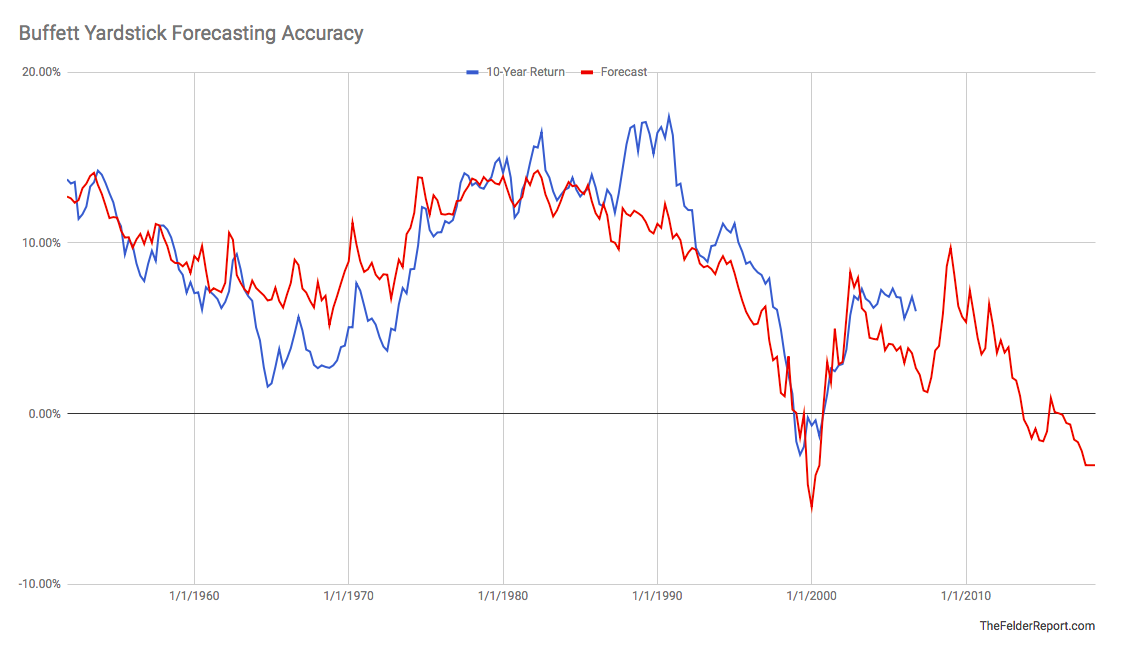
This suggests that at present levels, stocks are on track to make negative returns over the next decade including dividends (red line shown below).  The actual 10-year historical returns that have been experienced from different valuation levels in this indicator have been remarkably correlated (as shown below in blue).   But then, this time is surely different?
Posted in Main Page | Comments Off on ‘Buffett indicator’ screaming ‘fire’ to risk-blind stock holders

Australian royal commission into customer abuse in finance: familiar findings

Captive and impotent regulators and financial firms committing fraud and abusing client trust are the dominant financial model worldwide.

AMP is a financial services company in Australia and New Zealand providing superannuation and investment products, insurance, financial advice and banking products including home loans and savings accounts. AMP shares are included in the Australian Securities Exchange’s S&P/ASX 50 index. Its headquarters are in Sydney, Australia. See:  Another day, another disaster for financial institutions at the royal commission.

ABC Does The Royal Commission, AMP, CBA and Financial Planning.  Here is a direct video link.

Posted in Main Page | Comments Off on Australian royal commission into customer abuse in finance: familiar findings

Killing the ‘little guy’ with ‘investment’ sales dung

Abuse of trust is a dominant business model in conventional ‘investment’ sales and wealth ‘manglement’.

As I mentioned in April, this odious truth was on full display at the recent ‘Canadian Wealth Expo’ in Toronto, where gullible attendees were showered with high-powered propaganda like this line from one of the seminar selling, self-declared ‘experts’ on investment:  “Wealthy people don’t determine what they want based on what they can afford, they know what they want and figure out how to afford it.”  Run away!

As I have noted many times, those who buy assets at extreme valuations are speculating, not investing, whether they realize it or not.  Sooner or later, bad math works to eat them alive.  See some salient observations on Canadian real estate in this article:  Sylvester Stallone, Pitbull and the Canadian Wealth Expo ‘circus’:

Many people who piled in to the market in recent years are already finding that the sums are not adding up. Of the Toronto condo investors that took possession last year, for example, 44 per cent now collect less rent than the mortgage requires, according to CIBC Economics. Of those, more than a third are down at least C$1,000 a month.

Motivated sellers will be in increasing supply as prices stagnate and fall.  Those that wait for the panic liquidation before they buy, are likely to earn just rewards.

Posted in Main Page | Comments Off on Killing the ‘little guy’ with ‘investment’ sales dung





