Maximizing shareholder welfare is more than market value

Incentives that goose short term profits at the expense of longer term viability are misguided and counter-productive.  Policy changes are needed to shift the focus from short term financial gimmicks to longer term investment and innovation.

Oliver Hart is a professor of economics at Harvard University. Hart won the Nobel Prize in economics in 2016 for his work in contract theory and is the author of “Firms, Contracts, and Financial Structure.” Hart sat down with Business Insider’s Sara Silverstein at UBS’s Nobel Perspectives Live event in Brooklyn. In this interview, Hart discusses his most recent paper “Companies Should Maximize Shareholder Welfare Not Market Value.” He says that profit maximization is important to shareholders, but it’s not the only thing they care about.  Here is a direct video link.
Posted in Main Page | Comments Off on Maximizing shareholder welfare is more than market value

The rise of finance and the fall of American business

I reviewed Ms. Foroohar’s book Makers and Takers on the blog in 2016 here, well worth reading.  This recent interview continues the conversation.  It is posted in 6 different segments which automatically follow once you play the first at the link below.

On Reality Asserts Itself, Ms. Foroohar says financialization delivers stagnant wages, inequality and economic crisis; the Financial Times columnist and author of “Makers and Takers” says the financial sector represents only 7 percent of the U.S. economy, but takes around 25 percent of all corporate profit while creating only 4 percent of all jobs.  Here is a direct video link.

Posted in Main Page | Comments Off on The rise of finance and the fall of American business

Closing the gender pay gap key to social and economic progress

Many people talk about gender pay inequality as a female problem, actually it is a problem that costs the overall economy (everyone) greatly. While business leaders and politicians fear slow growth and fixate on ideas to stimulate the economy, pay equality is an obvious area to focus policy attention.

A woman earns around 80 cents for every one dollar earned by a man. What would happen to the economy if the gender pay gap closed?  Here is a direct video link.

What does equal pay mean for the economy? from CNBC.

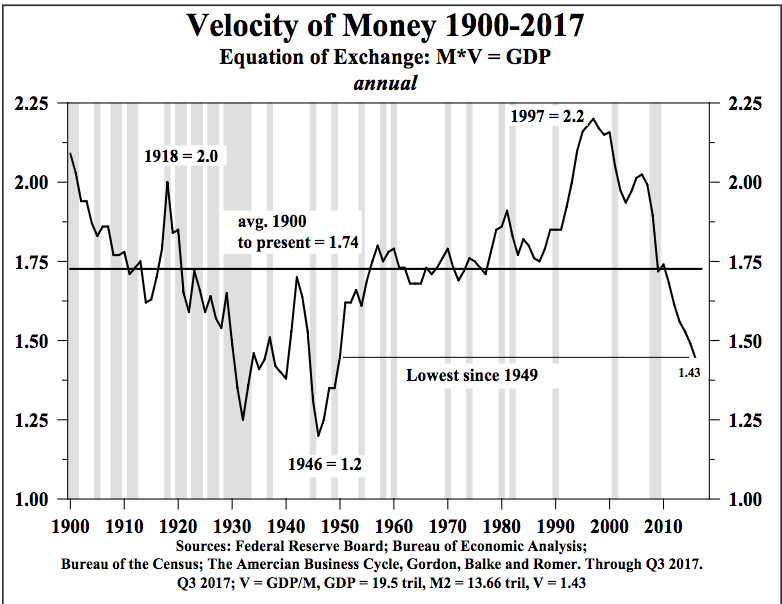
One thing for sure, policies that continue to funnel income gains to the same tiny fraction of the working population over the past 20 years, have had a counter-productive, depressive effect on the velocity of money (movement/multiplier effect) through the economy, as shown below since 1900 from Hoisington Management.  If we want to increase the growth, we need to spread the wealth and share child rearing responsibilities more equitably.

Posted in Main Page | Comments Off on Closing the gender pay gap key to social and economic progress