Separation from ‘smart phones’ needed for deeper thought

A recent study from the University of Chicago has found that the mere presence of one’s smartphone reduces available cognitive capacity.  It’s not enough to just have the screen or sound turned off, if we want deeper focus we need to be physically separate from our phones.  This connects with my own experience in trying to think and write, but also to drive attentively and be present in the moment while interacting meaningfully with other humans and nature.  See more here Having your smartphone nearby takes a toll on your thinking:

With these findings in mind, students, employees, and CEOs alike may wish to maximize their productivity by defining windows of time during which they plan to be separated from their phones, allowing them to accomplish tasks requiring deeper thought. Moreover, asking employees not to use their phones during meetings may not be enough. Our work suggests that having meetings without phones present can be more effective, boosting focus, function, and the ability to come up with creative solutions. More broadly, we can all become more engaged and cognitively adept in our everyday lives simply by putting our smartphones (far) away.

Posted in Main Page | Comments Off on Separation from ‘smart phones’ needed for deeper thought

Motivated misunderstanding and lies driving modern finance

Would-be investors and honest money managers face a mountain of lies and motivated misunderstanding around financial information everyday.  The bad guys are winning and everyone else pays the price.  Read this excellent article by Economist and mathematician Michael Edesess.   See Comey’s “Higher loyalty” and its message for Wall Street:

Much of the mathematics used in finance is a lie. It is used for sales or marketing purposes, not to actually obtain results or even to be correct.

Of course, very few people who use a marketing pitch perceive themselves as lying. If the marketing pitch employs or is based on mathematics that they don’t fully understand – even if they have written it themselves – then they will still not perceive themselves as lying. They will convince themselves that it is the absolute truth. Let us instead call it motivated misunderstanding and misinterpretation of mathematics.

This motivated misunderstanding and misinterpretation of mathematics is not only endemic in Wall Street, especially in the investment advice and management field, it is its stock in trade. For example, the mean-variance optimization model is heavily used in marketing of investment advice, even though it is widely acknowledged that it does not work at all for practical purposes.

Posted in Main Page | Comments Off on Motivated misunderstanding and lies driving modern finance

Tech wreck 2.0 looming over Indices, ETFs and mutual fund holders

Continuing to take risk measurements and pay attention to what’s under investment marketing wrappers is key to protecting and growing capital over full market cycles. But it takes discipline and constant attention, so most people don’t do it. Therein lies the downfall of the masses, and the opportunity inherent for the few who do.  This extreme cycle is one for the history books.

Amazon is a top holding in over 140 exchange-traded funds. A liquidity event for Amazon shares — perhaps triggered by issues related to the Trump administration’s ordered review of the company’s impact on the U.S. Postal Service — would create uncontrollable selling, in our view.

Zooming in further, around 40 ETFs hold Amazon within the top 5 percent. Look out below: This is a colossal failure of common sense.

Investors have been stuffing themselves on a Thanksgiving feast full of technology stocks. Today, tech sector equities comprise nearly 30 percent of all large-cap mutual fund portfolios; this is an accident waiting to happen.

See:  Why Amazon could be the next black swan for the market.

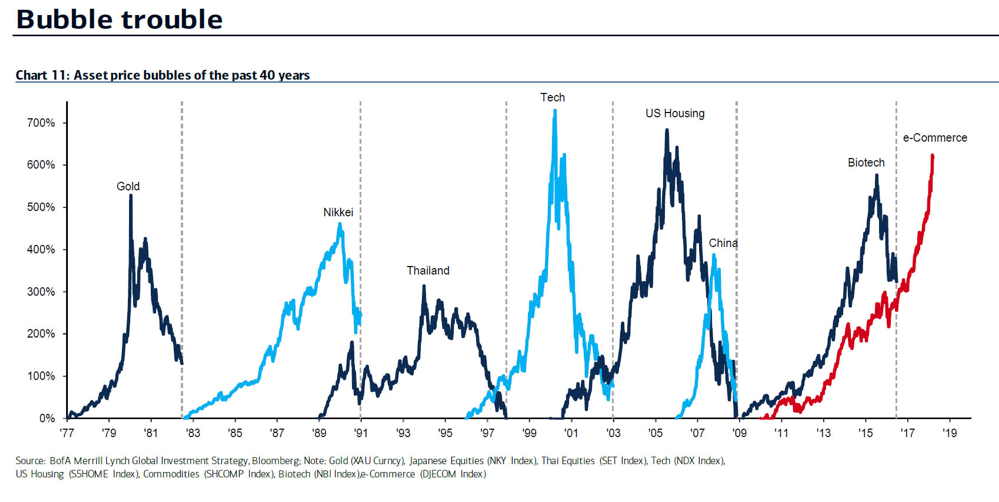
The most recent ‘e-commerce bubble’ ranks with technology shares in 2000 and US homes in 2006 as the three largest asset bubbles in the last century. As charted below since 1977, all such previous bubbles were followed by bust cycles that saw prices fall an average of 60 to 80% and take many years thereafter to recover.

Posted in Main Page | Comments Off on Tech wreck 2.0 looming over Indices, ETFs and mutual fund holders