Electric buses helping air and hurting oil demand

Millions of deaths each year from air pollution are driving city governments to zero-emission public transportation.  With the largest population and worst air pollution in the world, China is now leading the way in adding an estimated 9,500 zero-emissions buses every 5 weeks.  Since conventional buses consume 30 times more fuel than average sized cars, the impact on energy use is much greater than electric passenger sedans.  The drop in oil demand is compunding.  See: Electric buses are hurting the oil industry

For every 1,000 battery-powered buses on the road, about 500 barrels a day of diesel fuel will be displaced from the market, according to BNEF calculations. This year, the volume of fuel not needed may rise 37 percent to 279,000 barrels a day because of electric transport including cars and light trucks, about as much oil as Greece consumes, according to BNEF. Buses account for about 233,000 barrels of that total.

Other cities are taking notice. Paris, London, Mexico City and Los Angeles are among 13 others that have committed to only buying zero emissions transport by 2025.  It’s about time!

Here is a direct video link.

Posted in Main Page | Comments Off on Electric buses helping air and hurting oil demand

Record price to sales for developed world stocks

It’s hard to be hyperbolic about the present level of equity valuations. Suffice to acknowledge:  the overpricing today is more extreme and pervasive than at the tech fueled market top in 2000.  This suggests the correction phase coming should also be wider and deeper, just as many holders are 18 years older, and savings and pension deficits much larger than in 2000–and that’s even before the next wave of capital losses hit.

We are wise to face facts and govern our finances accordingly, while making ready for the asset liquidation sale coming.  See:  Unchartered territory for stock valuations:

“…The median company in our developed world index (which covers the top 85% of companies in each country) just achieved a price to sales ratio that eclipsed the 2000 peak…What’s more, unlike in 2000 when the median valuation was driven higher primarily by tech stocks, leaving plenty of “value” areas to flock to, valuations today are extended across the board, from staples, to industrials to tech to materials.”


Posted in Main Page | Comments Off on Record price to sales for developed world stocks

Our late ‘great’ credit cycle

Over the past decade, record low interest rates and central bank-driven-speculation drove unprecedented global appetite for junky investment assets.  As investment-grade yields fell from 5 and 6% to 1 and 2%, most individuals and pensions did not, or could not, increase their saving/contribution rates sufficiently to offset the loss of investment income.  Even those who could have increased their contributions, mostly did not because they believed (hoped) that ‘higher yield’ (much higher risk) products were a solution.  The financial sector, for its part, wanted to keep the dream of free-lunches alive, and not decrease its fee rates as yields fell, so it doubled down on selling the highest-fee products.  Meanwhile, companies and individuals that could borrow more cheaply than ever before, did so with wild abandon.

Investors who were previously only comfortable in A-rated bonds migrated to BBBs, and those who were comfortable in BBBs moved to even lower quality.  Moreover, as time went on, most did so with a higher percentage of their capital than ever before deemed prudent.

This chart of the mountain of non-investment grade debt (blue bars) issued since 2010 tells the tale.
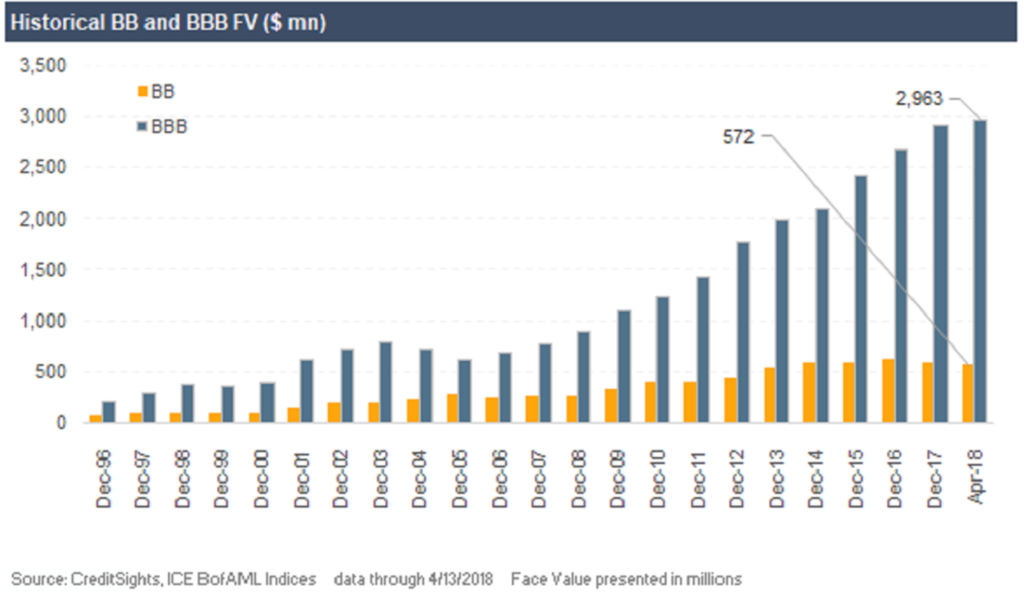
Now as rates have risen and cash flows fallen, defaults have begun surging in typical late cycle patterns.  Only this time, asset holders are more risk exposed, and have more to lose, than ever before. See: A $3 trillion dollar credit market has corporate bond investors on edge:

“We’re late in the credit cycle, and trying to figure out when everything turns,” said Erin Lyons, a senior credit strategist at New York-based research firm CreditSights Inc. “Some of these may eventually be downgraded.”

Notes in the lowest rungs above high-yield junk — in the BBB group from S&P Global Ratings or the Baa bucket from Moody’s Investors Service — total about $3 trillion, almost the size of Germany’s gross domestic product. The concern is that as rates rise it will cost companies more to roll over their obligations, and if earnings begin to slump as economic growth slows, that could blow out leverage ratios and lead to credit-rating cuts.

Not ‘could’ or ‘if’, just a matter of when–the turn has already started.  During this part of the cycle, North American government bonds typically see ‘relative safe haven’ inflows.

Posted in Main Page | Comments Off on Our late ‘great’ credit cycle