Extreme wealth concentration not merit-based and bad for economy

Today the wealthiest 1% of the global population has more more than at any time in the last 50 years.  While this may sound like progress for some, a compounding cost of extreme wealth concentration is that it is highly inefficient resource utilization and bad for economic growth and human progress.

Case in point:  the Organization for Economic Cooperation and Development, representing a number of the world’s richest countries including the United States, estimates that inequality has knocked nearly five percentage points off economic growth in those countries over the past 15 years, and the drag is getting worse with each passing year.  See OECD:  Why less inequality benefits all:

In high-inequality countries, people from poor households typically have less access to quality education. This leads to “large amounts of wasted potential and lower social mobility,” which directly harms economic growth, according to the OECD.

Whether one is in or out of the wealthiest percentile, pragmatists should admit that the largest factor driving income and wealth disparity over the past 20 years has not been merit or ‘hard work’ but rather extreme financialization which has ballooned asset bubbles and reinforced policies and incentives for corporations, central banks and governments to artificially boost the price of leveraged assets to unsustainable levels at the expense of labor and productivity.  In the end, this trend is self-defeating for business, as well as everything else.

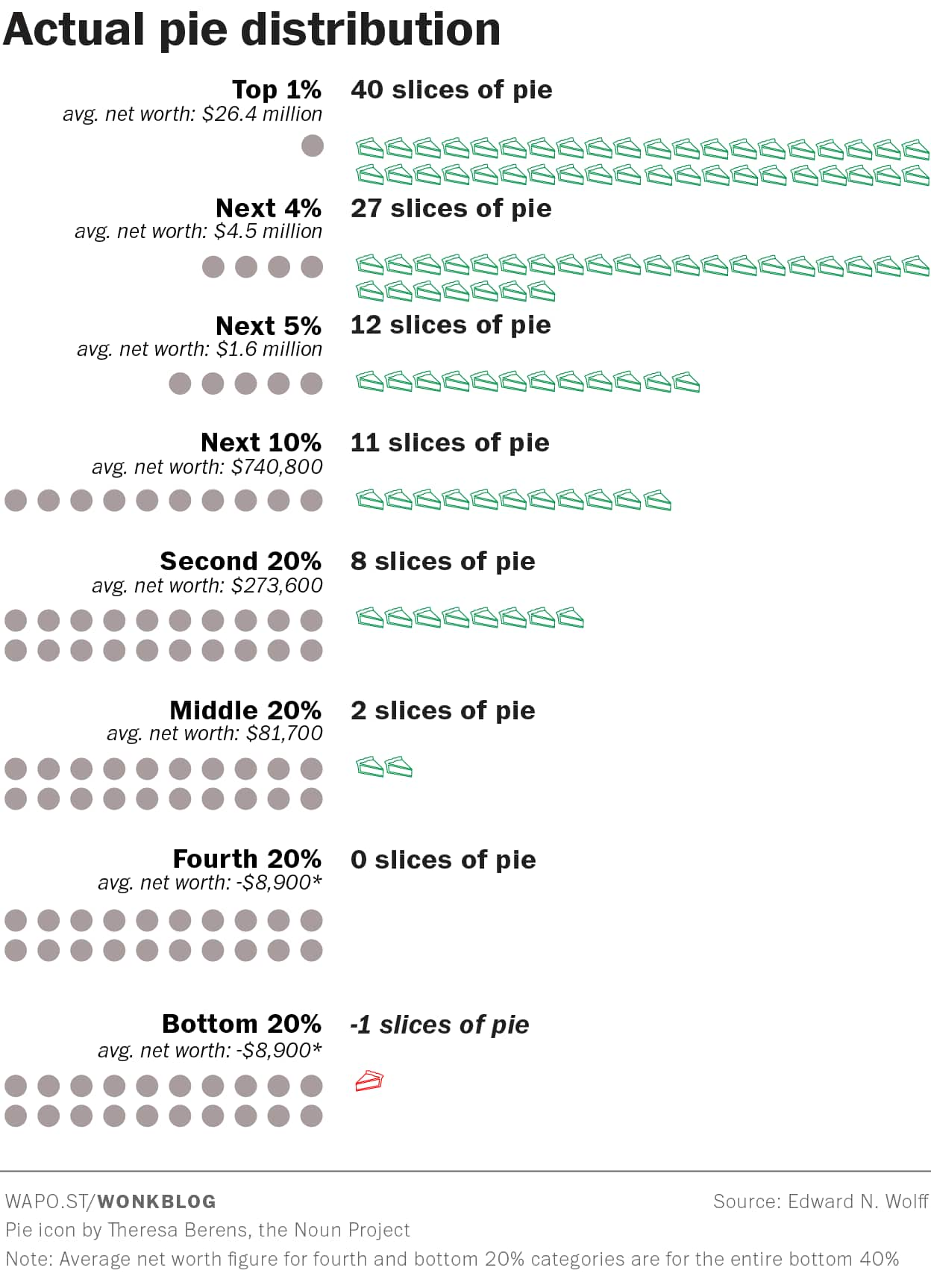
A good graphical explanation of the reality is captured in the below chart of pies.  Where the top 1% of the population has 40 slices and the bottom 40% has no pie at all.  The result:  lots of wasted resources (pie) and  a very low multiplier effect through the economy.  See:  The richest 1% of the population now owns more of the country’s wealth than at any time in the last 50 years.
Policies that continue to pile more pie where it is will go unused are just dumb management.  And in the end history shows, folks with no pie eventually come and take pie off those that are hoarding it.

A couple of easy rule changes that would go a long way to amend currently destructive incentives:

  • re-ban corporate share buybacks (considered illegal market manipulation before 1982)
  • Tie executive pay to balance sheet improvement rather than increases in share price
  • Separate all investment underwriting and sales away from deposit-taking banks-backed by taxpayers.
  • add a consumption based tax to the US
Posted in Main Page | Comments Off on Extreme wealth concentration not merit-based and bad for economy

A word on analyst forecasts as we approach year end

As we move into year end, the airwaves are full of analyst forecasts for further equity gains in 2018.   Saved from bankruptcy by government bailouts in 2008 and emboldened by years of central bank asset buying since, the long always siren song has never been louder.

But already the second longest expansion in market history, at some point here, odds favor less favorable outcomes.  As shown in this table since 1850, there has never been a decade that escaped having at least one economic recession. Bulls are betting 2008-2018 will be the first.

It is critical for thinking people to remember that the investment sales sector is always bullish.  No matter how much undeserved gains they have already been gifted, this crowd will always call for more–because they are paid to keep people in risk assets at all costs.  This reminder from Sven Henrich on the bulls of 2008 is useful.  Same crowd today, same message always.  Buy and holders beware.

Posted in Main Page | Comments Off on A word on analyst forecasts as we approach year end

BOC: Canadian economy looking ‘uncertain’ into 2018

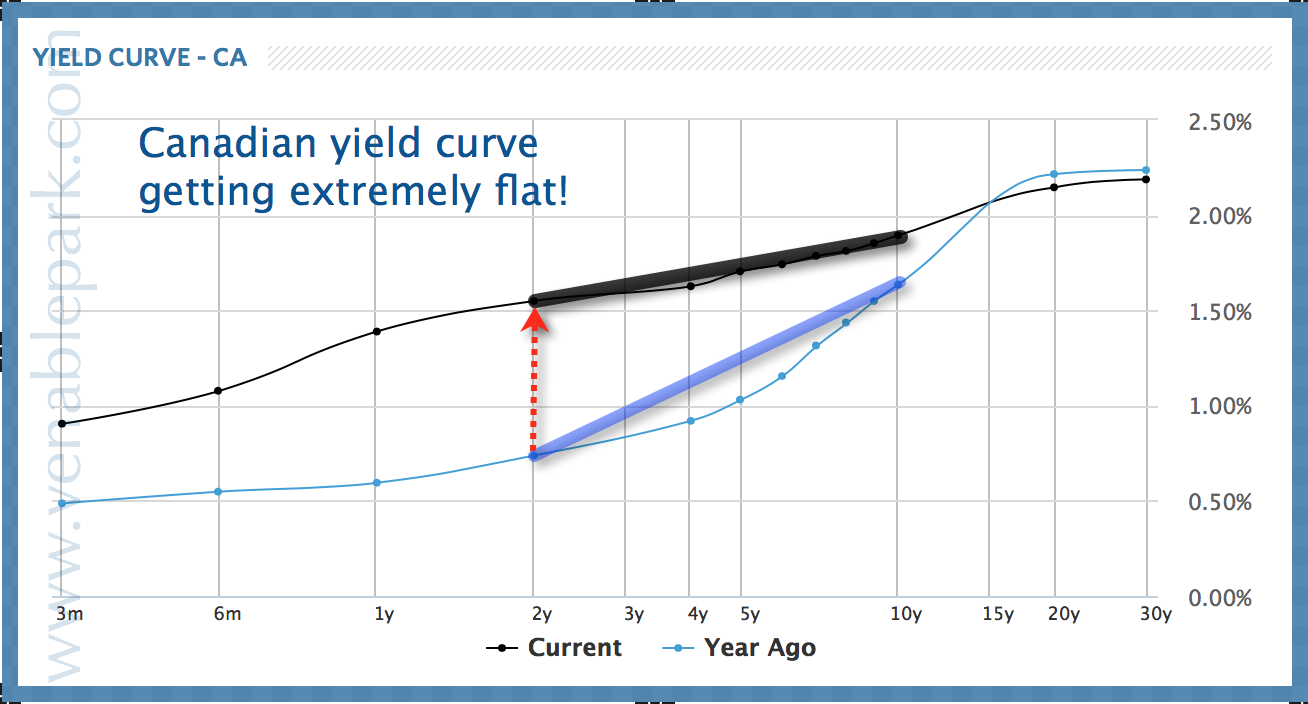
Bank of Canada sat tight today–no rate hike–seeing economy weakening into 2018.  With the 10 to 2 year Canadian government yield spread now .36% versus .75 a year ago (red arrow), the bond market also sees slow growth looking into the new year.


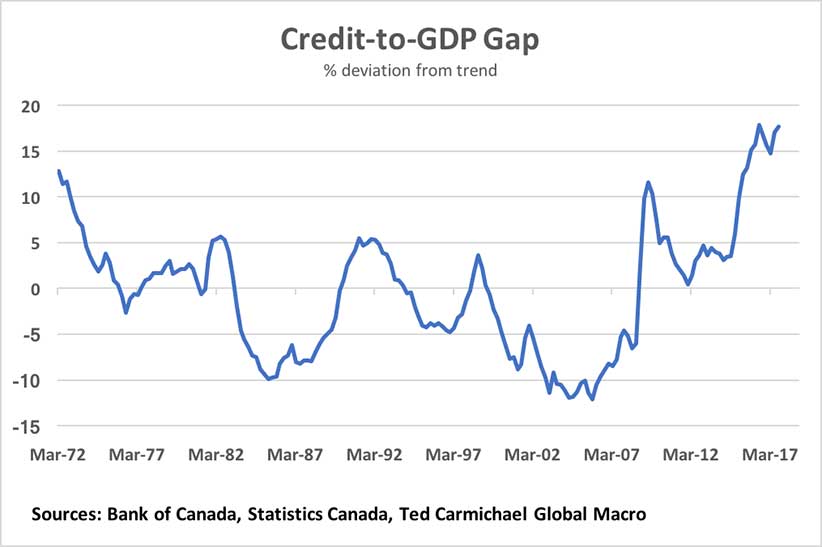
A few charts from The 91 Most important economic charts to watch in 2018 sums Canada’s headwinds well here.  The first one is Credit (household and business) to Gross Domestic Product Gap now at a 45 year high, as shown here.  Ted Carmichael, explains his chart this way:

“Previous peaks preceded or coincided with economic recessions in 1981-82, 1990-91, and 2008-09… According to the BIS, countries with Credit Gaps of greater than 10 per cent of GDP are at risk of a financial crisis. Only China, Hong Kong, Singapore and Canada currently have Credit Gaps exceeding 10 per cent. Large credit gaps usually result from extended periods of low interest rates and/or lax borrowing standards. Canada’s gap of 17.8 per cent is considerably higher than the 12.4 per cent that the U.S. credit gap reached in the first quarter of 2008, just at the onset of the Global Financial Crisis.”

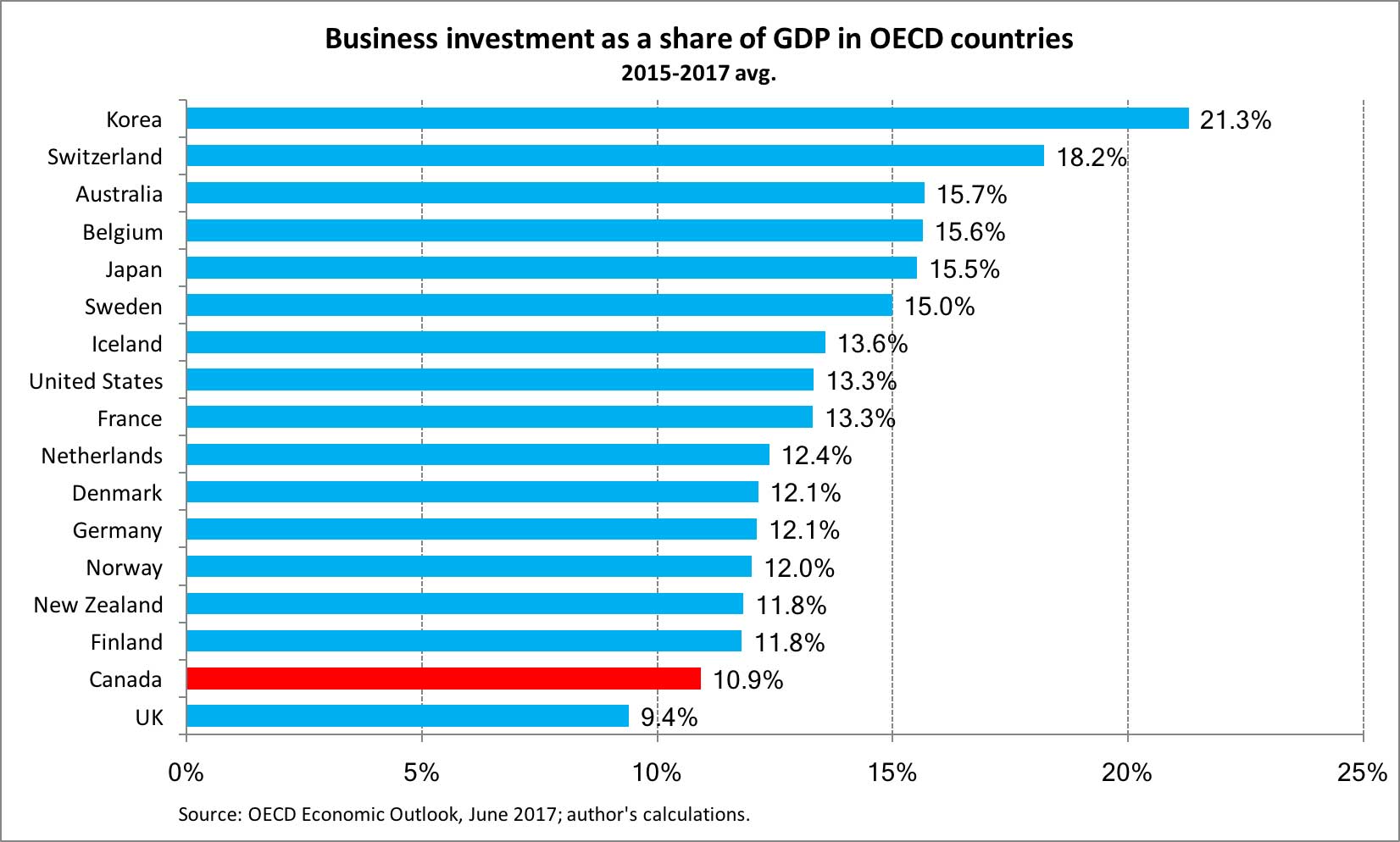
And unfortunately, Canada’s record indebtedness is not from productive investment that revamped our infrastructure or business sector to boost future productivity. As shown here, Canada’s business investment as a share of GDP has actually been one of the lowest of the OECD countries.

No, Canadian households and businesses have levered themselves to record highs this cycle, not to make smart investments for the future, but rather to buy things that depreciate like cars and discretionary goods, as well as over-valued real estate and corporate shares (that are also likely to depreciate from present levels).

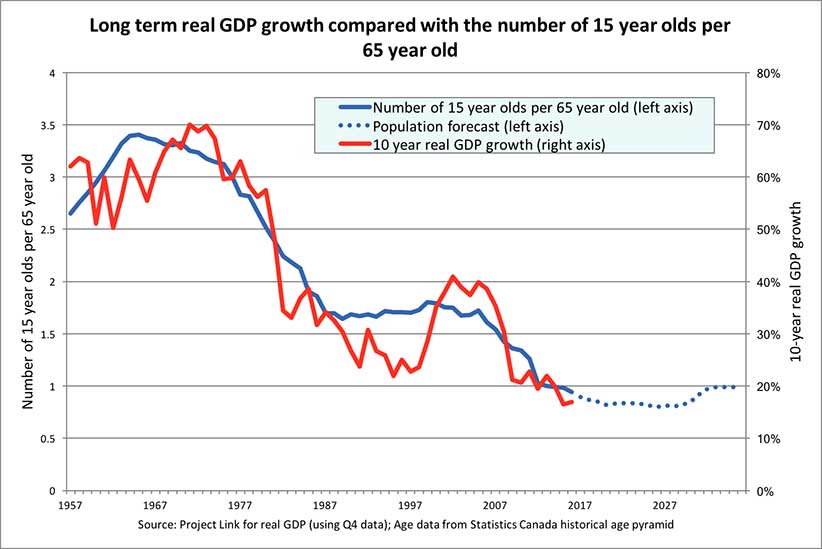
All while our aging demographics are set up to detract from growth and revenue over the next 20 years as shown below.  This will make paying back what’s already been borrowed, that much harder and take that much longer.


Posted in Main Page | Comments Off on BOC: Canadian economy looking ‘uncertain’ into 2018