
BOC: Canadian economy looking ‘uncertain’ into 2018

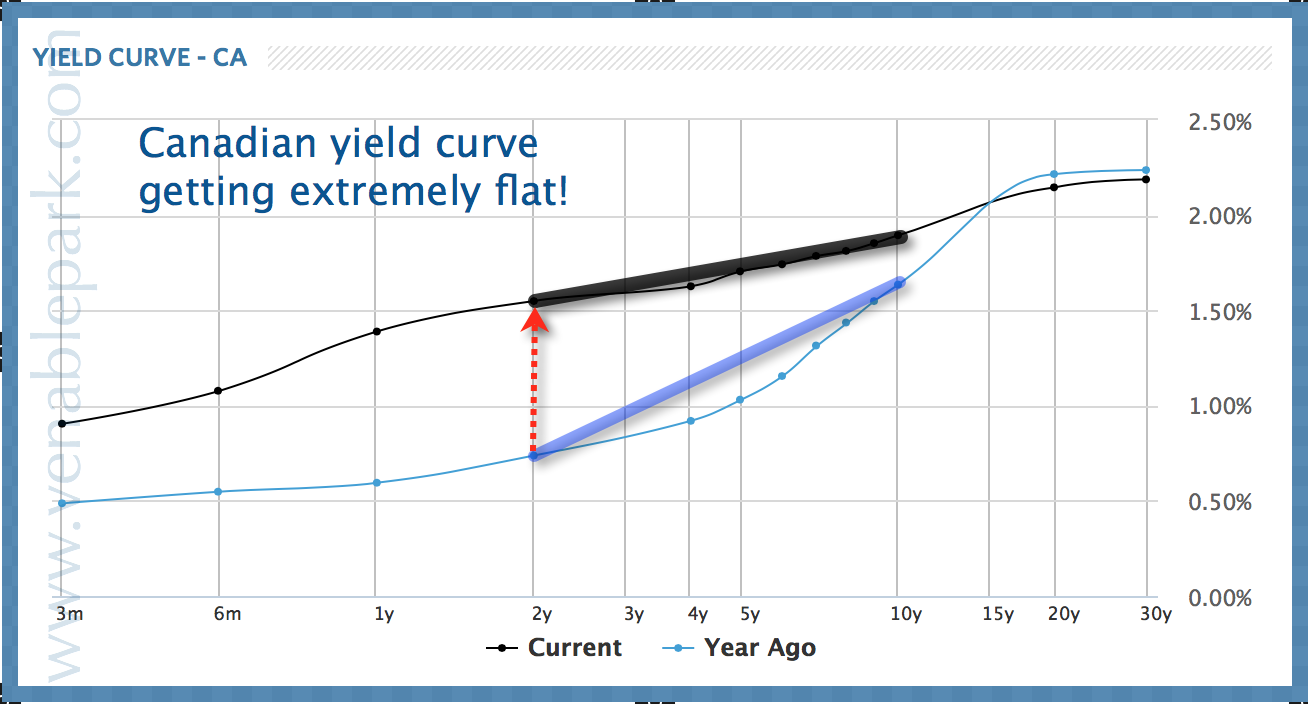
Bank of Canada sat tight today–no rate hike–seeing economy weakening into 2018.  With the 10 to 2 year Canadian government yield spread now .36% versus .75 a year ago (red arrow), the bond market also sees slow growth looking into the new year.


A few charts from The 91 Most important economic charts to watch in 2018 sums Canada’s headwinds well here.  The first one is Credit (household and business) to Gross Domestic Product Gap now at a 45 year high, as shown here.  Ted Carmichael, explains his chart this way:
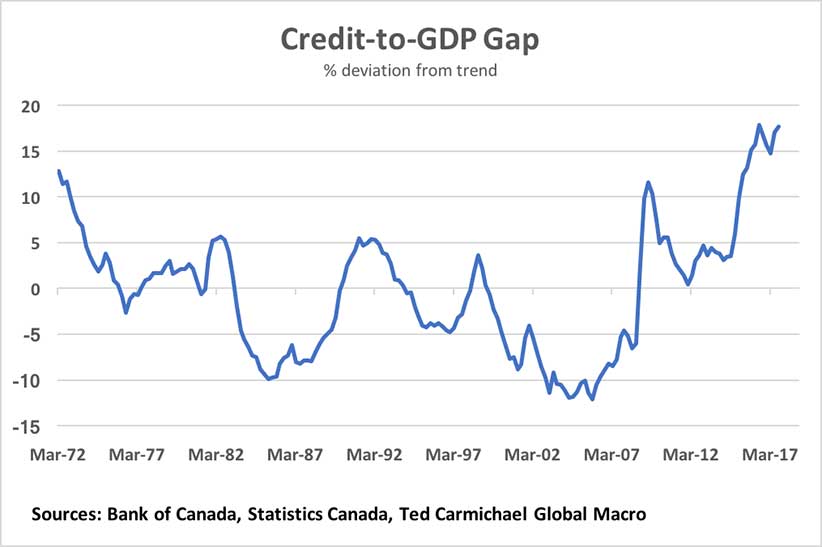
“Previous peaks preceded or coincided with economic recessions in 1981-82, 1990-91, and 2008-09… According to the BIS, countries with Credit Gaps of greater than 10 per cent of GDP are at risk of a financial crisis. Only China, Hong Kong, Singapore and Canada currently have Credit Gaps exceeding 10 per cent. Large credit gaps usually result from extended periods of low interest rates and/or lax borrowing standards. Canada’s gap of 17.8 per cent is considerably higher than the 12.4 per cent that the U.S. credit gap reached in the first quarter of 2008, just at the onset of the Global Financial Crisis.”

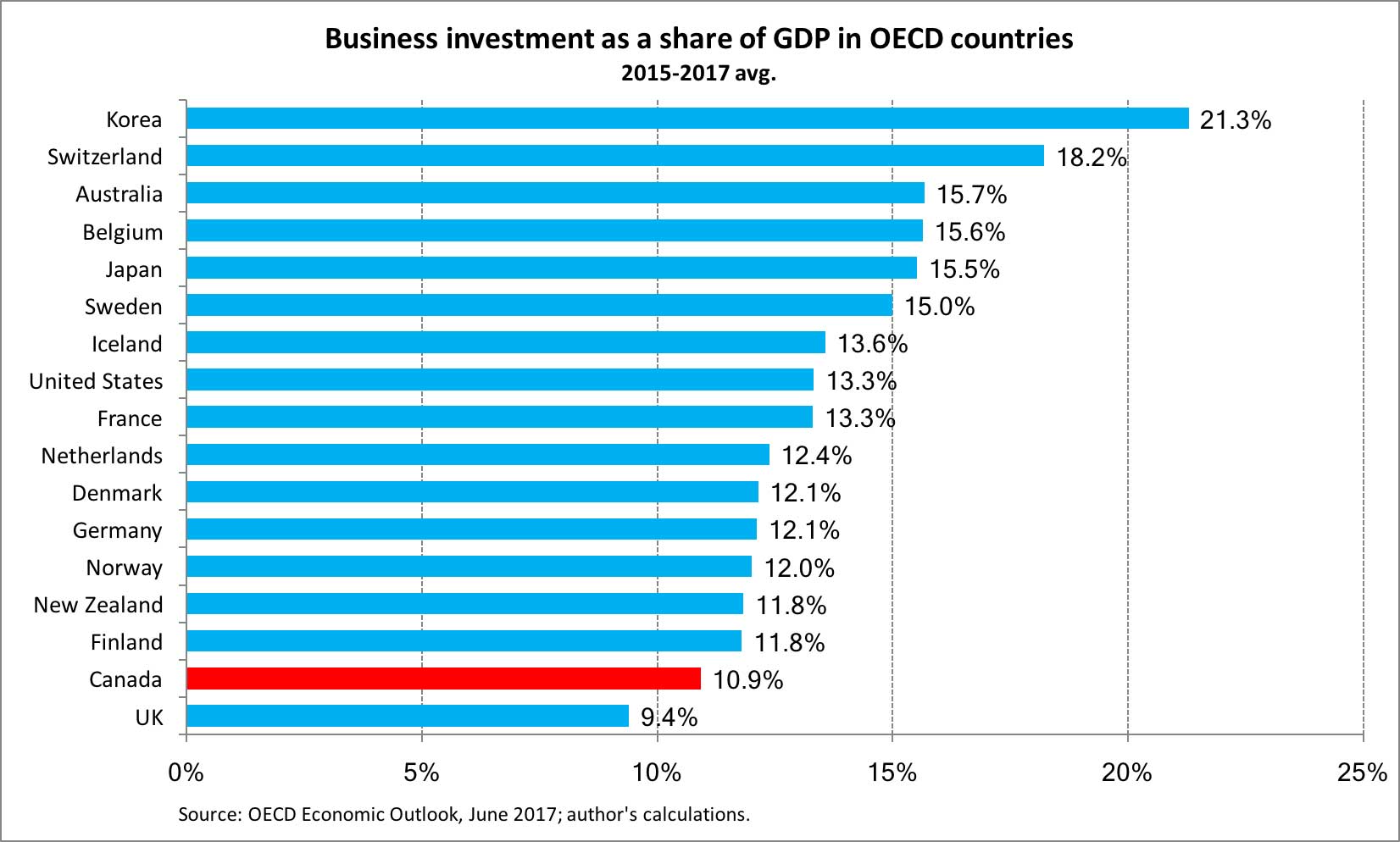
And unfortunately, Canada’s record indebtedness is not from productive investment that revamped our infrastructure or business sector to boost future productivity. As shown here, Canada’s business investment as a share of GDP has actually been one of the lowest of the OECD countries.
No, Canadian households and businesses have levered themselves to record highs this cycle, not to make smart investments for the future, but rather to buy things that depreciate like cars and discretionary goods, as well as over-valued real estate and corporate shares (that are also likely to depreciate from present levels).

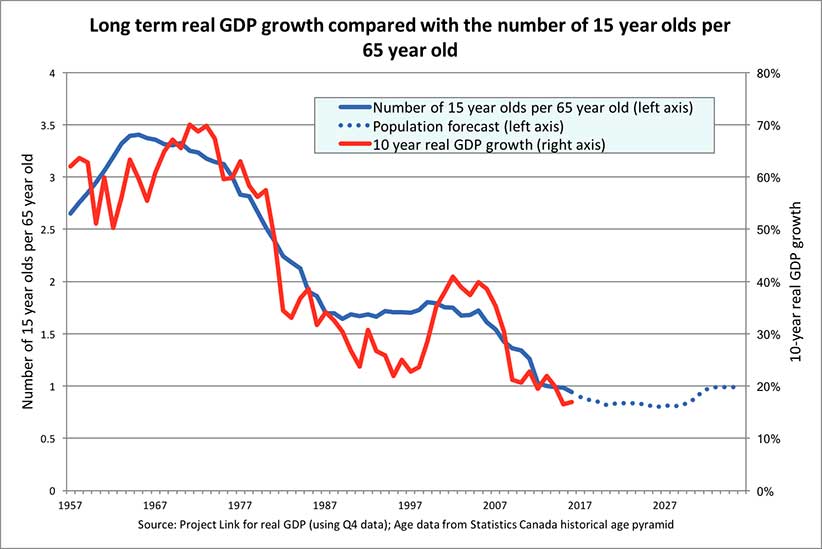
All while our aging demographics are set up to detract from growth and revenue over the next 20 years as shown below.  This will make paying back what’s already been borrowed, that much harder and take that much longer.

 

Posted in Main Page | Comments Off on BOC: Canadian economy looking ‘uncertain’ into 2018

TED: Gender equality is in everyone’s best interests–men included

Yes, we all know it’s the right thing to do. But Michael Kimmel makes the surprising, funny, practical case for treating men and women equally in the workplace and at home. It’s not a zero-sum game, but a win-win that will result in more opportunity and more happiness for everybody. Here is a direct video link.

Posted in Main Page | Comments Off on TED: Gender equality is in everyone’s best interests–men included

Government largess to large corps ballooning public debt

The Irish economy collapsed in the 2008 recession and financial crisis, leading to a massive government bail-out of investment banks and highly levered corporations. The efforts shackled the taxpayers with generational debt that they have been laboring to repay amid cuts to other social programs.  At the same time, Ireland shares the common plight of developed nations everywhere:  toxic processed food habits, and soaring sick-care costs, amid an aging population that is putting increasing strain on productivity and government resources.  It is within this context that one reads the following headline this morning:  Ireland forced to collect €13 billion in tax from Apple it doesn’t want.

The Irish government reached an agreement with Apple to start collecting the €13bn ($15bn) owed by the tech giant after the European Commission ruled in August 2016 that the iPhone maker must reimburse the Irish state for unpaid taxes that illegally permitted Apple to pay substantially less tax than other businesses.  Irish political leaders argue that collecting the back taxes could dent the country’s attractiveness as a low tax entryway for multinationals seeking access to the EU.

The funds are now to held in escrow while both Apple and Ireland appeal the decision to the European Commission, arguing that Cork-registered companies should be able to claim “stateless” income–profits that are beyond the jurisdication of any state to tax them.  See:  Apple and Ireland will fight the EU’s tax ruling all the way:

Apple is expected to take a similar line when it lodges its own appeal: that no rules have been broken, and that the company is the victim of a political attack that retrospectively and unreasonably unpicks tax treatments which have endured for decades without objection.

How has Apple been investing the gift from taxpayers of tax-lite cash flow?  The lion share has been used to buy back its own shares and increase dividends to shareholders.  See: Apple has been a buyback monster and Apple sells $5 billion of debt to fund share buybacks and dividends:

Apple is about three-fourths of the way through a program that’s returning $300 billion of capital to shareholders by the end of March 2019. At the start of July, the company was sitting on more than $261.5 billion of cash — 94 percent of which was outside the U.S., Chief Financial Officer Luca Maestri said on an earnings call. The Cupertino, California-based company declared a regular quarterly dividend of 63 cents a share last month.

There is a direct connection here between the corporate capture of political leaders that has helped to queer government policies in favor of the largest corporations at the expense of everyone and everything else. Low corporate tax rates, subsidies to mature businesses, and other largess from governments are directly related to the massive debt and crushing costs (health, environmental, social) now weighing on the stability and progress of the free world.

The sooner we re-ban share buybacks as illegal market manipulation (as they were before 1982) and stop helping the largest corporations slip through tax loopholes, the sooner we will begin the investment-intense work of rebuilding a sustainable future.  Funneling a further embarrassment of riches onto some shareholders, and investment banks doing the underwriting, at the expense of the public purse, must end now.

Posted in Main Page | Comments Off on Government largess to large corps ballooning public debt




