Downsizing expenses and waste: a trend whose time has come

We’ve been writing for some time about secular trends that will increasingly urge baby boomers to downsize McMansion-style homes.  Not only do people physically want less property upkeep as they age, but the drop in ‘safe’ income yields from 5 to 6% in 2007 to 1 to 2% today, has increased pressure on retirees, and those contemplating it, to reduce operating expenses and extract cash from their house asset.  Where a million in savings could pretty safely produce 50K a year of income a decade ago, today it can produce about 20k.  In other words, we need about 2.5x more savings today, to produce the same retirement income, as we did 10 years ago.  Something has to give, and it’s living expenses.

At the same time, not only do younger buyers generally lack the down-payments and income ability to buy McMansions, they also lack the interest.  Most are wisely attracted to more efficient housing with lower operating and environmental costs.

A recent survey by the Ontario Securities Commission found that 45% of pre-retired Ontario homeowners age 45 plus, are relying on the value of their home increasing from present (already lofty) levels to fund their retirement. The survey also found that while 73% of this group own homes — half of those still have a mortgage and half have no investment savings at all.

For those thinking that they will need or want to downsize their home to raise cash and lower expenses within the next 5 years, best to take proactive steps sooner than later.  See Boomers worry they can’t sell big homes when the time comes:

For owners of large homes near retirement, the best thing they can do is to close a sale while the sellers’ market is hot…

You can also invest in energy efficient and green technologies that make maintaining a large home more affordable, update the kitchens and baths, and remove the emotion from your decision.

This unsustainable era of oversized people, homes, expenses and debts is coming to a close of necessity.  The future will be leaner in every way.  And that is a good thing for those who can see and evolve their habits and thinking now.
Posted in Main Page | Comments Off on Downsizing expenses and waste: a trend whose time has come

Fossil fuel era ending faster than most can imagine

Oil prices are poised to crash to just $10 per barrel over the next six to eight years as alternative energy fuels continue to attract more and more investors, Chris Watling, chief executive of Longview Economics, told CNBC on Friday.  Here is a direct video link.

Also see:  Oil giant Shell buys leading operator of EV charging stations.

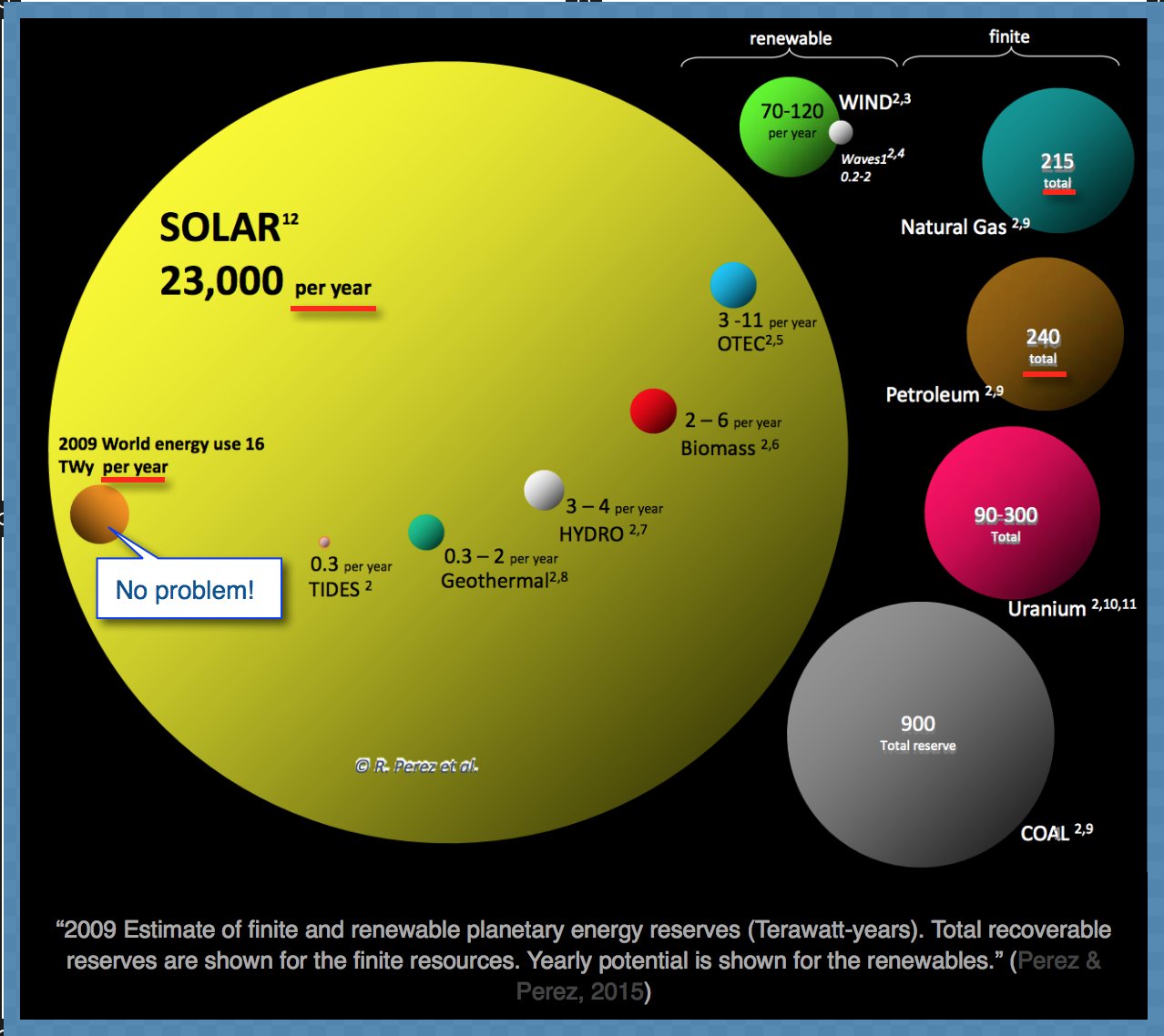
And then there is the below little graphic to offer some perspective as to the relative size of the known power resources on the planet and compared with global demand.
The cost savings in feeding electrical grids via solar-fuel and battery storage versus fossil fuels is mind-boggling and life changing for the world and its present political and economic order. Who is preparing for the inevitable and ongoing transition underway?

“If you wanted to power the entire U.S. with solar panels, it would take a fairly small corner of Nevada or Texas or Utah; you only need about 100 miles by 100 miles of solar panels to power the entire United States,” Musk said. “The batteries you need to store the energy, to make sure you have 24/7 power, is 1 mile by 1 mile. One square-mile. That’s it.”

See: It’s possible to power the entire US with solar, here’s how.

Posted in Main Page | Comments Off on Fossil fuel era ending faster than most can imagine

Nikkei’s secular bear continues: 28 years and counting

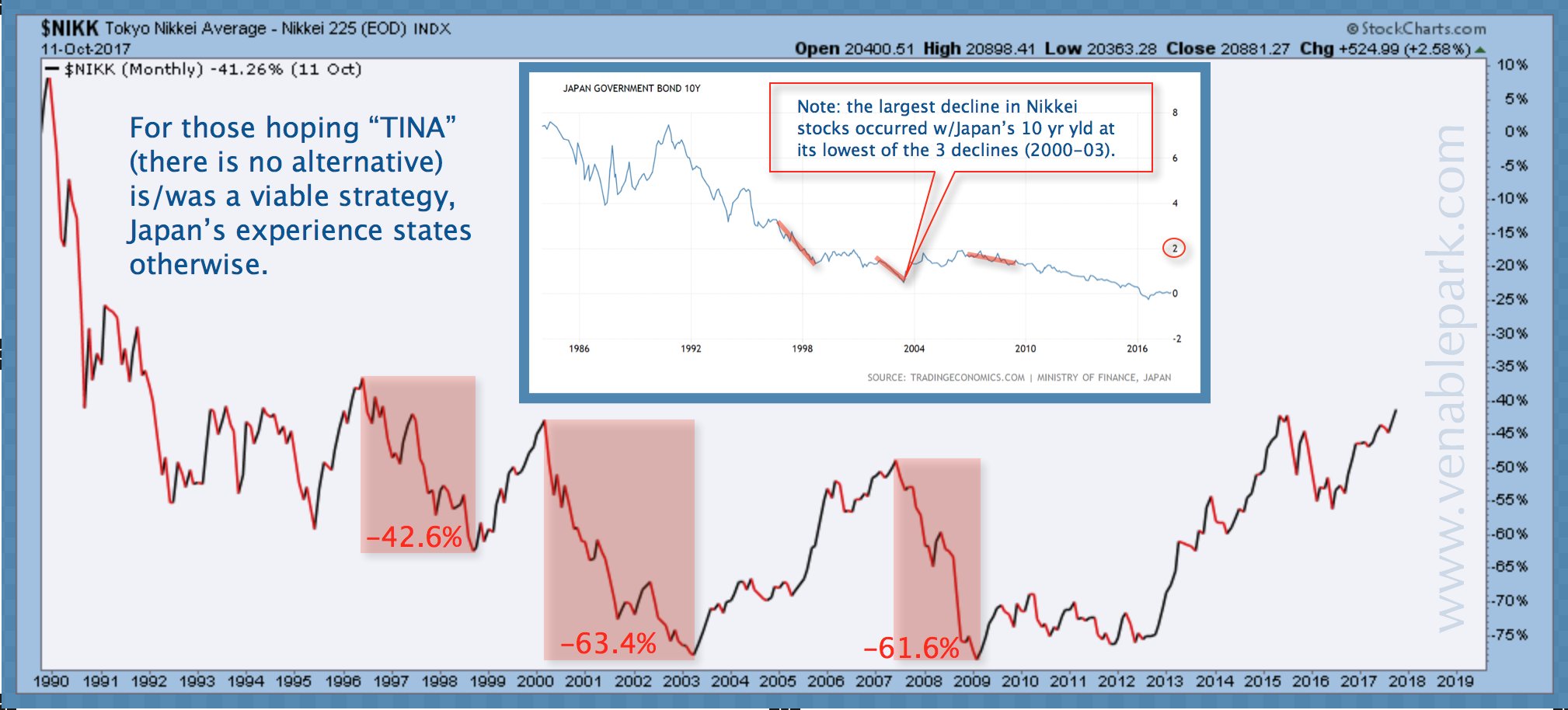
Excited headlines this week point out that after rising some 26% in the past 12 months, Japan’s Nikkei 225 stock index hit a 21 year high, rebounding to just under 21,000. The below chart of the Nikkei since 1990 shows the reality of the Japanese stock market, still some 46% below its last ‘everything bubble peak’ at 38,916 in December 1989.

Twenty-eight years and counting, and Japan’s stock market continues to grind through a secular bear born from obscene over-valuations, leverage and what became a government enabled, national obsession of speculation and reckless risk-taking in property and financial markets.  The leverage boom at home, enabled Japan’s speculative frenzy to spread ’round the world, driving up realty prices in places like North America to impossible (and thus unsustainable) levels for domestic home-buyers and renters to afford.


When the deserved mean reversion finally hit in Japan, asset prices plunged 50 to 80% and the debts endured (as they do) like a supernatural force smothering the economy and plunging the nation’s banks into insolvency.  After slashing policy rates to zero with little effect, the Bank of Japan (BOJ) began an experimental asset buying program in 2001 called Quantitative Easing that was recommended by then Princeton professor Ben Bernanke (this ringing any bells?).  The IOU ‘asset’ buying has continued in various iterations and increasingly larger sums ever since.  Today the Bank of Japan owns more than 40% of all Japanese government bonds, and at the end of June, more than 70% of all the common shares listed in Japanese ETFs.

Notwithstanding unending devotion to financially suicidal policies for the nation, and trillions in Ponzi-like financial assets bought with borrowed funds, now piled on central bank balance sheets worldwide, the Japanese stock market has nevertheless, moved through three cyclical declines of 40-63% in the last 20 years and–to repeat–remains 46% below its 1989 high.   All the while, Japanese bond yields have moved lower, with now negative yields out to 5 years, and less than .88 all the way out to 30 years.

To all the market cheerleaders who continue to assert that corporate bonds and stocks will keep moving higher because in a world of low yields, ‘there is no alternative’, the history of the past 30 years and beyond, begs to differ.  As noted by my partner Cory Venable in the chart above, each time stocks have relapsed into bear markets, government bonds have been bid, pushing their yields even lower as deleveraging participants run for liquidity and cash as the most valuable and essential asset class.

Many valuable lessons can be learned here, but first we need to look and see, and stop following the policies and leaders that have enabled the world through 30 years of wasteful and destabilizing boom and bust cycles to date.  Otherwise we are doomed to endure the  Sisyphean-like futility of pushing asset prices up only to watch them roll back down wiping out the economy and leaving prosperity and society further behind and ever more desperate.

Posted in Main Page | Comments Off on Nikkei’s secular bear continues: 28 years and counting