Warren shows what must be done to curb lawless financial sector

We need zero social and political tolerance and stiff personal penalties for individuals who enable and profit off financial crimes, if we are to rout out widespread abuse in this sector.  And if we don’t develop that, then we, the taxpayers and savers of the world, will just keep paying the price, over and over again.

Sen. Elizabeth Warren demands that Wells Fargo CEO Timothy Sloan be fired for his role in allowing the bank’s fake-accounts scandal to occur.”Wells Fargo needs to start over, and that won’t happen until the bank rids itself of people like you who led it into this crisis,” said Warren, who previously had demanded that the 12 board members in place during the scandal be removed. Here is a direct video link.

Elizabeth Warren to Wells Fargo CEO: You should be fired from CNBC.

Posted in Main Page | Comments Off on Warren shows what must be done to curb lawless financial sector

No back to school bounce back in Canadian housing

After a sharp pullback in sales and average prices over the past 6 months, realtors were predicting a back-to-school buyer surge in September.  That didn’t happen.  In the Greater Toronto Area, September’s sale volumes fell 38 to 45% over August, depending on home and location, according to Zoocasa’s data. Vancouver home sales also fell 7.3% from August through September.

Meanwhile a recent UBS study, named Toronto the most dangerously inflated housing market in the world today, with Vancouver also making the top 5.  See:  Toronto tops global list of real estate bubble risks.  Notably, as real prices have doubled in 13 years, real rents have increased by only 5% and real income by less than 10%.

In July, justified concern about highly indebted Canadian households and historic lows in interest rates, prompted the Canadian Office of the Superintendent of Financial Institutions to propose that all buyers needing a mortgage (not just those with less than 20% down) qualify based on a rate 2% higher than being offered, ie., if the lender is offering a rate of 2.85%, the borrower has to qualify for the loan based on a 4.85% rate, similar to the test now used for CMHC insured borrowers. This would reduce purchasing power by about 18% based on current interest rates.  If passed, the new rule would take effect in the New Year.

Bottom line:  stress-testing to make borrowers qualify at higher interest rates is necessary for longer term stability.  Short-term though, its likely to accelerate the mean reversion already underway in Canadian realty markets and Canadian economic growth. See:  Why the worst may be yet to come in Canadian housing, and here is a direct video link.

Posted in Main Page | Comments Off on No back to school bounce back in Canadian housing

US Tax reform: hype and hope over substance

As some dream that lower US corporate taxes will magically save the business/credit cycle from its normal and overdue correction phase and justify stock prices today trading at obscene valuations, the truth, as charted below, is that taxes paid by U.S. companies as a share of their operating profits, is already the lowest since 1947, next to the depths of the 2008 financial crisis.  See Blissful Delusion:

“Put simply, it seems misguided to imagine that “tax reform” will somehow make the most obscene speculative bubble in U.S. history something other than the most obscene speculative bubble in U.S. history. Corporations are already enjoying strikingly light tax burdens from a historical perspective, and investors are already paying extreme valuation multiples on elevated earnings.

We are observing an episode that will make future investors wince. Just like the two closest analogs, the 1929 high and the tech bubble, I expect that future investors will shake their heads in wonder at the stark raving madness of it all, and ask what Wall Street could possibly have been thinking.”

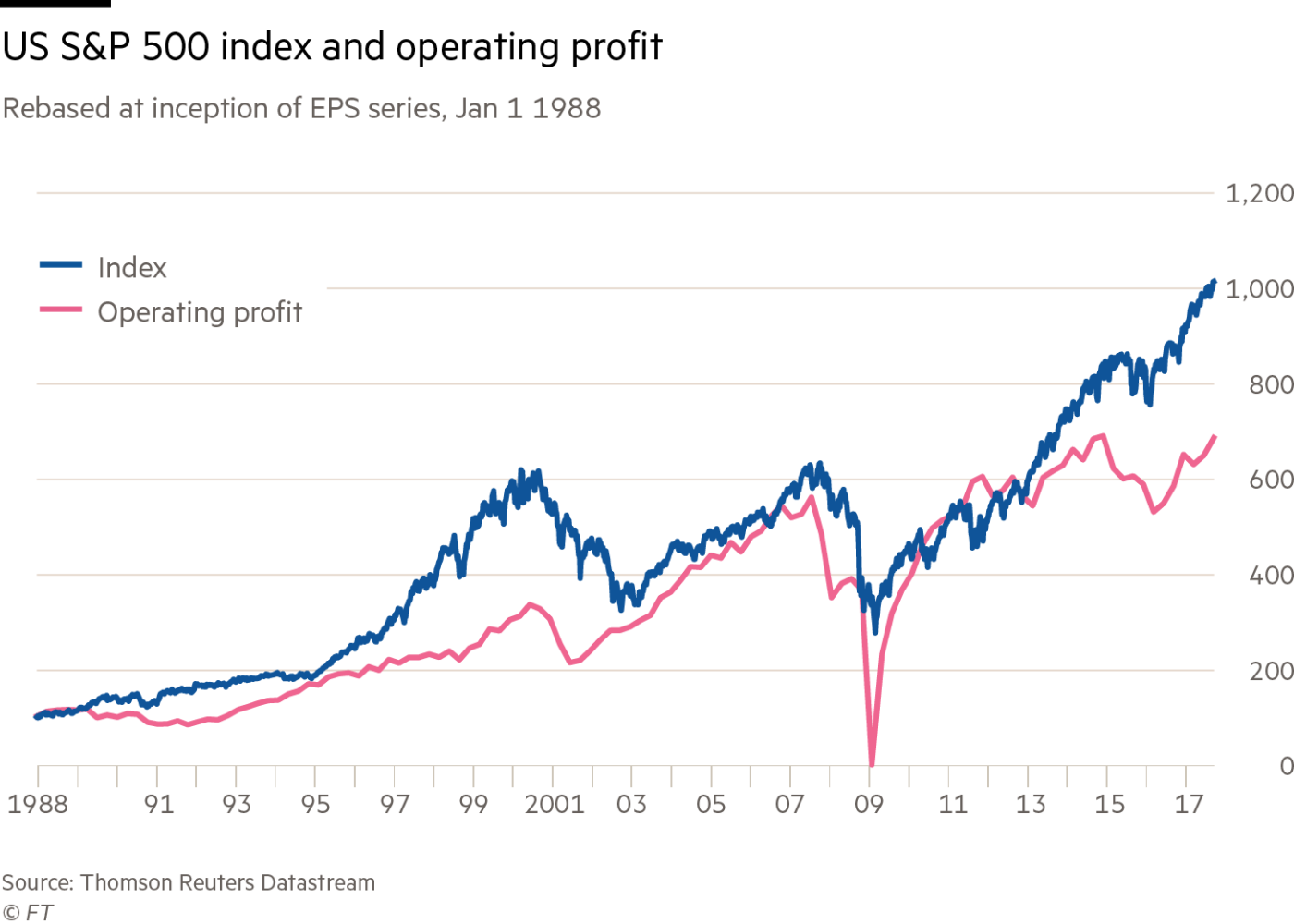
Comparing S&P 500 stock prices (in blue) with operating profits (before tax of any level–in pink below since 1988), we can see clearly that the third and greatest irrational exuberance episode of the past 20 years, has so overshot any logical connection to operating cash flows here, that only a mean reversion in stock prices can restore rational investment prospects.  No, paying even lower taxes won’t make this madness sane.  But it will make government deficits even larger.  All the less to bail out this mess once the debt bubble bursts again.
Posted in Main Page | Comments Off on US Tax reform: hype and hope over substance






