Oil and auto demand peaking because of economics, not carbon

As I (and many others) have explained many times (recently here), the business/economic case for transitioning to much smarter, cleaner more efficient water, food, transportation and energy systems is so overwhelming today, that change is happening with or without politicians or climate-change believers.  The catalyst is not the environment, but rather economic efficiency and the math of full cost accounting.

As highlighted in The future of transportation and the death of big oil and big auto, a new 77 page report, with great graphics available here: Rethinking Transportation 2020-2030: The disruption of transportation and the death of the internal combustion vehicle and oil industries.

Co-author Tony Seba projects that from the day autonomous vehicles (AVs) are approved for public roads it will take ten years for 95% of road travel to be autonomous, electric and shared. This will be disrupt individual vehicle ownership, internal combustion engine automobiles and oil producers.  See more here: If you can’t compete at $25 a barrel, you are out!

For those who think transportation disruption cannot happen within 10 years, Seba reminds that Uber did not yet exist in 2008 and yet today it has more bookings than the entire US taxi industry.

This is all about on-demand, relaxing, efficient transportation without the stress and responsibility or the negative cash flow of maintaining individual vehicles.  Seba explains the math:

“…electric autonomous vehicles operating in fleets and on demand, will be ten times cheaper than buying a new car. Every time there has been a factor of ten difference in cost, in any product or service in history, there has been a disruption. People are going to stop buying cars. We spend around 10 000 dollars a year on car ownership. We will be able to get the same level of transportation for 1000–2000 dollar. It makes rational economic sense to change your behavior. People will save 7, 8 or 9000 dollars. Who would not want to do that? Also, even if you own a car that is already paid off, so that all you need to do is to pay for petrol, maintenance and operating costs, that is still going to be 2-4 times more expensive than transport as a service. So even if somebody gives you a car for free, the running costs will be 2-4 times more expensive than transport as a service. This means that no one will buy a new car, and those who own a car, once they get rid of their car, they are not going to buy a new one, because at that point the differential in cost will increase. The cost of transportation as a service will keep going down and the cars for private ownership will keep going up. So over time it will make even more sense to get rid of your car and get into transport as a service.”

Posted in Main Page | Comments Off on Oil and auto demand peaking because of economics, not carbon

Plea for Glass-Steagall continues on Hill today

Excellent, must-understand-article from Paul Craig Roberts on the necessity for a return to hard divisions between taxpayer-backed bank deposits and product sales and speculation by investment banks, should be read by everyone. See:  Without Glass-Steagall America will fail.

I would broaden the statement beyond America to the free world: capitalism and democracy globally will are failing now. Restorative action in reconnecting loss responsibility to those taking capital risks is foundational for survival of a functioning society.  This is no over-statement:

America cannot survive if excessive risks and financial fraud can be bailed out by taxpayers.

US Representatives Walter Jones and Marcy Kaptur and members of the House and staff on both sides of the aisle, along with former Goldman Sachs executive Nomi Prins and leaders of citizens’ groups,  have arranged a briefing in the House of Representatives on June 14 about the importance of Glass-Steagall to the economic, political, and social stability of the United States.  Let your representative know that you do not want the financial responsibility for the reckless financial practices of the big banks.  Let your representative know also that you do not want big banks that dominate the financial arena. Let them know that you want the return of Glass-Steagall.

The effort to reduce the financial risks arising from the commingling of commercial and investment banking by requiring stronger capital positions of financial corporations is futile. The 2007-08 financial crisis required the taxpayers and the printing press and an amount of money that exceeded any realistic capital and liquidity requirements for financial institutions.

If we don’t re-enact Glass-Steagall, the risks taken by financial greed will complete the economic destruction of America.

Posted in Main Page | Comments Off on Plea for Glass-Steagall continues on Hill today

Cov-lite loan madness back with a vengeance

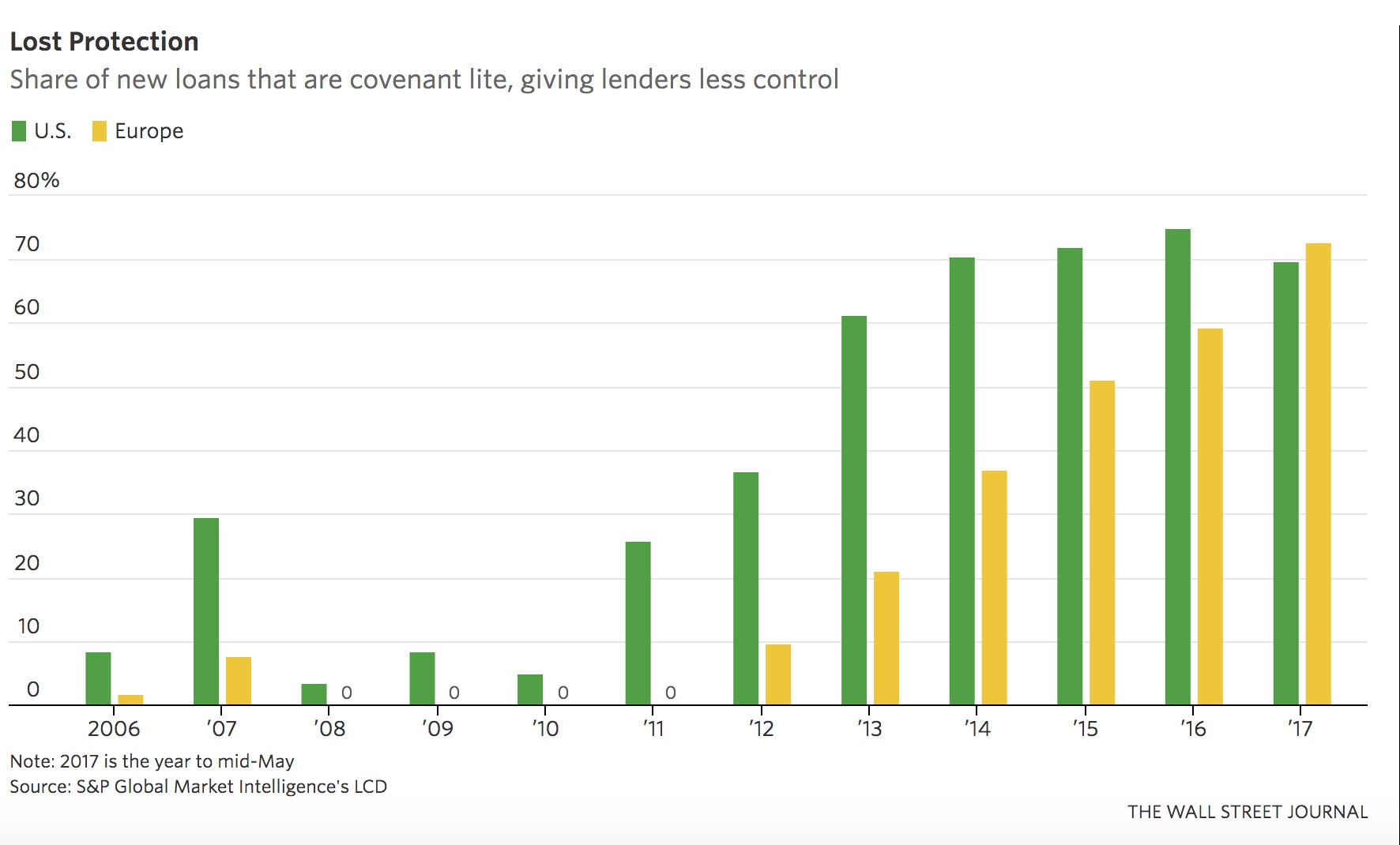
Dramatically under-pricing capital risk has been the hallmark of the last 20 years of the most interventionist monetary policy in human history.  Increasingly more reckless capital allocations have led to three successively larger financial bubbles–punctuated by two global busts to date–in 17 years.  The present (third) bubble is the biggest yet, and has infected every asset class.  One of the most obvious indicators of present risks can be found in the leveraged loan market–the same products that triggered the 2007-09 collapse–only this time, it is much larger.

To wit:  in 2007, just under 30% of U.S. loans and 8% of European loans were covenant lite, according to S&P Global Market Intelligence’s LCD research unit. Last year almost 60% of European deals and 75% of U.S. deals were covenant lite.  Superfluous capital desperate for yield has been throwing itself into the certainty of capital losses.  Here is the chart from the Wall Street Journal.  See Hunt for yield is driving loan investors crazy:

Leveraged loans are popular because they pay higher yields than investment-grade bonds, are secured against borrower assets and give investors protection from changes in underlying interest rates. But they are also relatively risky because borrowers are usually heavily indebted.

Lenders used to get extra protection by attaching conditions to the loan, known as covenants, which allowed them to take action if a borrower’s earnings deteriorate, for example. These days, most loans are “covenant lite” meaning lenders get less influence over a borrower’s actions.


Posted in Main Page | Comments Off on Cov-lite loan madness back with a vengeance