Plea for Glass-Steagall continues on Hill today

Excellent, must-understand-article from Paul Craig Roberts on the necessity for a return to hard divisions between taxpayer-backed bank deposits and product sales and speculation by investment banks, should be read by everyone. See:  Without Glass-Steagall America will fail.

I would broaden the statement beyond America to the free world: capitalism and democracy globally will are failing now. Restorative action in reconnecting loss responsibility to those taking capital risks is foundational for survival of a functioning society.  This is no over-statement:

America cannot survive if excessive risks and financial fraud can be bailed out by taxpayers.

US Representatives Walter Jones and Marcy Kaptur and members of the House and staff on both sides of the aisle, along with former Goldman Sachs executive Nomi Prins and leaders of citizens’ groups,  have arranged a briefing in the House of Representatives on June 14 about the importance of Glass-Steagall to the economic, political, and social stability of the United States.  Let your representative know that you do not want the financial responsibility for the reckless financial practices of the big banks.  Let your representative know also that you do not want big banks that dominate the financial arena. Let them know that you want the return of Glass-Steagall.

The effort to reduce the financial risks arising from the commingling of commercial and investment banking by requiring stronger capital positions of financial corporations is futile. The 2007-08 financial crisis required the taxpayers and the printing press and an amount of money that exceeded any realistic capital and liquidity requirements for financial institutions.

If we don’t re-enact Glass-Steagall, the risks taken by financial greed will complete the economic destruction of America.

Posted in Main Page | Comments Off on Plea for Glass-Steagall continues on Hill today

Cov-lite loan madness back with a vengeance

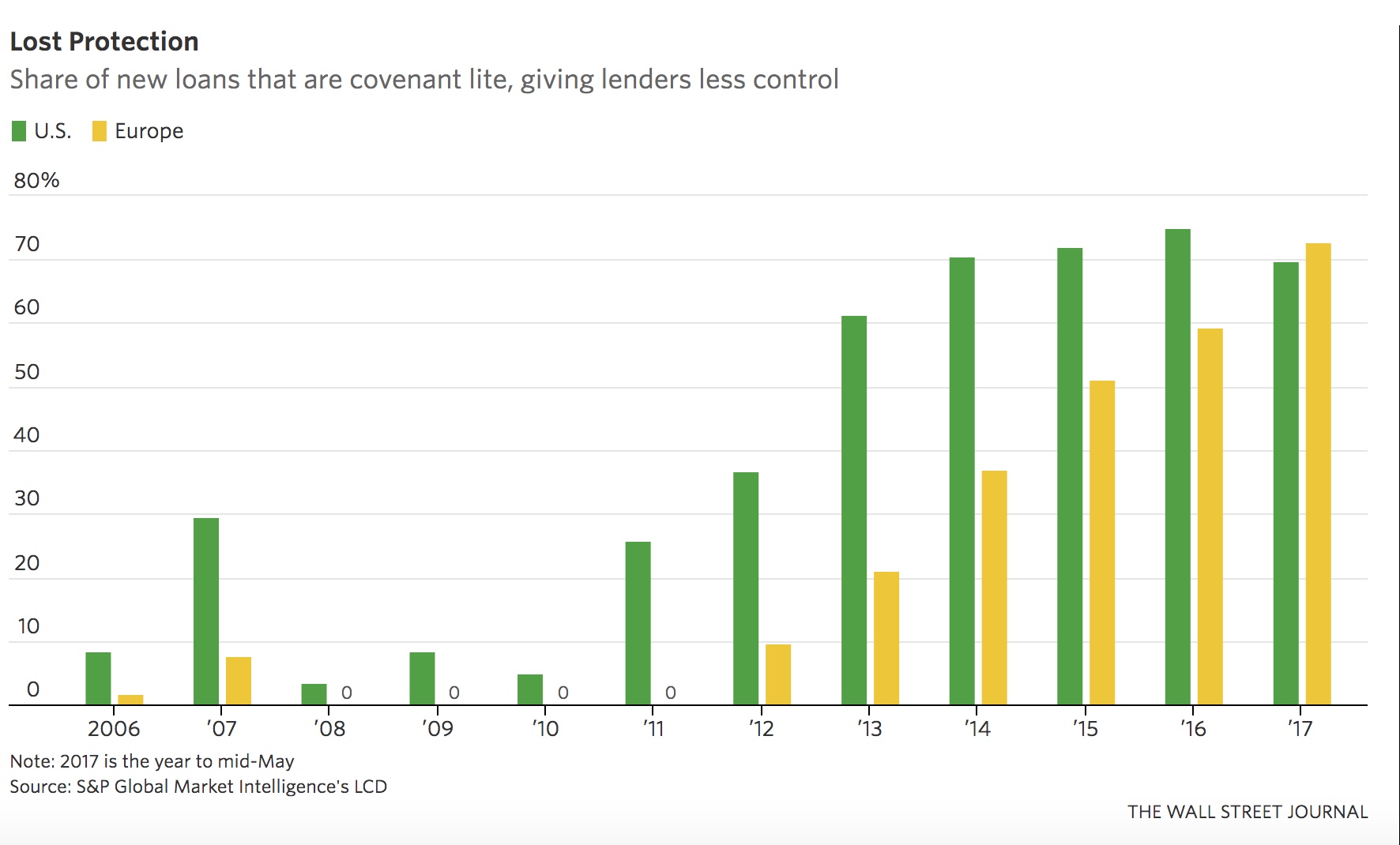
Dramatically under-pricing capital risk has been the hallmark of the last 20 years of the most interventionist monetary policy in human history.  Increasingly more reckless capital allocations have led to three successively larger financial bubbles–punctuated by two global busts to date–in 17 years.  The present (third) bubble is the biggest yet, and has infected every asset class.  One of the most obvious indicators of present risks can be found in the leveraged loan market–the same products that triggered the 2007-09 collapse–only this time, it is much larger.

To wit:  in 2007, just under 30% of U.S. loans and 8% of European loans were covenant lite, according to S&P Global Market Intelligence’s LCD research unit. Last year almost 60% of European deals and 75% of U.S. deals were covenant lite.  Superfluous capital desperate for yield has been throwing itself into the certainty of capital losses.  Here is the chart from the Wall Street Journal.  See Hunt for yield is driving loan investors crazy:

Leveraged loans are popular because they pay higher yields than investment-grade bonds, are secured against borrower assets and give investors protection from changes in underlying interest rates. But they are also relatively risky because borrowers are usually heavily indebted.

Lenders used to get extra protection by attaching conditions to the loan, known as covenants, which allowed them to take action if a borrower’s earnings deteriorate, for example. These days, most loans are “covenant lite” meaning lenders get less influence over a borrower’s actions.


Posted in Main Page | Comments Off on Cov-lite loan madness back with a vengeance

Worthwhile read: ‘How to make money’

Bill Gross has penned a succinct and worthwhile heads-up-primer for his June monthly letter.  See:  How to Make Money.  After 8 years of near zero rates and $8 trillion in global QE indiscriminately bidding up asset prices everywhere, it’s important to hold fast to cycle and valuation bearings, lest we too succumb to financial suicide with the masses.  Here’s a snippet:

Because of the secular headwinds facing global economies, currently labeled as the “New Normal” or “Secular Stagnation”, investors have resorted to “making money with money” as opposed to old-fashioned capitalism when money and profits were made with capital investment in the real economy.

…But don’t be mesmerized by the blue skies created by central bank QE and near perpetually low interest rates. All markets are increasingly at risk.

Money will currently be made, or at least conservatively preserved, by acknowledging the exhaustion of “making money with money”.  Strategies involving risk reduction should ultimately outperform “faux” surefire winners generated by central bank printing of money. It’s the real economy that counts and global real economic growth is and should continue to be below par.

Posted in Main Page | Comments Off on Worthwhile read: ‘How to make money’