
The US Fed hiked its policy rate by 25 bps yesterday to 3.75-4%, as expected, and 16 of 18 FOMC members expect an additional hike in 2026 (two rate decisions remain: October 28 and December 9).
Anticipating stubborn inflation, eight of the 18 participants (roughly 44%) see further tightening needed in 2027, six see holding pat while 4 see cuts. No one on the committee indicated that they see an economic contraction (but they never do).
Stocks and bonds sold off after the announcement (yields/rates higher); both are rebounding again this morning (yields/rate lower). The influential 10-year US Treasury yield closed above 5% yesterday for the first time since April 2007.
In April 2007, oil (WTIC) was also above $100 a barrel, and higher interest rates were compounding financial stress even as the stock market remained near cycle highs.
The U.S. fed funds rate had been held at 5.25% from June 2006, and the consensus predicted growing demand and persistent inflation through 2007.
By September 2007, the Fed responded to an emerging financial crisis with a 50 bp cut to 4.75%, followed by an aggressive easing cycle through December 2008, ending at a policy rate of 0 to 25bps.
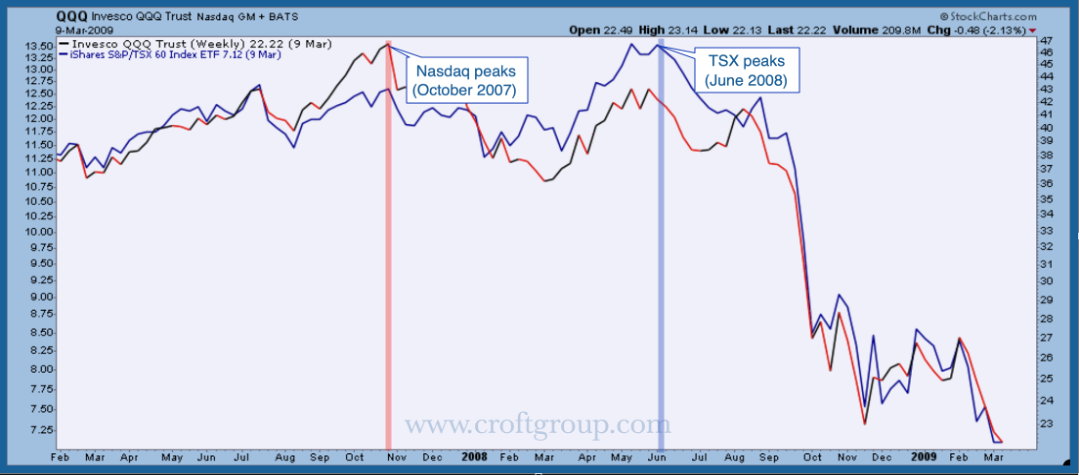
Contrary to consensus, commodities, equity prices, and corporate bonds plunged, while Treasury prices rose, taking the U.S. 10-year Treasury yield from 5.26% to 2% (as shown below).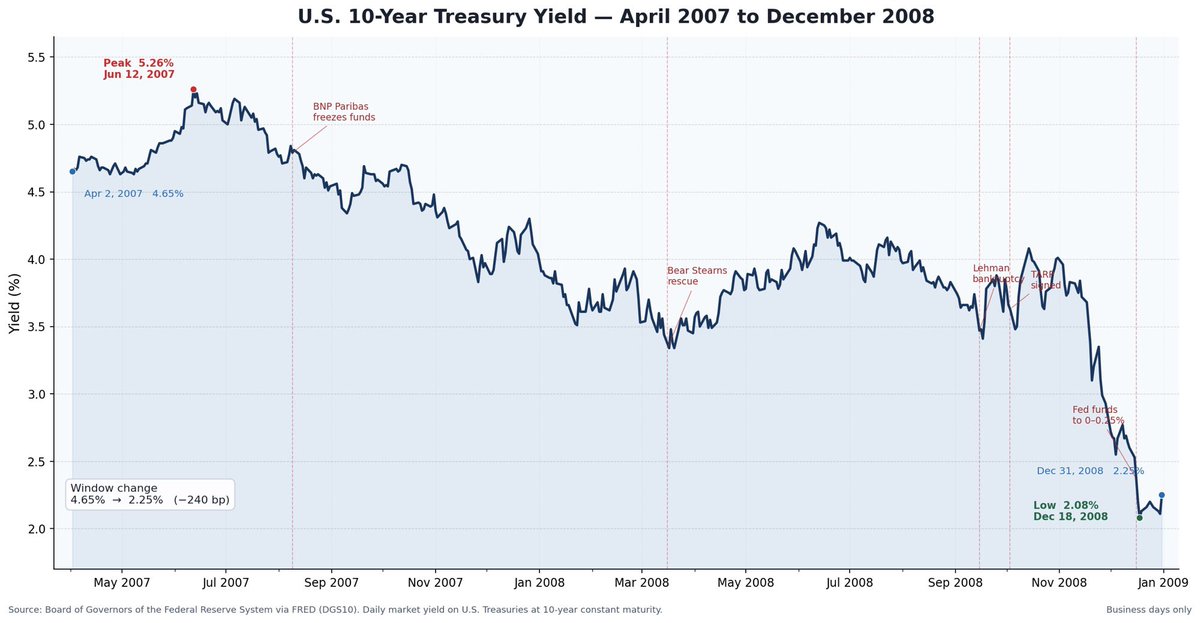 In 2007, as now, many predicted that equities and, particularly, Canada’s commodity-heavy stock market would prove resilient. That was not the case; the TSX (in blue below) tumbled with the tech-heavy US NASDAQ (in red) from October 2007 through March 2009.
In 2007, Canada was not in the midst of a housing bubble bust. Today, it is, along with many other countries including the U.S., U.K., Australia, New Zealand and China. Record debt and falling home prices pose a significant economic burden.
No one knows how long the current geopolitical tensions will persist, but global demand will continue to fall out of necessity, as financial conditions tighten. We have seen this movie several times before.








