It’s the economy…

US Consumer sentiment sank about 11% this month, extending a decline that began with the start of the Iran conflict, and is currently about 9% below a year ago.

Demographic groups across age, income, and political party all posted setbacks in sentiment, as did every component of the index, reflecting the widespread nature of this month’s fall. One-year expected business conditions plunged about 20% and are now 6% below last April.

It seems gaslighting by stock market cheerleaders can’t fool all of the people all of the time. Assessments of personal finances declined about 11%, with consumers expressing a substantial increase in concerns over high prices and weaker asset values.

Buying conditions for durables and vehicles worsened again, driven by high prices. (source: U of M), Also see US Consumer Sentiment Drops to Record Low on Price Concerns.

The preliminary April sentiment index slumped to 47.6 from 53.3 in March (top left below), while inflation expectations rose, current economic conditions hit a record low, and the current financial situation index hit the lowest since March 2009.

Yesterday, the U.S. Bureau of Economic Analysis reduced its third estimate of real U.S. gross domestic product (GDP) for the final quarter of 2025 to an annualized rate of 0.5 percent, down from 1.4% in the advance report and 0.7% in the second estimate.

At the end of February, StatsCan said Canada’s economy contracted .60% annualized in the final quarter of 2025. We get the Q1 GDP growth estimate on May 29th.

Today, StatsCan announced that the economy added a modest 14,000 jobs in March, clawing back a fraction of the 109,000 job losses seen during the first two months of the year (shown below).In the World Happiness Report 2026 Canada ranked 25th out of 147 countries– its worst-ever showing in the 14 years the report has been published. A decade ago, Canada ranked 6th, in the same league as Scandinavian countries.

The situation is particularly dire among young Canadians — when only under-25s are counted, Canada falls to 71st place. Young people were once the happiest Canadian cohort; now they are the most miserable. Compared with 136 countries, Canada’s 10-year drop in youth life satisfaction ranks among the largest in the world. (Source: The Globe and Mail)

In the Ipsos Global Happiness Survey 2026, financial situation was cited as the number one cause of unhappiness, cited by 57% of respondents. (Ipsos)

The common thread across all surveys is a country that is holding together on the surface but facing real and deepening unhappiness, particularly among younger generations, driven by unaffordable housing, financial insecurity, and social factors, including social media use.

Stocks started the day on a positive note, but are falling off again in the early afternoon. Only high-frequency traders and those acting on inside information can trade with confidence. Everyone else has good reason to be cautious, at least until asset prices come down enough to restore some margin of safety.

Remember, when it’s time to buy, most won’t want to, and few will have meaningful cash to deploy.

Posted in Main Page | Comments Off on It’s the economy…

Treasuries gain on rising recession odds

Markets are celebrating that the United States and Iran agreed to a two-week ceasefire amid ongoing negotiations.  So far, the parties seem worlds apart, especially on issues like Iran continuing its nuclear program. But we all hope for a sane and rapid end to the carnage. Fossil fuel prices are down sharply, and stocks are giddy. More importantly, government bond prices are rising.

Falling fossil fuel prices reduce inflation fears. So do falling home prices and rents. Shelter accounts for 30% of Canada’s CPI basket and 36% of the US CPI — by far the largest single inflation driver in both countries.

Last month, home sales in the Greater Toronto Area (GTA) rose 1.4% over February but were still 52% below the 10-year average for March. See, Toronto home sales post first monthly increase since September.

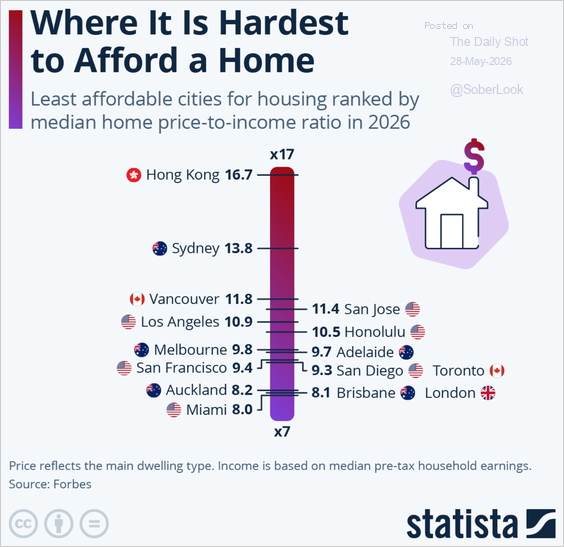
Every type of property has lost value in Toronto and its surrounding suburbs, but prices remain debilitating for most. Last month, the GTA home price index was $928,000 — 7% lower than in March of 2025 and still an impossible 9 to 10x the median household income (around 100k before tax).

The real estate industry loves to cite economic uncertainty as a deterrent to prospective buyers, with little mention of unaffordable pricing. Significantly more mean reversion is needed before purchasing power returns to buyers.

Struggling consumers are a major reason the bond market’s best guess of inflation over the next five years has remained flat, even since the war began. Higher prices reduce spending power, and in the long term, that’s less inflationary. This morning, Futures markets are back to pricing in an easing Fed by year-end. For some historical context, see Pain at the Pump Should Mean Pain in the Economy, Not Higher Rates:

In the annals of central-bank mistakes, three loom large: 1973, 2008 and 2011.

In the oil shock of 1973-74 caused by the Arab oil embargo, the Federal Reserve is generally regarded as having ignored the second-round effects of oil prices and kept monetary policy too easy.

But the mistake was made not when oil prices rose, but when they fell back during the deep recession caused by the oil-price spike. As recession took hold, the Fed eased policy, then kept it easy even when core inflation refused to drop below 6%.

It’s hard for those who weren’t there to believe now, but in 2008 and 2011 the ECB raised rates, focusing on soaring crude prices and ignoring already obvious trouble in the financial sector. In 2008, it had to reverse course rapidly as banks imploded, and again in 2011 as the entire euro system threatened to implode.

In each case, the problem of high oil prices quickly turned into a problem of a weak economy, with lower oil prices and falling inflation. As the saying goes in commodities markets, the cure for high prices is high prices. These hurt demand and, eventually, stimulate investment in new supply.

Second, high oil prices also hit the economy. Consumers and businesses face higher and hard-to-avoid costs, much like a new tax. There should be no need for a double whammy for borrowers in the form of higher interest rates.

It’s hard for inflation to find purchase amid a deteriorating labour market. Canada’s economy has lost 100k jobs in the past two months, and Moody’s Chief Economist Mark Zandi points out that the indicator that has called every recession since WWII just signalled the US is already in one.

Danielle Di-Martino Booth connected many of these dots well this morning on Bloomberg.

Posted in Main Page | Comments Off on Treasuries gain on rising recession odds

We can learn from financial hardship

For more than two decades, I have been warning individuals about the heightened risk and stress associated with high debt levels and financial bubbles. Unfortunately, many older people are financially uninformed and don’t set a good example for younger people. Worse, many parents and grandparents have encouraged and enabled young people to become heavily indebted. They thought they were helping, but in many cases, their advice was harmful. We are now paying the price for that with interest.

The Bloomberg Nanos Canadian Consumer Confidence Index fell to 46.93 in the week ended April 3, while the expectations index extended its four-week loss to almost 10 points. A reading below 50 indicates net negative views. It was the lowest reading for both indexes since May 2025, when consumers and businesses were still digesting the initial shock of US President Donald Trump’s “Liberation Day” tariffs.

Just 15% of Canadians see a stronger economy six months from now, compared with 27% four weeks ago. See, Canadian Consumer Confidence Hits 11-Month Low as Iran War Drags On.


Food bank usage increased 90% between 2019 and 2024, according to Food Banks Canada. Other social transfers in kind, where Statistics Canada records food bank usage, are up nearly 40% for Canada’s lowest income households over the same period, compared to 28% across all households (RBC report).

Beyond a sluggish economy, rising unemployment, and angst with our largest trading partner, Canadians are the most indebted households of developed economies. Household debt totals $3.1 trillion, equivalent to 100.8% of GDP (Q4 2025).

The US comparison tells the real story. Both countries had similar household debt levels in the early 2000s, but their paths diverged sharply after the 2008 financial crisis. American households went through a sustained deleveraging — paying down debt and rebuilding balance sheets — while Canadian households kept borrowing, largely fuelled by rising home prices and cheap mortgages. Canada’s ratio surpassed the US’s around 2011 and has continued to outpace it since, with Canadian households reaching a peak debt-to-income ratio of 188% in Q3 2022 — higher than the US ever reached, even at the peak of its 2007 housing bubble. (Statistics Canada)

The recent modest decline from that 188% peak reflects the impact of higher interest rates cooling mortgage borrowing, but the debt-to-income ratio rose again to 177.2% in Q4 2025, marking a fifth consecutive quarterly increase as debt growth continued to outpace income.

Record debt levels led Canada into a world-famous housing bubble that is now in its 4th year of deflating, eroding notional equity from household balance sheets while debt levels persist. Deflating stock prices are another depressant of net worth. It will take time, more price deflation and debt retirement to dig our way back to economic health and resiliency. The upside is that we can learn from the experience.

Honest, unvarnished by salespersonship, advocates for financial literacy are rare, but they do exist, and it is never too late to admit past mistakes, repent, and reform behaviours to recover. Everyone who takes the time to learn and understand can help. The discussion below is worth sharing.

Our guest this episode is Doug Hoyes — Co-Founder of Hoyes Michalos (‪@DebtFreein30‬) Licensed Insolvency Trustee and one of Canada’s leading experts on debt and personal insolvency. Doug has spent decades helping Canadians navigate financial hardship and is a passionate advocate for ensuring people understand their options and find the right path forward. In this episode, Dave and Doug dive into the world of debt, bankruptcy and consumer proposals — what they are, how they work and when each option might make sense. They break down how Licensed Insolvency Trustees operate, how consumer proposals are negotiated and what actually happens if you file for bankruptcy (what you keep, what you lose and who typically ends up choosing each path). Doug also shares insights into why so many Canadians are struggling with debt today, from inflation and the “K-shaped” economy to mortgage renewals, rising vehicle costs and the financial impact of divorce.  Here is a direct video link.


Posted in Main Page | Comments Off on We can learn from financial hardship