The simple, ego-free, mathematical valuation measurements that have had a near perfect 97% correlation in predicting actual investment returns over subsequent 7 to 12 year periods (such as forward operating price to earnings multiples, Shiller CAPE, price to cash flow, price to dividend, Tobin’s Q, the Fed Model, and market capitalization to GDP) are all forecasting flat to negative returns for North American stocks from present levels. See: Valuation Breakevens, The truth about earnings and stock values, and here is GMO’s latest Q1 2017 asset class return forecasts based on similar valuation measurements they have been tracking for decades. Why ever should we care?
Because these same measurements suggested similar forward returns at euphoric cycle peaks in 1998-2000 and 2005-2007, and they were proven accurate courtesy of massive price declines (-55 to -78%) and the many years it took thereafter to make back losses.
Here is a nominal price chart of the NASDAQ Index since 1998, showing the 17 years it has spent making back the 2000-2003 losses before finally breaking through to some tiny nominal progress (in green) over the past few months. Still think it’s fine to ignore asset valuation readings? Think this time is different?

Some of the index components have changed since 2000: bankruptcy, mergers, consolidations and some new upstarts have all changed the mix. Here is a comparison of the top ten constituents in 1999 and 2015.
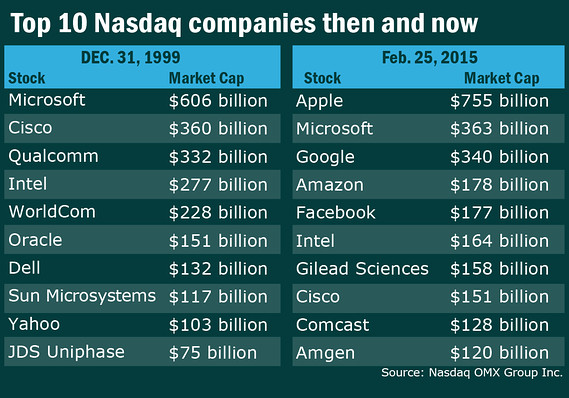
Companies and their promoters come and go, while investors win and lose. But historical valuation metrics have always been prescient. The fact that it takes indefinite periods of time for mean reversion to complete a full cycle, doesn’t make the measurements wrong but it can try patience.
Sticking to a valuation discipline doesn’t offer precision timing nor a cure for mental weakness, but it is more useful than anything else we have. In the words of Matthew McLennan, head of global value, First Eagle Investment Management:
“As a value investor, you have to be willing to be short on social acceptance for long periods of time. Individual ideas about how to assess value will always evolve, but fundamentally value capitalizes on the fact that investors are extraordinarily talented when it comes to making bad decisions at the worst possible time. That won’t change.”