Happy Monday!
Heading into the traditionally challenging second year of the US presidential cycle, global news flow continues to erode consumer and business confidence. In response, the Trump administration is intensifying efforts to boost popular support through handouts and distractions. In the early going this morning, equity futures are down, along with the US dollar.
Among the top headlines yesterday, President Trump directed the US Department of Justice to serve the Federal Reserve with grand jury subpoenas, threatening a criminal indictment over Chairman Jay Powell’s congressional testimony last June regarding the ongoing renovation of the central bank’s headquarters.
In a written and video statement released Sunday evening, Fed Chair Powell took the gloves off, saying:
“The threat of criminal charges is a consequence of the Federal Reserve setting interest rates based on our best assessment of what will serve the public, rather than following the preferences of the president.”
Meanwhile, layoffs are continuing at a pace as tariffs and weaker demand bite into profit margins. Companies of all stripes are filing for bankruptcy; large corporate bankruptcies are at their highest level in 15 years. See, Bankruptcies are exploding across the economy, hitting small businesses and households. Few industries are immune:
“Rising costs, tighter credit conditions, and ongoing geopolitical volatility continue to exert pressure on households and businesses already facing financial strain,” Amy Quackenboss, the executive director at the American Bankruptcy Institute, said earlier this month.”
The University of Michigan consumer sentiment index, at 53.3 in December, was 23% below the 69.6 average reading at recession lows since 1953, and only weaker at the May 1980 recession low of 51.7.
Despite record capital spending on Artificial Intelligence (AI) infrastructure, the US Index of Leading Economic Indicators (LEI), published by the Conference Board, has been flat or declining for 10 consecutive months and now sits at an 11-year low. The year-over-year LEI has been negative every month since July 2022 (-3.3% currently), a persistence historically seen only during outright recessions. Absent the positive lift from rising equity markets, the deterioration in leading economic signals would be even more pronounced.
More than at any point in modern history, the economy has become dependent on the direction of the stock market. Forecasts are notoriously backward-looking, with consensus targets historically lagging price moves by roughly two months (Piper Sandler data).
Market prices have therefore proven to be a better leading indicator of forecasts than forecasts are of prices, making it unsurprising that after three consecutive years of double-digit equity gains, Wall Street forecasters are reporting record optimism for 2026.
Historically, the second year of the US presidential cycle (2026) has been the weakest for equities. Since 1948, the S&P 500 has suffered an average peak-to-trough decline of roughly 17% in Year Two, and closer to 20% in first-term administrations. The pattern highlights that midterm years often coincide with political uncertainty and economic adjustment, conditions that tend to challenge risk assets even within longer-term bull markets.
In the rare instances when stock prices entered the second year of the presidential cycle at high valuations, in 1962, 1966, 1974, 1990, 2002, 2010, 2018, 2022, drawdowns ranged from -20 to -48%.
The current 23x S&P 500 12-month forward price-to-earnings ratio has only been seen twice before, at bubble peaks in 2000 and 2022; prices fell 48% and 25%, respectively.
The S&P 500’s cyclically adjusted price-to-earnings ratio (CAPE)—price divided by the average inflation-adjusted earnings of the past ten years—now stands near 40×. There has never been an instance in which markets trading above a 35× CAPE did not generate losses over the subsequent 1-, 3-, 5-, and 10-year periods.
At the same time, the S&P 500 is trading at roughly 3.33× sales—the highest level on record and about double its long-term median of 1.67×.
The most reliable way to make money in the stock market is not by buying shares, but by creating a company and selling shares to the market—especially when valuations are at record highs. In that case, the outcome is favourable for the seller and far less so for the buyer.
In a recent interview, Elon Musk, the world’s richest person, underscored this reality when asked what companies people should invest in, noting: “I don’t really buy stocks… I don’t have a portfolio or anything. I don’t look for things to invest in. I try to build things, and then there happens to be stock of the company that I built.”
The second-best way to make money in the stock market is to buy when others are panicking and liquidating their holdings at steep discounts. To capitalize on those periods, we must prepare in advance, reducing risk exposure by storing cash to support our financial and psychological wherewithal.
Because common shares have no maturity date, their duration— the time required to recover the investment—is effectively infinite. In practice, this means that equities behave like very long-duration assets, roughly comparable to 20- to 40-year securities, because most of their value derives from earnings far in the future. Growth stocks that pay little or no dividends therefore have the most extended duration, while dividend-paying equities have shorter duration. By contrast, government bonds, with fixed maturities and contractually defined interest payments, have much lower duration and repayment risk.
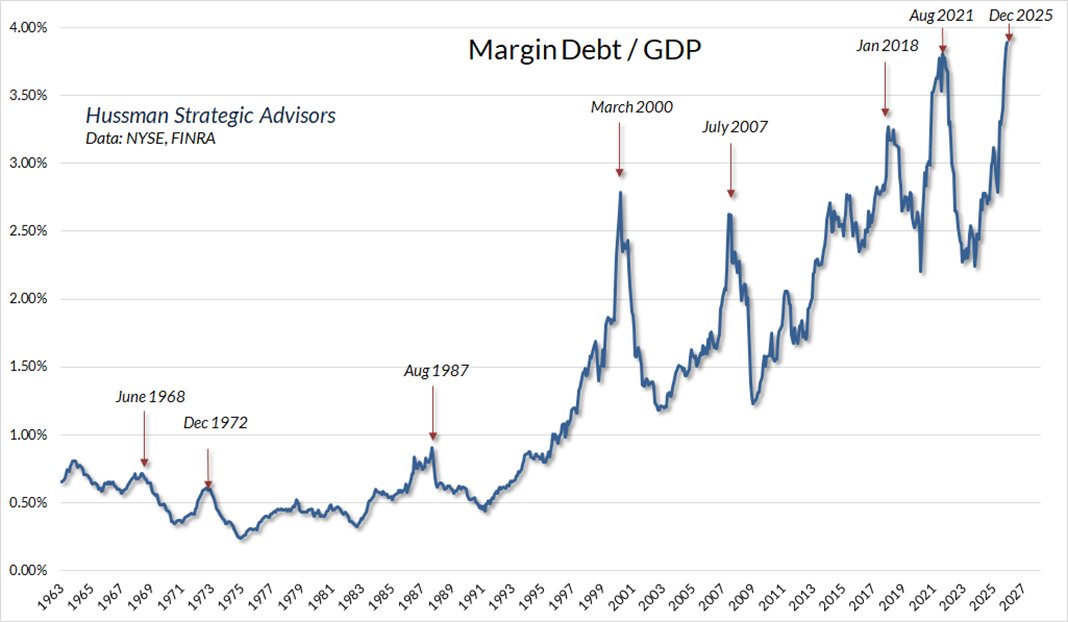
A financial business that enriches itself by selling risky securities to others has successfully convinced the masses to be price-indiscriminate buyers. Households are holding a record concentration of their net worth in equities.
At a dinner party last night, several attendees complained that their businesses were struggling even as stock markets were trading at all-time valuation highs. “It doesn’t make any sense,” bemoaned one head of the Americas for an international sports equipment and apparel manufacturer. An architect noted that major builders were calling him daily, hoping for leads for new projects as their existing pipeline dries up.
We cannot control others or world events; we can control our own behaviour, leverage, and risk exposure to market cycles within our finite lifespans. As our moms used to say, just because others are doing reckless things does not mean that we have to. There is power in autonomy, math and personal discipline.