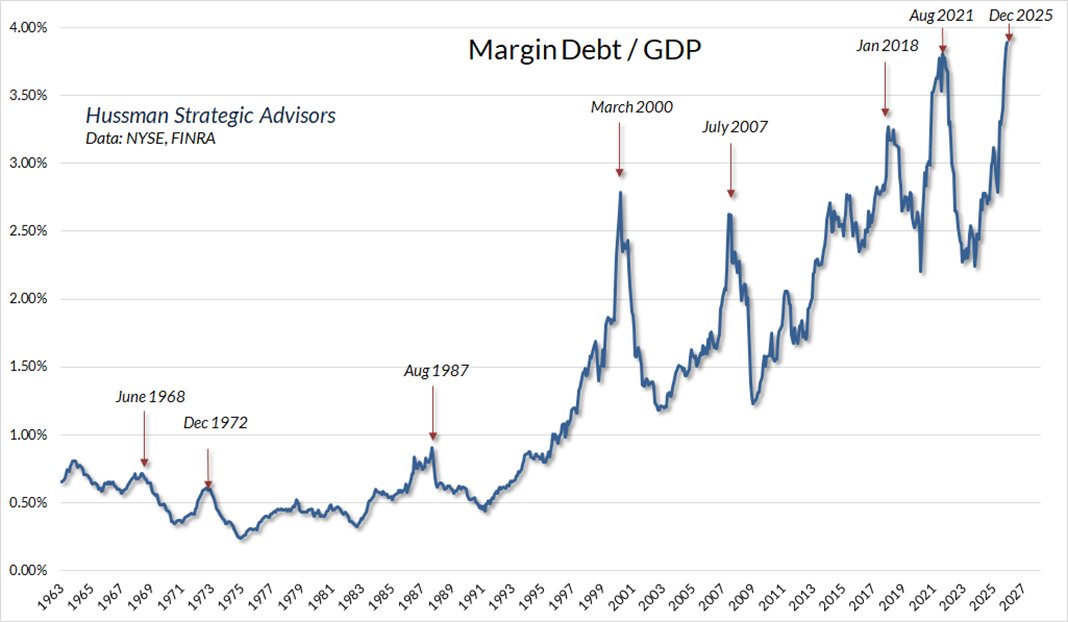
After three years of unusually high stock market gains, Wall Street equity analysts entered 2026 with record bullishness and no “sell” recommendations.
After being burned on recession calls in 2022, no mainstream economist is calling for a recession in 2026, and no strategist is willing to forecast a flat or down market. Major asset classes are all priced in expectation of favourable financial conditions. The public is buying with record inflows to Exchange Traded Funds (shown below, courtesy of The Daily Shot).
 In reality, the probability of negative outcomes rises with prices and investor optimism, so record levels of both mean the prospects for disappointment have rarely been higher.
There has never been an instance in which stock markets trading at currently extreme valuations did not generate losses over the following 1-, 3-, 5-, and 10-year periods.
With more than 35% of the US stock market concentrated in just ten mega-cap growth stocks (in yellow below, via The Daily Shot), market concentration is at its highest since 1900 and now exceeds the legendary late-1990s market bubble.
 The “AI” trade that inspired market mania in 2025 faltered in the final quarter (as shown below since November 2024, courtesy of my partner Cory Venable), with only Google and Tesla still finding some lift.

The Canadian stock market is even more concentrated, with the top 10 most expensive companies (major banks, energy and materials companies) accounting for 44% of the TSX market capitalization. The second-half surge in metals and financial shares (shown below since 2022) catapulted the TSX to the best-performing among major developed markets in 2025.

In the real world, labour-market stress is spreading, with the broadest US U-6 unemployment rate at 8.7%, a level last seen in August 2021, and at the onset of the 2001 and 2007 recessions. Canadian labour market conditions have been deteriorating since mid-2022.
December’s US ISM Manufacturing PMI contracted for the 36th time in the last 38 months (shown below since 2015). New orders (in black) and employment (in blue) both remained in contraction (sub 50).

As in 2000, 2007, and 2021, serious risk management is being rejected by the masses, while seasoned value investors like Warren Buffett’s Berkshire Hathaway hold nearly a third of its assets in cash.
Each person must decide for themselves how much they wish to participate in price bubbles. But there’s little chance that those who are long now will avoid the drubbing of the next bear market and the lost decade likely to follow. No one gets cycles all their way.